Explosive Ordnance Disposal Robots
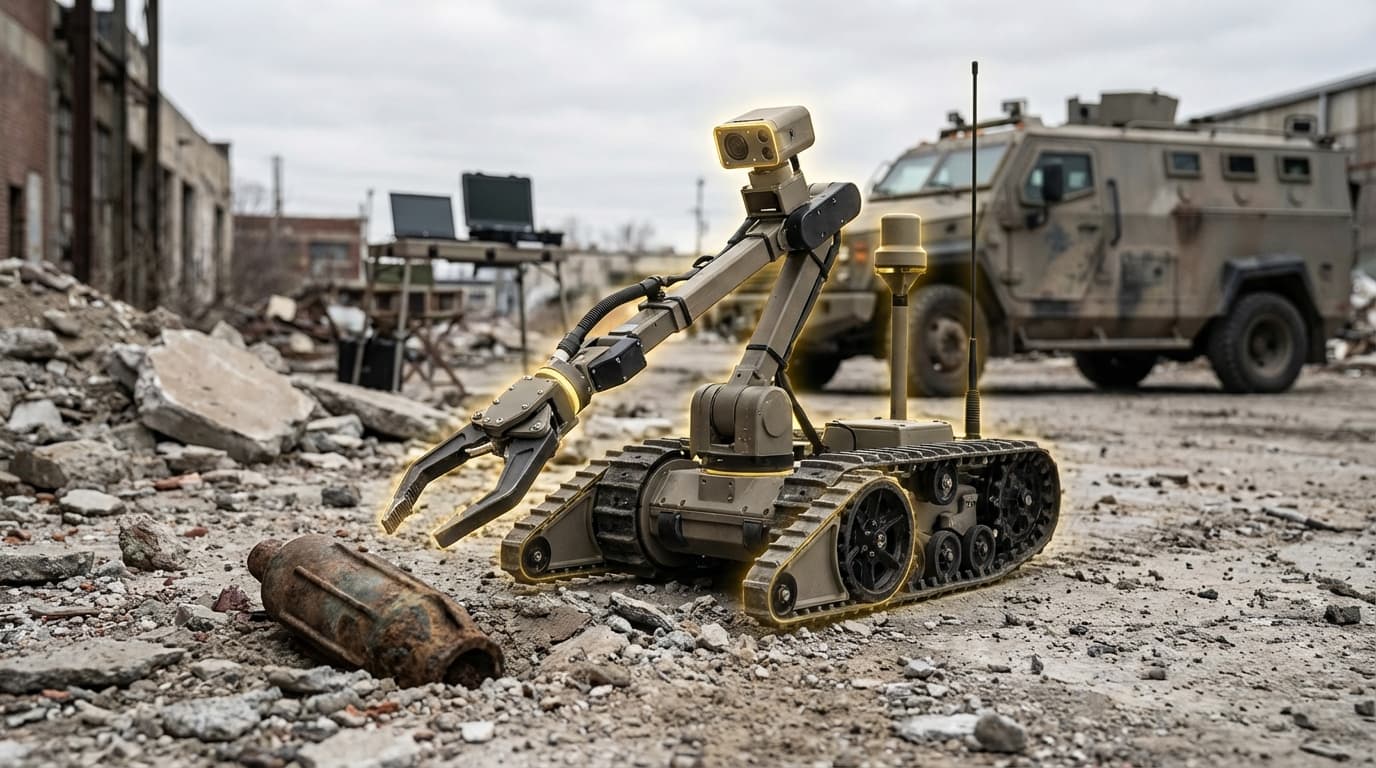
Explosive Ordnance Disposal robots represent a critical advancement in protecting military and civilian personnel from the lethal threats posed by improvised explosive devices, unexploded ordnance, and chemical, biological, radiological, and nuclear hazards. These remotely operated systems typically employ tracked locomotion platforms that provide stability across varied terrain, from urban rubble to desert sand. Operators control the robots from safe standoff distances—often hundreds of meters away—using ruggedized control stations that integrate video feeds, sensor data, and manipulator controls. The robots are equipped with multiple cameras providing different viewing angles, X-ray imaging systems to visualize device internals without physical contact, and precision manipulator arms capable of delicate tasks like wire cutting or forceful actions like door breaching. Advanced models incorporate haptic feedback systems that transmit force and resistance information back to the operator, enabling more nuanced manipulation of suspicious objects. Disruptor tools, which fire high-velocity projectiles of water or other materials, allow operators to neutralize devices by severing firing circuits or dispersing explosive materials from a distance.
The defense and security sectors face an evolving threat landscape where adversaries increasingly employ improvised explosive devices in asymmetric warfare and terrorist operations. Traditional manual EOD procedures place highly trained technicians in immediate proximity to potentially lethal devices, resulting in unacceptable casualty rates and psychological stress. EOD robots fundamentally transform this equation by inserting a mechanical intermediary between the threat and the operator, dramatically reducing risk while maintaining operational effectiveness. These systems address the challenge of operating in contested or contaminated environments where human presence is either tactically inadvisable or physiologically impossible. By enabling remote investigation and neutralization, EOD robots allow security forces to maintain operational tempo without exposing personnel to blast effects, fragmentation, or CBRN contamination. The technology also overcomes the limitation of protective suits, which severely restrict mobility and dexterity while providing only partial protection. Modern EOD robots can operate continuously for extended periods without the fatigue that affects human operators in high-stress scenarios.
Military forces worldwide have deployed thousands of EOD robots across conflict zones, with systems proving particularly valuable in counter-insurgency operations where roadside bombs represent a persistent threat. Law enforcement agencies increasingly employ these platforms for domestic bomb squad operations, investigating suspicious packages in public spaces, and responding to potential terrorist incidents. Recent developments indicate a trend toward greater autonomy, with research exploring semi-autonomous navigation and object recognition capabilities that could reduce operator workload during initial reconnaissance phases. The integration of artificial intelligence for threat assessment and improved sensor fusion promises to enhance operator situational awareness and decision-making speed. As urban warfare becomes more prevalent and the proliferation of explosive threats continues, EOD robotics will likely evolve toward lighter, more agile platforms with enhanced manipulation capabilities, supporting the broader defense industry shift toward unmanned systems that reduce human exposure to kinetic threats while maintaining mission effectiveness.
Related Organizations

A global aerospace and defense technology innovator delivering end-to-end solutions.

Produces the Switchblade loitering munition and Puma UAS, key assets for autonomous tactical reconnaissance and strike.

Croatian manufacturer of heavy-duty robotic systems for demining and mining.


Major defense contractor developing Reciprocal Quantum Logic (RQL) for cryogenic computing.

French company specializing in robotics for hostile environments.

Operates a dedicated Simulation & Training division providing gunnery and combat simulators.

Roboteam
Israel · Company
Designs and manufactures autonomous unmanned ground vehicles (UGVs) for tactical military use.

French manufacturer of terrestrial robots for safety and defense.
Supporting Evidence
Research this in Signals
Signals turns a topic into a sourced research record you can inspect and rerun. Your first scan is free, and this one starts with Explosive Ordnance Disposal Robots already loaded, so edit it or scan as is.