Structured Emission Lighting
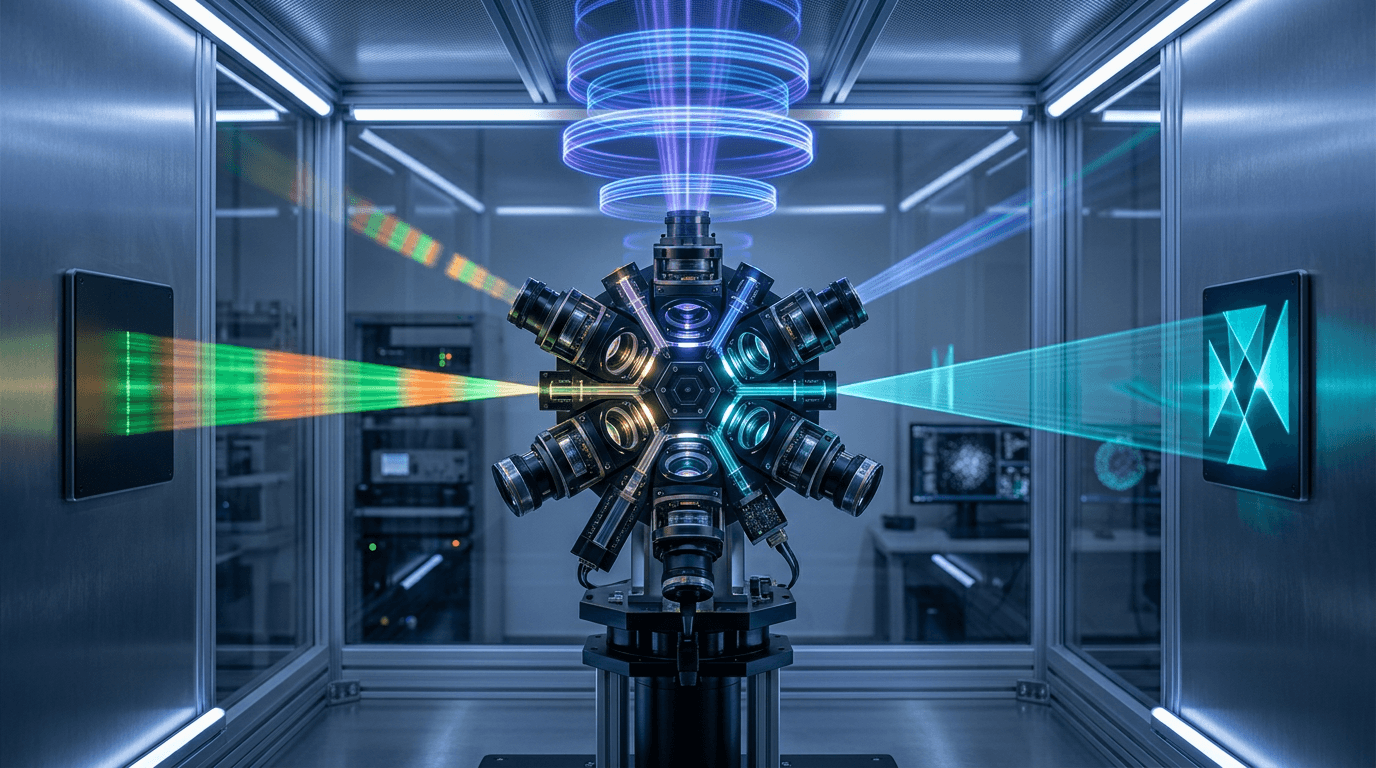
Multiple UAP observations report highly structured luminous behavior beyond simple navigation lights: circumferential rotating bands; panel-like edge lumina; discrete strobing or Morse-like sequences; color changes correlated with acceleration/attitude; and tightly collimated beams with minimal atmospheric backscatter.
Functional Hypotheses
Functional hypotheses include (1) field visualization—visible emissions as a byproduct of plasma/EM boundary-layer management; (2) comms/control—patterned photonic signaling between craft or with observers; (3) spectral shift with load—emission spectra shifting as drive fields intensify under maneuvering; and (4) lure/deception—attention capture or sensor saturation. Reports of synchronized lighting patterns across formations support intentional signaling rather than incidental heating. The combination of rotating bands, edge lumina, and maneuver-correlated color shift is a recurring UAP signature that suggests integrated surface emission systems tightly coupled to flight dynamics and communication needs.
Alternative Explanations
Human parallels include electroluminescent skins, phased LED panel systems, and plasma sheath research (which often increases optical signature). Alternative explanations include: photographic exposure artifacts, rolling shutter banding, and atmospheric scattering creating apparent structured lighting patterns.
Research this in Signals
Signals turns a topic into a sourced research record you can inspect and rerun. Your first scan is free, and this one starts with Structured Emission Lighting already loaded, so edit it or scan as is.