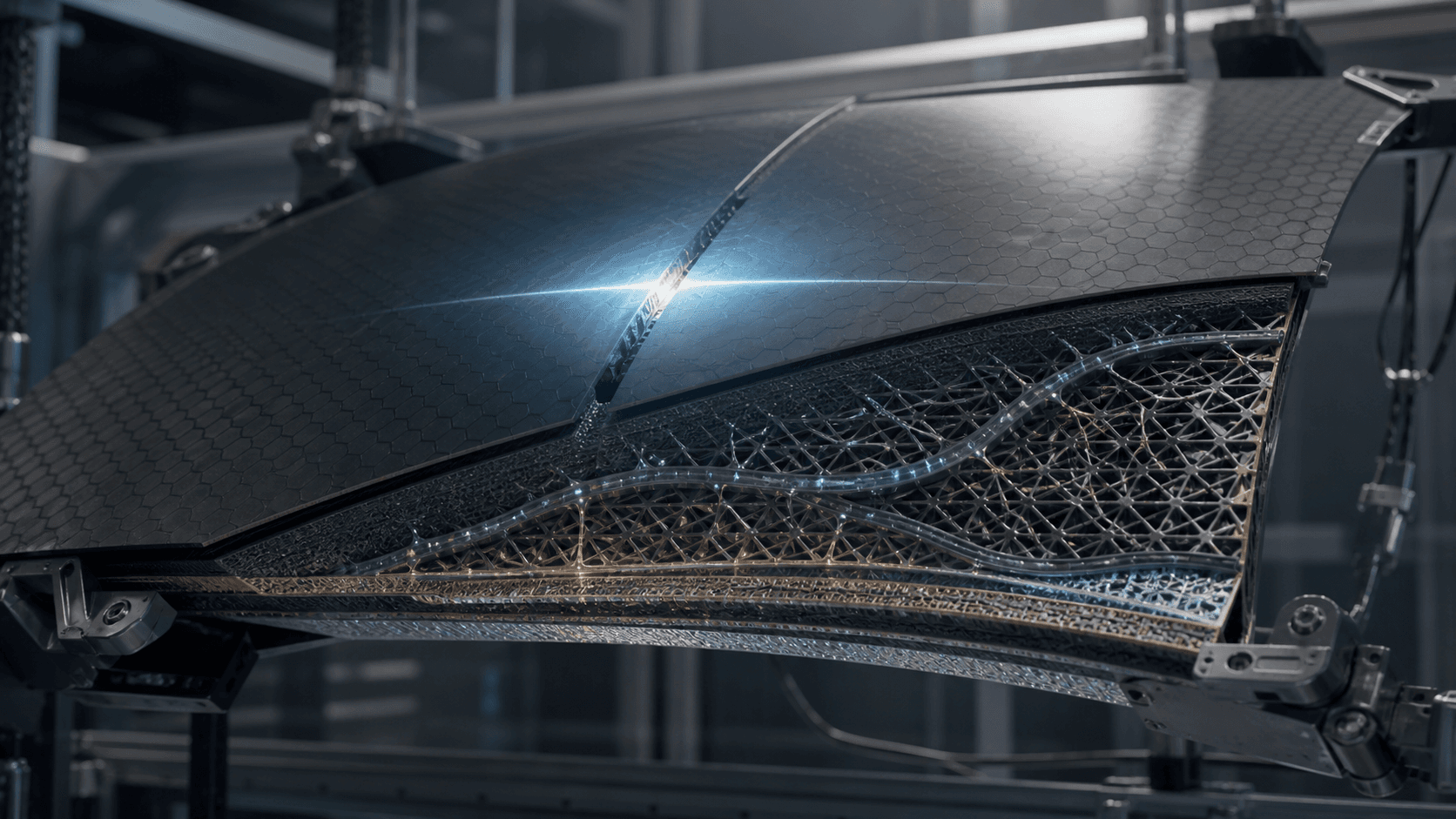
Self-Healing Smart Materials
Claims of UAP surviving extreme maneuver loads and impacts without damage align with an advanced materials stack: multi-scale lattices with non-Newtonian response; microvascular self-healing polymers/ceramics; auxetic and anisotropic metamaterial cores; and active morphing skins that close tears and reconstitute stiffness on demand.
Proposed Architecture
A xenotech hull could combine: (1) passive damage tolerance via hierarchical lattice architectures; (2) distributed sensing for crack/strain localization; (3) stimuli-responsive healing chemistries (thermal, electrical, photonic triggers); and (4) active field-stiffening that tunes modulus under load. Observational motifs—instant deformation with perfect rebound, lack of panel seams, and morphic surface continuity—are consistent with an integrated smart-skin plus lattice system.
Human Technology Parallels
Human state-of-the-art demonstrates partial analogs
microcapsule and reversible polymer chemistries (self-healing coatings and elastomers), phase-changing lattices, and shape-memory alloys/polymers that recover programmed forms. While full, instantaneous macroscopic healing exceeds current engineering, the convergence of self-healing polymers, architected materials, and active skins provides a plausible pathway.
Research this in Signals
Signals turns a topic into a sourced research record you can inspect and rerun. Your first scan is free, and this one starts with Self-Healing Smart Materials already loaded, so edit it or scan as is.