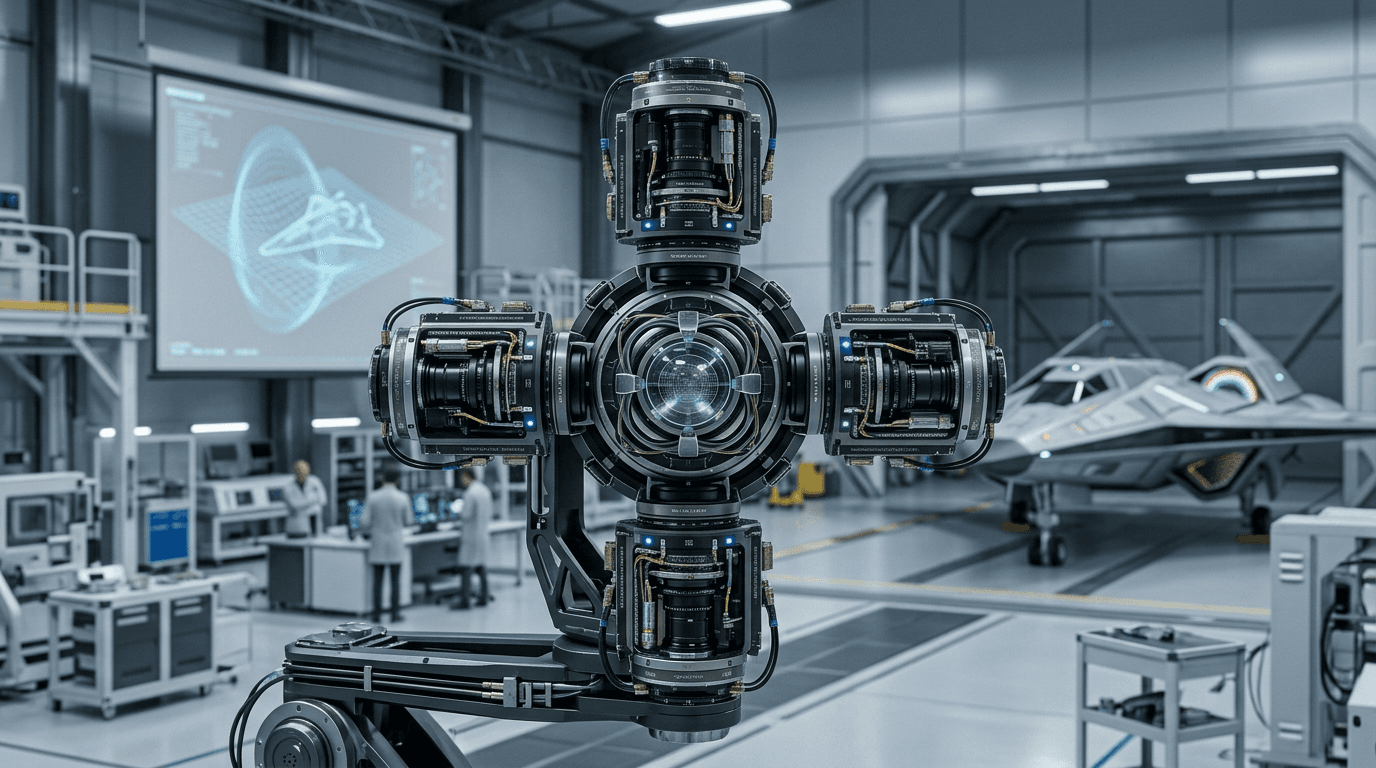
Field Cameras
Spacetime topology sensors represent theoretical devices designed to measure minute metric distortions around craft for warp-field signature detection, based on DIA/AATIP technical outlines and advanced propulsion detection concepts.
DIA/AATIP Technical Context
The Defense Intelligence Agency (DIA) and Advanced Aerospace Threat Identification Program (AATIP) technical outlines describe advanced sensor systems for detecting warp-field signatures and metric distortions around craft. These systems would enable detection of exotic propulsion technologies through spacetime metric analysis.
Proposed Mechanisms and Applications
Metric Distortion Detection
The technology involves detecting minute metric distortions through: precision gravitational field measurement; spacetime curvature detection; and metric distortion analysis around craft. The approach seeks to achieve detection of exotic propulsion through spacetime analysis.
Warp-Field Signature Detection
The systems claim to detect warp-field signatures through: controlled metric distortion measurement; field signature analysis; and propulsion technology identification. The approach seeks to achieve detection of exotic propulsion through field analysis.
Field Camera Technology
The devices use 'field camera' technology for detection through: precision field measurement; field visualization; and field analysis for propulsion detection. The approach seeks to achieve detection through field imaging.
Craft Detection Applications
The technology could enable craft detection through: metric distortion measurement around craft; warp-field signature detection; and exotic propulsion identification. The approach seeks to achieve detection of advanced propulsion technologies.
Technical Implementation and Current Status
The systems would require precision gravitational field measurement; spacetime curvature detection; and metric distortion analysis. The technology requires advanced sensor capabilities for practical implementation. While theoretically grounded in gravitational field measurement and spacetime analysis, spacetime topology sensors remain speculative with significant technical challenges. The technology represents an extension of gravitational field detection into exotic propulsion identification, though practical implementation requires advanced sensor capabilities.
Research this in Signals
Signals turns a topic into a sourced research record you can inspect and rerun. Your first scan is free, and this one starts with Field Cameras already loaded, so edit it or scan as is.