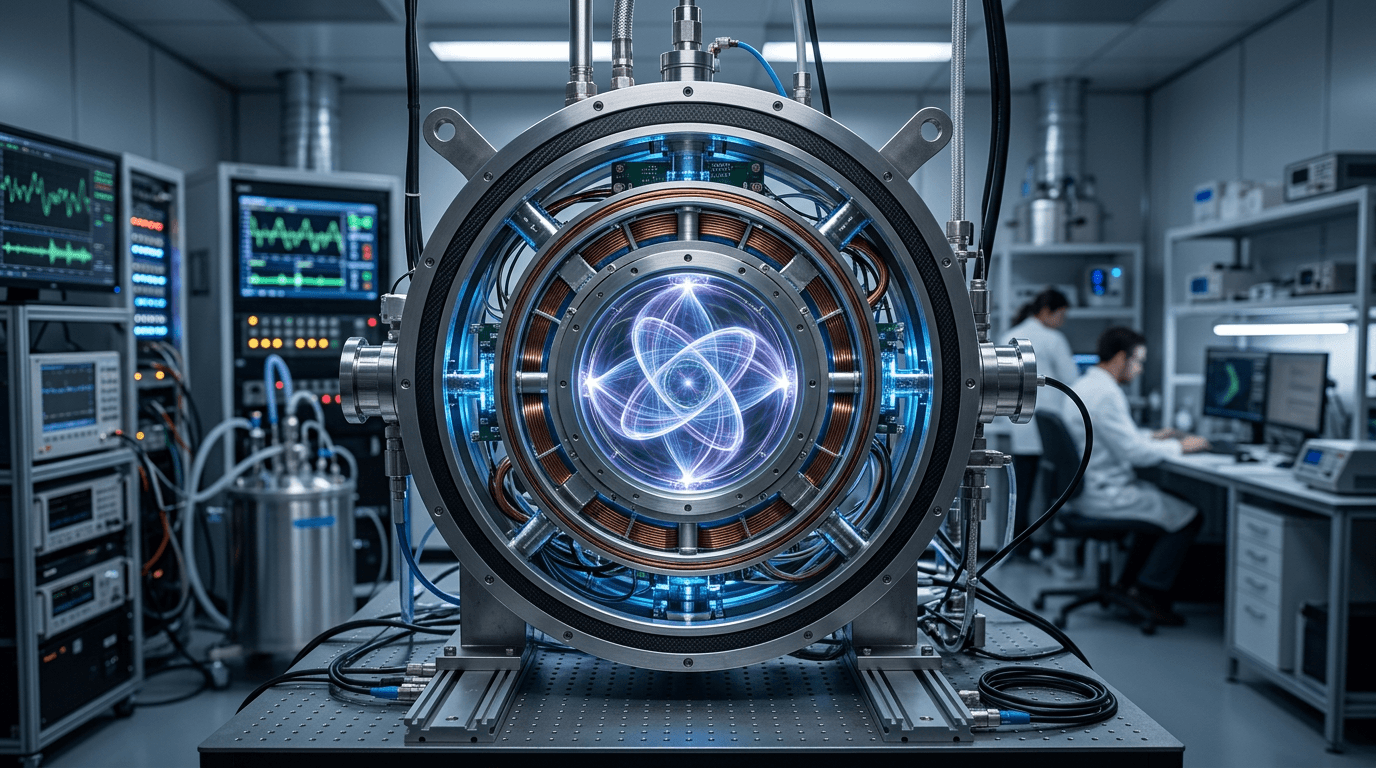
Metric Waveguide
Metric waveguide devices represent theoretical systems designed to modulate local spacetime curvature for communication or propulsion applications, building on negative-energy field manipulation concepts and extending into controlled spacetime metric engineering.
Eric Davis DIRD Foundation
Dr. Eric Davis's work under the Defense Intelligence Reference Documents (DIRD) program explored traversable wormhole metrics and spacetime manipulation for practical applications. His research examined how controlled spacetime curvature could be achieved through negative energy fields and exotic matter configurations for communication and propulsion systems.
Space-Time Corrugation Concept
The metric waveguide approach involves creating controlled 'corrugations' in spacetime geometry through: negative energy field generation; exotic matter field manipulation; and controlled spacetime curvature modulation. These corrugations would create pathways for information or matter transmission through spacetime manipulation.
Communication Applications
The technology could enable communication through: spacetime curvature modulation for signal transmission; gravitational wave generation for information transfer; and controlled metric manipulation for directed communication. These applications would bypass conventional electromagnetic communication limitations.
Propulsion Applications
Metric waveguide systems could provide propulsion through: spacetime curvature manipulation for thrust generation; controlled metric distortion for directional movement; and field manipulation for reactionless propulsion. The approach seeks to achieve movement through spacetime geometry control rather than reaction mass expulsion.
Negative Energy Field Requirements
The technology requires negative energy fields for spacetime manipulation, including: exotic matter with negative energy density; controlled field generation and manipulation; and energy requirements that may exceed current capabilities. The negative energy requirements represent significant technical challenges.
Theoretical Framework
The approach builds on general relativity's prediction that energy-momentum curves spacetime, extending to: controlled energy-momentum distribution for metric manipulation; field configuration control for spacetime geometry; and theoretical frameworks for practical spacetime engineering. The technology seeks to achieve macroscopic spacetime control.
Technical Challenges
Implementation faces significant obstacles including: negative energy field generation; exotic matter requirements; energy density requirements; and field control precision. The technology requires capabilities beyond current physics and engineering.
Current Status
While theoretically grounded in general relativity, metric waveguide devices remain speculative with significant physics and engineering challenges. The technology represents an extension of theoretical spacetime manipulation concepts into practical applications, though implementation remains beyond current capabilities.
Research this in Signals
Signals turns a topic into a sourced research record you can inspect and rerun. Your first scan is free, and this one starts with Metric Waveguide already loaded, so edit it or scan as is.