Quantum Navigation
Quantum-inertial navigation systems represent next-generation positioning technology operating without GPS satellites, radio beacons, or external reference signals. UAP performance—precise navigation during high-speed maneuvers, operation in GPS-denied environments (underwater, deep space, shielded locations), and trans-medium transitions without navigation disruption—suggests sophisticated self-contained navigation exceeding conventional systems.
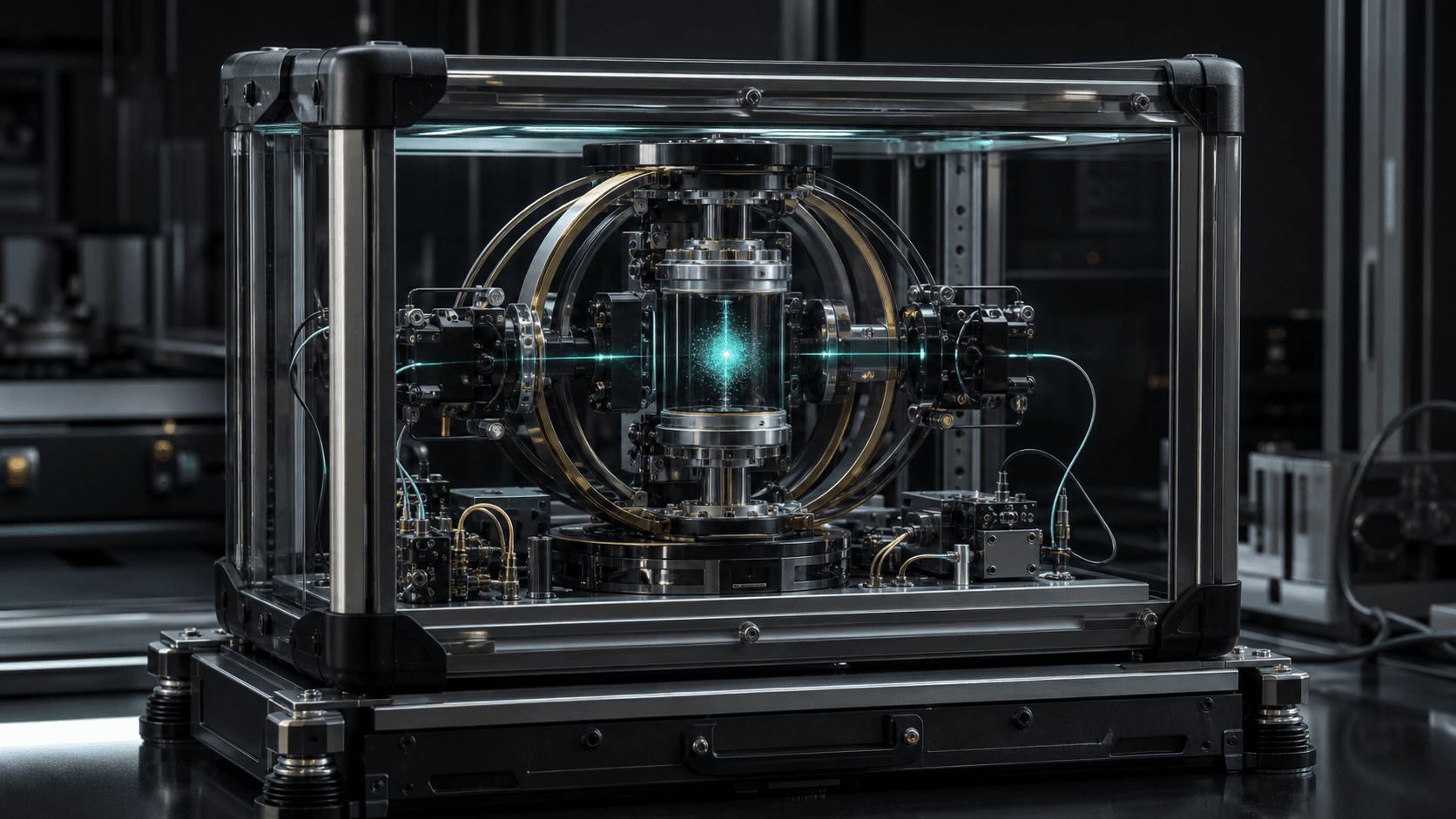
Current inertial navigation systems (INS) use accelerometers and gyroscopes integrating movement to track position from known starting point. However, sensor drift accumulates errors requiring periodic external corrections (GPS, stellar, or landmark navigation). Quantum sensing promises revolutionary improvements: cold-atom interferometers measuring acceleration via matter-wave interference (detecting gravitational gradients at unprecedented precision); quantum gyroscopes using atomic spin states (drift-free rotation measurement); and quantum gravimeters mapping Earth's gravitational field variations for position fixing.
Demonstrated quantum navigation technologies include
atom interferometer accelerometers achieving sub-micro-g sensitivity; chip-scale atomic clocks enabling long-duration autonomous navigation; and quantum magnetometers detecting magnetic anomalies for terrain-relative positioning. These technologies enable GPS-free navigation lasting days to weeks without drift—critical for submarines, autonomous vehicles in contested environments, and space exploration. Research programs (DARPA, UK Defence Science, multiple academic institutions) have demonstrated laboratory quantum INS with performance exceeding classical systems.
Exotic navigation concepts implied by UAP capabilities include
gravitational reference navigation (using local spacetime curvature as coordinate system—'feeling' gravitational terrain); quantum entanglement-based positioning (if non-local correlations could provide reference frame); higher-dimensional navigation (using additional spatial dimensions as coordinates); and vacuum-fluctuation reference frames (if zero-point field structure provided navigation substrate). More speculatively, some propose consciousness-based navigation—craft responding to operator intent rather than calculated coordinates.
Physically grounded quantum-inertial navigation represents achievable near-future technology—demonstrated in laboratories, transitioning toward field deployment. Challenges include: miniaturization (current cold-atom systems require vacuum chambers, lasers, and magnetic shielding); environmental robustness (vibration, temperature, acceleration tolerance); and power requirements. However, engineering trajectory suggests operational quantum INS within 10-20 years for military and autonomous systems.
The more exotic navigation concepts (gravitational terrain following, higher-dimensional coordinates) lack experimental demonstration. However, UAP navigation performance—seamless operation across environments, precise high-speed maneuvering without drift, and apparent independence from human navigation infrastructure—suggests either advanced quantum-inertial systems approaching theoretical limits or genuinely novel navigation principles. The technology represents area where classified human systems may account for some UAP performance while most exotic capabilities remain speculative.
Research this in Signals
Signals turns a topic into a sourced research record you can inspect and rerun. Your first scan is free, and this one starts with Quantum Navigation already loaded, so edit it or scan as is.