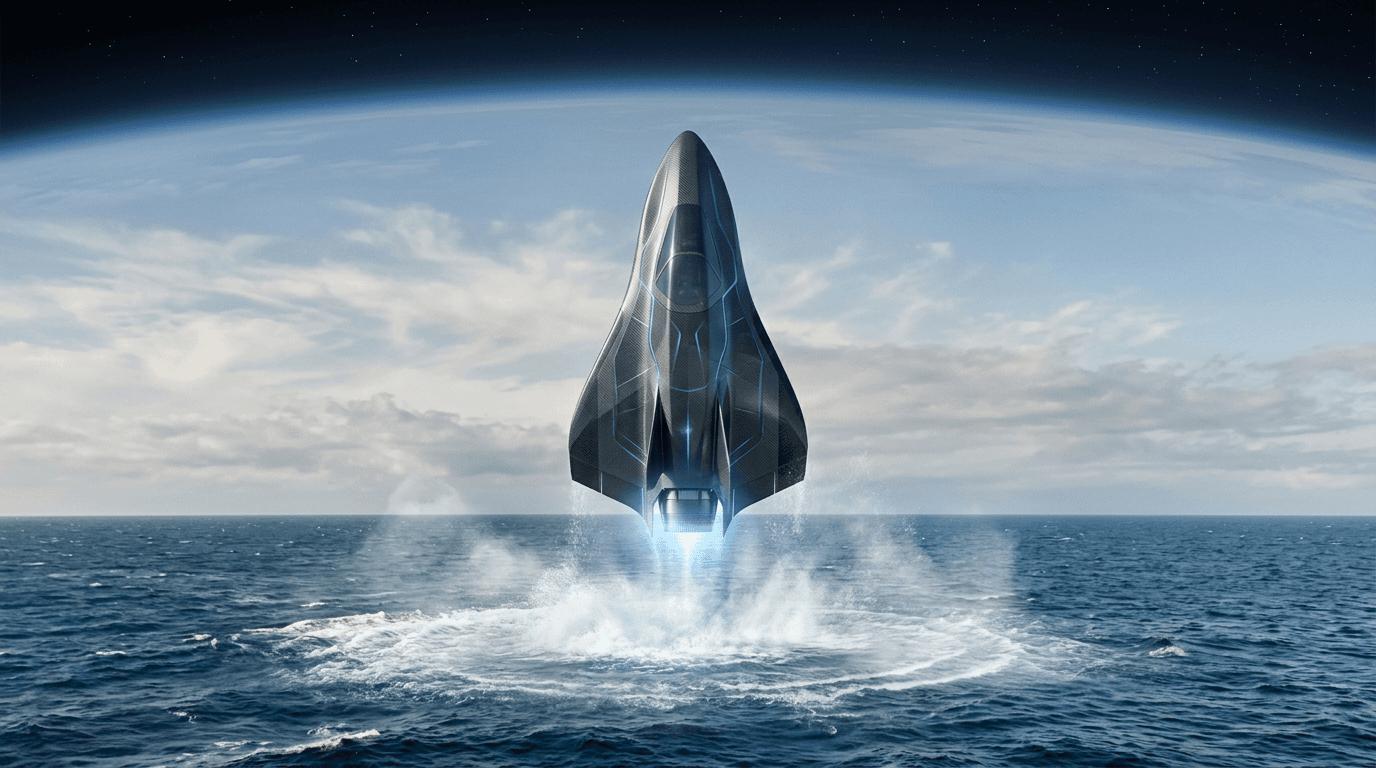
Transmedium Propulsion
Documented UAP encounters consistently describe propulsion systems fundamentally different from any known aerospace technology: complete absence of visible propulsion means or exhaust signatures, instantaneous velocity changes reaching hundreds of gravities, and seamless movement across medium boundaries without apparent transition effects.
Propulsion Without Exhaust
Multiple well-documented encounters (2004 USS Nimitz, 2014 USS Roosevelt, 2019 USS Omaha) describe objects exhibiting no visible propulsion systems, engine exhaust, fuel signatures, or aerodynamic control surfaces. Unlike conventional craft requiring vectored thrust or aerodynamic lift, these objects move through space seemingly without expelling any reaction mass. The absence of propulsion signatures raises fundamental questions about both power source and thrust generation mechanism—whether through exotic field effects, spacetime manipulation, or as-yet unknown physics.
Instantaneous Acceleration
Witness testimony, radar data, and sensor recordings document velocity changes incompatible with known inertial physics. Objects accelerate from stationary to hypersonic speeds (Mach 20+) in seconds, change direction at 90-degree angles at constant velocity, and achieve accelerations exceeding 600-700g—levels that would instantly destroy any conventional vehicle structure and crew. Fighter pilots describe objects 'breaking the laws of physics' with stops, reversals, and direction changes that appear instantaneous to radar tracking systems. These performance characteristics suggest either: inertial mass manipulation reducing effective g-forces; propulsive forces applied throughout vehicle volume rather than points of thrust; or systems violating conservation of momentum entirely.
Transmedium Capability
Perhaps most striking is seamless transition between fundamentally different physical environments. Objects documented entering water at high speed without splash, cavity formation, or hydrodynamic effects; emerging from water into air without visible exhaust or surface disruption; and maintaining consistent flight characteristics across air, water, and near-vacuum environments. The 2019 USS Omaha incident involved objects submerging into the ocean and executing precise underwater maneuvers. This suggests either: propulsion mechanism independent of medium properties; structural integrity maintained through spacetime manipulation rather than material strength; or advanced control of surrounding media (water, air) rather than conventional aerodynamic/hydrodynamic principles.
Nimitz Case Study (2004)
The USS Nimitz encounter provides most complete data set: objects detected via multiple independent sensor systems (SPY-1 radar, infrared sensors, visual observation), tracked by fighter aircraft, and documented by trained military observers. Objects demonstrated: descent from 80,000 feet to sea level in under a second; hovering with no visible propulsion; radar jamming capabilities indicating electromagnetic sophistication; and 'tic-tac' shape lacking wings, rotors, or exhaust. The incident is formally documented in DoD reports and widely considered among strongest UAP evidence.
Thermal Signatures and Energy
Infrared tracking reveals unusual thermal properties—objects often appear cold against warmer backgrounds, suggesting heat absorption or dissipation mechanisms beyond current understanding. Some objects display variable thermal signatures or sudden temperature changes during maneuvers. Energy requirements for observed accelerations would be enormous (terawatts for sustained hypersonic flight), yet no obvious power generation or dissipation systems are evident. This suggests either: revolutionary energy density (fusion, antimatter, or beyond); tapping environmental energy sources; or physics beyond standard conservation laws.
Physics Implications
The combination of reactionless propulsion, instantaneous acceleration, and transmedium capability challenges fundamental principles of aerospace engineering. Standard Newtonian mechanics requires reaction mass; relativistic acceleration limits necessitate controlled thrust application; and medium transitions require specialized vehicle configurations. These observations suggest either: (1) Propulsion system operating through field effects rather than reaction mass expulsion; (2) Inertial properties manipulated allowing acceleration without g-forces; (3) Spacetime manipulation creating local regions of reduced or modified physics; or (4) Technology so advanced it appears to violate known physics when actually operating through unknown principles.
Scientific Assessment
These observed capabilities exceed known aerospace technology by orders of magnitude. Even classified military systems follow conventional physics—no stealth aircraft eliminates exhaust, no hypersonic vehicle achieves instantaneous direction changes, no submarine flies through the air. If the observations are accurate rather than sensor artifacts or misidentification, they represent either: foreign adversary breakthrough technology decades beyond public knowledge; classified US research achieving revolutionary propulsion physics; truly anomalous technology from unknown origin; or systematic misinterpretation of conventional phenomena. The consistency of reports across multiple incidents, independent observers, and sensor systems reduces likelihood of simple misidentification, while physics-defying characteristics challenge any conventional explanation.
Research this in Signals
Signals turns a topic into a sourced research record you can inspect and rerun. Your first scan is free, and this one starts with Transmedium Propulsion already loaded, so edit it or scan as is.