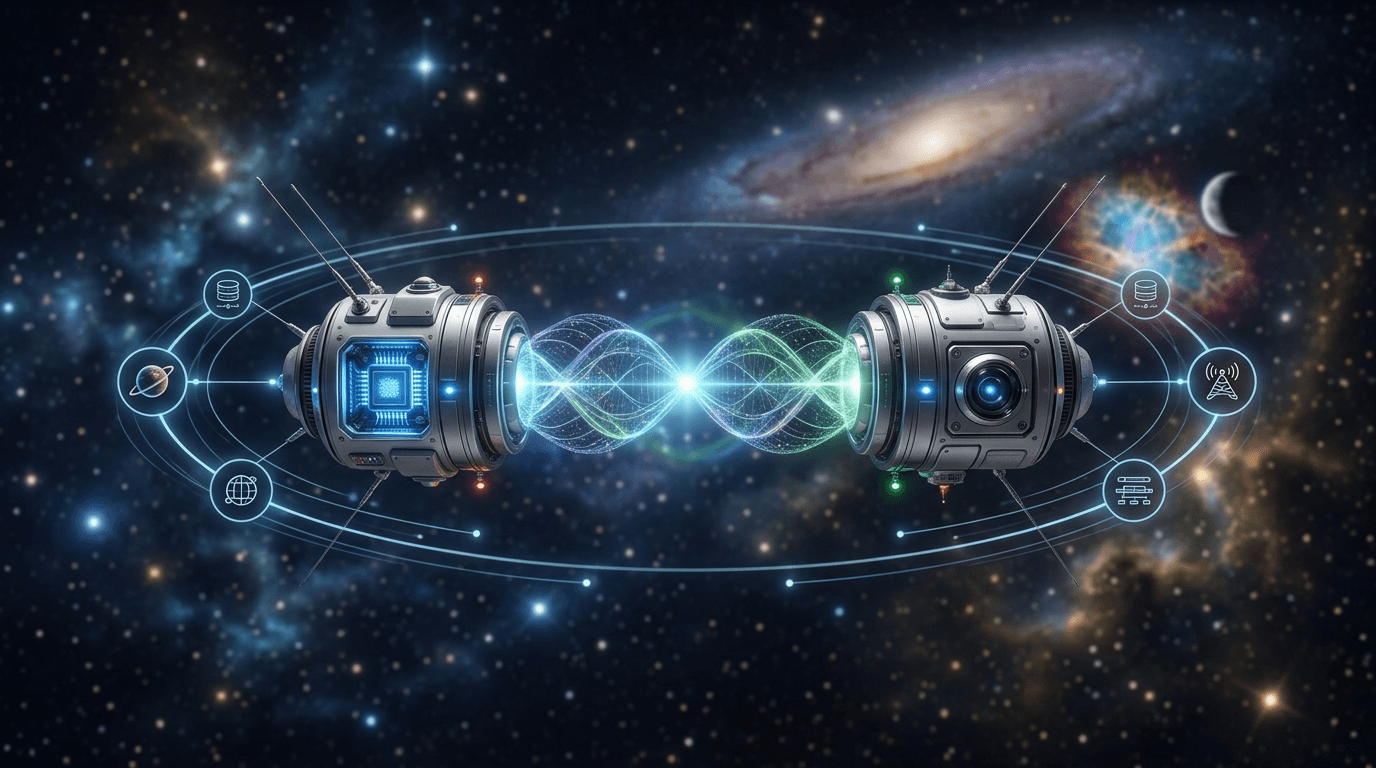
Quantum Entanglement
Quantum entanglement communication represents one of the most controversial applications of quantum mechanics—the possibility of using entangled particle correlations for instantaneous information transfer across arbitrary distances. The DIA's DIRD-16 (2009, AAWSAP program) assessed whether quantum non-locality could enable communications violating light-speed constraints—revolutionary for deep-space missions, real-time interstellar contact, or covert channels immune to interception.
Quantum Entanglement Fundamentals
When particle pairs are created in entangled states, measuring one particle's property (spin, polarization) instantaneously determines the other's—regardless of separation distance. Einstein called this 'spooky action at a distance'; Bell's theorem (1964) and subsequent experiments (Aspect 1982, Zeilinger 1990s-2000s) confirmed entanglement violates local realism—correlations exceed any classical explanation. However, critical constraint: while measurement outcomes are correlated, they appear random to each observer independently. Standard quantum mechanics forbids using entanglement for FTL signaling—'no-communication theorem' proves information transfer requires classical channel (light-speed limited).
Proposed FTL Communication Schemes
Despite no-communication theorem, speculative mechanisms include: Superluminal signaling via entanglement-assisted protocols (if quantum mechanics is incomplete—hidden variables, nonlinear extensions); post-selection schemes (detecting subtle correlations missed by standard analysis); quantum erasure and delayed-choice variants (exploiting measurement-timing dependencies); and macroscopic entanglement (scaling quantum effects to detectable classical signals). All proposed schemes either: violate established quantum mechanics requiring new physics, contain subtle flaws enabling only classical information transfer, or haven't been experimentally demonstrated.
Legitimate Quantum Communication
While FTL signaling remains unproven, entanglement enables real quantum communication applications. Quantum key distribution (QKD) uses entanglement for provably-secure encryption—eavesdropping detection via quantum state collapse (commercially deployed by ID Quantique, Toshiba, Chinese quantum satellites). Quantum teleportation transfers quantum states via entanglement+classical channel—demonstrating non-local state transfer (though classical information still light-speed limited, preventing FTL). These applications exploit entanglement for security and state transfer, not superluminal messaging.
DIRD-16 Assessment Context
The study evaluated: theoretical frameworks claiming entanglement-based FTL (Nimtz experiments, evanescent tunneling claims); experimental tests and null results; foreign research programs (Chinese quantum satellites, European quantum networks); and implications if FTL communication were possible (military advantages, physics revolutions). Likely conclusions: standard quantum mechanics forbids FTL signaling; no verified demonstrations exist; but monitoring foreign research and fringe theoretical proposals merits intelligence attention given revolutionary implications.
Space Communication Rationale
Deep-space missions face communication delays—Mars 4-24 minutes, outer solar system hours, interstellar years to millennia. Entanglement-based FTL communication would revolutionize: real-time spacecraft control (eliminating light-delay); interstellar exploration (enabling contact with distant probes); SETI (if advanced civilizations use quantum channels); and military space operations (covert, instantaneous coordination). These applications explain Pentagon interest despite mainstream physics skepticism.
Experimental Status & Controversies
Günter Nimtz's claimed superluminal photon tunneling (1990s-2000s) involves evanescent wave propagation through barriers—mainstream analysis concludes signal velocity never exceeds c, apparent superluminality reflects wave-packet reshaping not information transfer. Chinese quantum satellite Micius (2016) demonstrated entanglement distribution over 1200 km and intercontinental quantum teleportation—validating entanglement persistence at scale but not FTL communication. No experiment has convincingly demonstrated information transfer exceeding light speed via entanglement, consistent with no-communication theorem.
UAP & Exotic Technology Connection
Quantum entanglement communication appears in UAP speculation as: explanation for coordinated multi-craft behavior (instant communication without EM signatures); interstellar contact mechanism (if UAPs represent probe network); and consciousness-technology interface (some theories conflate quantum entanglement with telepathy). DIRD-16's inclusion in AAWSAP suggests Pentagon assessed whether: alleged UAP coordination implies FTL communication; foreign adversaries achieved quantum communication breakthroughs; or recovered technology might demonstrate entanglement-based signaling.
Critical Assessment
DIRD-16 represents intelligence due-diligence—surveying fringe quantum communication claims, foreign programs, and theoretical proposals despite mainstream physics consensus against FTL signaling. The no-communication theorem is robust within standard quantum mechanics; violating it requires either: new physics beyond quantum mechanics (hidden variables, nonlinear modifications); discovering loopholes in existing analysis; or demonstrating macroscopic quantum effects escaping decoherence. Current evidence shows: entanglement is real and useful (QKD, teleportation) but doesn't enable FTL information transfer. The study likely concluded: maintain awareness of theoretical proposals and foreign research, but expect no near-term FTL communication breakthrough—barring revolutionary physics discoveries.
Quantum entanglement communication occupies unique position—grounded in real, Nobel-prize-winning physics (entanglement is experimentally validated) yet claiming application (FTL signaling) forbidden by established theory. Its presence in DIRD studies reflects Pentagon's systematic approach: even low-probability revolutionary technologies merit assessment given strategic implications, while acknowledging mainstream scientific consensus against feasibility.
Research this in Signals
Signals turns a topic into a sourced research record you can inspect and rerun. Your first scan is free, and this one starts with Quantum Entanglement already loaded, so edit it or scan as is.