Dream Decoding
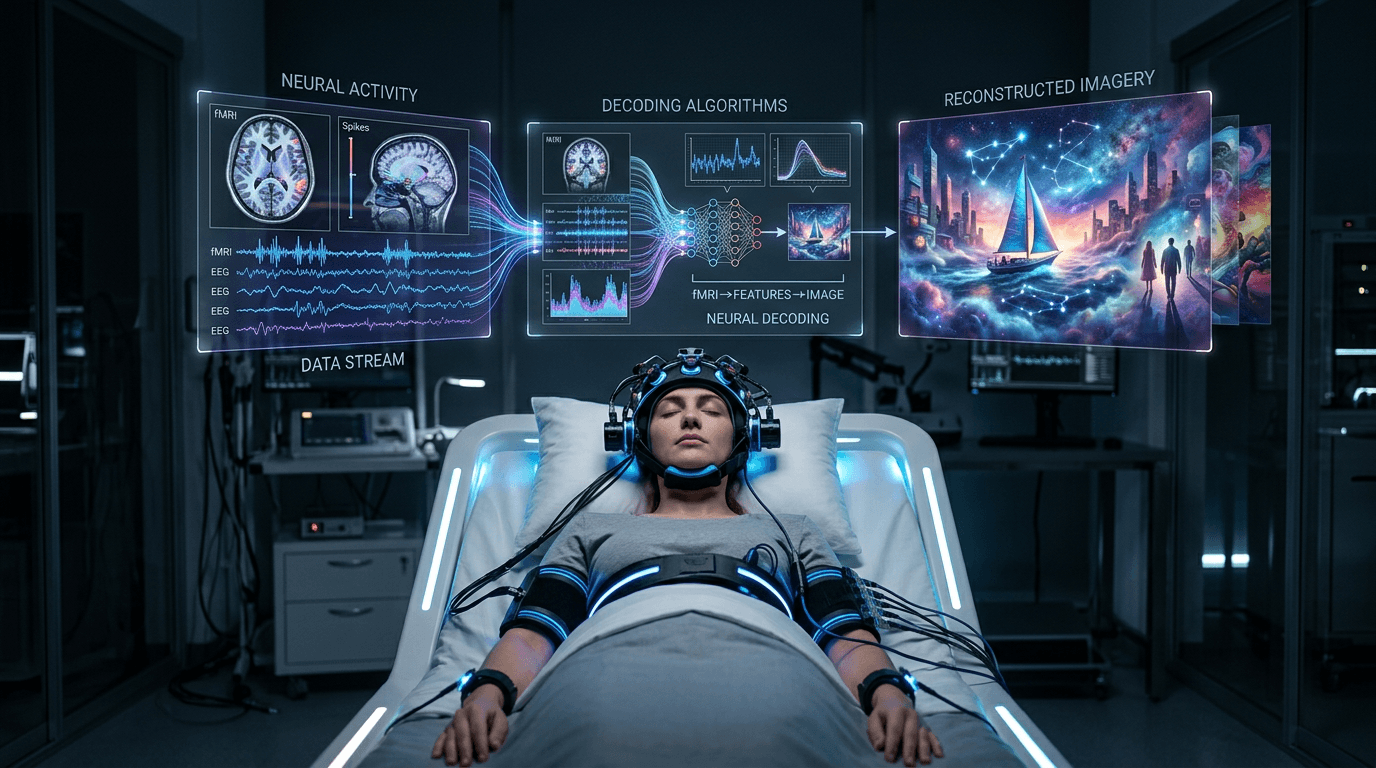
Dream decoding represents the ambitious intersection of neuroscience and artificial intelligence—using advanced machine learning to reconstruct visual and narrative content from brain activity during sleep. The approach combines high-resolution neuroimaging (fMRI, high-density EEG) with multimodal generative models (diffusion models, vision-language transformers) to translate neural patterns into dream imagery and story elements.
Technical Approach
Technical approach involves: real-time or post-sleep analysis of neural activity patterns during REM and NREM stages; feature extraction from visual cortex, temporal lobes, and default mode network; alignment of neural features to semantic embeddings and visual representations; generative model training on neural-to-content mappings; and iterative refinement using dreamer feedback and recall validation.
Current Capabilities and Challenges
Current capabilities include: basic object recognition from visual cortex activity during sleep; emotional valence prediction from limbic system patterns; simple scene reconstruction using diffusion model guidance; and narrative structure analysis from language network activation. Challenges include: limited spatial resolution of non-invasive imaging; individual variability in neural-to-content mappings; temporal dynamics of dream content evolution; and validation against subjective dream reports.
Advanced Implementations and Applications
Advanced implementations propose
real-time dream streaming to external displays; collaborative dream sharing through neural interfaces; therapeutic applications for nightmare processing; and creative inspiration extraction from hypnagogic states. The technology bridges consciousness research, computational neuroscience, and generative AI—offering unprecedented access to the sleeping mind's creative processes.
Ethical Considerations
Ethical considerations include privacy of mental content; consent for neural data collection; potential for dream manipulation; and implications for consciousness and identity. While current implementations remain experimental with limited accuracy, the convergence of high-resolution neuroimaging and powerful generative models suggests increasingly sophisticated dream decoding capabilities in the coming decade.
Research this in Signals
Signals turns a topic into a sourced research record you can inspect and rerun. Your first scan is free, and this one starts with Dream Decoding already loaded, so edit it or scan as is.