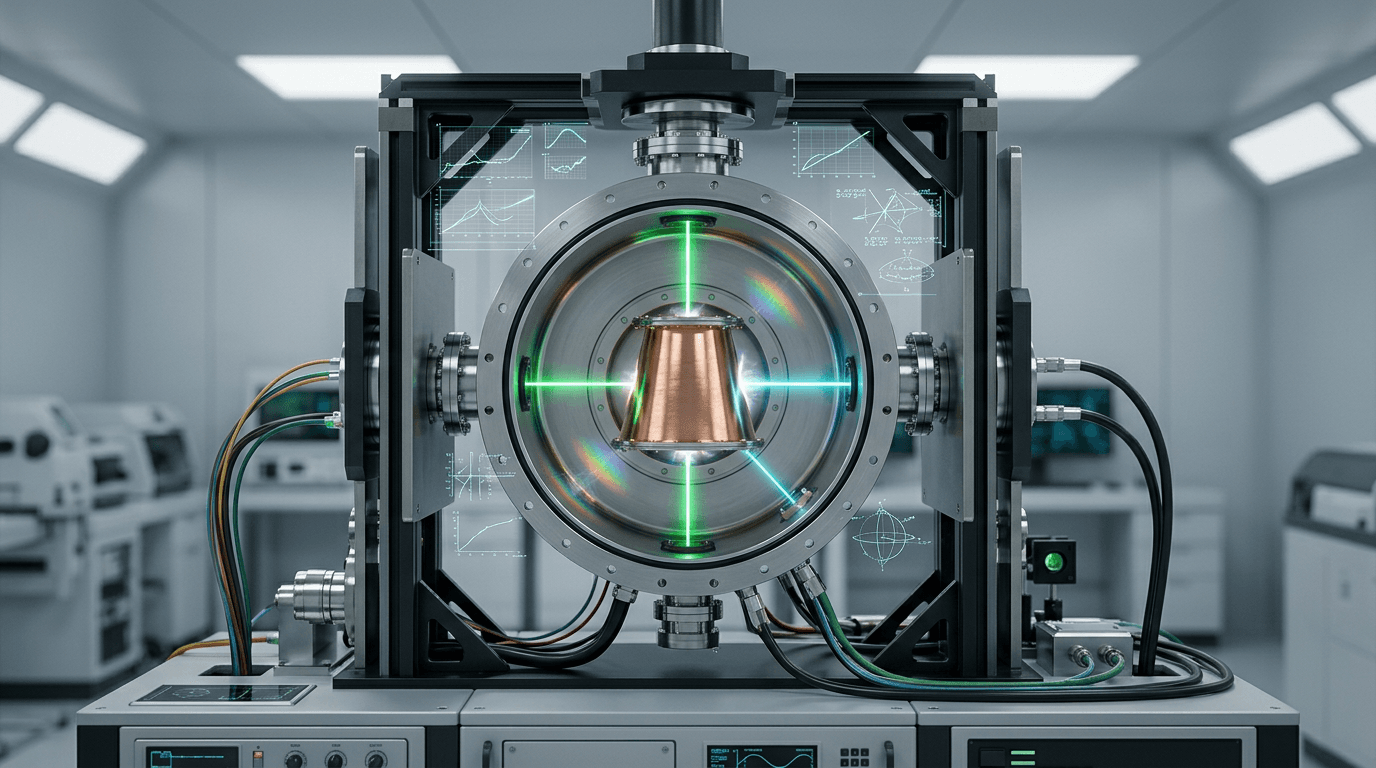
Cavity Resonance Thrusters
Cavity resonance thrusters represent a family of propellantless propulsion devices based on microwave resonant cavities that allegedly generate thrust without expelling reaction mass. The most prominent example is the EmDrive (Electromagnetic Drive) developed by Roger Shawyer, though similar concepts include the Cannae Drive and various microwave cavity configurations.
EmDrive Architecture and Theory
The EmDrive consists of a truncated cone-shaped microwave cavity where microwaves bounce between the narrow and wide ends. Shawyer's theory proposes that radiation pressure differences between the two ends create net thrust in the direction of the narrow end. The device allegedly converts electrical power directly to thrust without requiring propellant, violating Newton's third law and conservation of momentum as conventionally understood.
NASA Eagleworks Testing and Results
NASA Eagleworks Laboratory (Johnson Space Center) conducted independent testing of EmDrive prototypes, reporting small but measurable thrust levels in vacuum conditions (2016). The results sparked international interest and controversy, with measured forces ranging from micronewtons to millinewtons per kilowatt of input power. However, thrust measurements remain within experimental error margins and don't scale predictably with power input.
Proposed Mechanisms and Physics Challenges
Proposed mechanisms include: quantum vacuum virtual plasma interactions with cavity walls; relativistic effects from asymmetric electromagnetic field distributions; thermal expansion and convection artifacts; and measurement errors from electromagnetic interference. Mainstream physics remains skeptical, noting that closed electromagnetic systems cannot generate net momentum without external interactions.
Technical Challenges and Replication Attempts
Technical challenges include precise cavity geometry optimization for maximum thrust-to-power ratios; electromagnetic shielding to prevent interference with measurement equipment; thermal management of microwave heating effects; and scaling from laboratory prototypes to practical spacecraft applications.
Replication attempts worldwide have yielded mixed results, with some groups reporting positive thrust measurements while others find null results. The controversy highlights challenges in measuring extremely small forces and distinguishing genuine propulsion effects from experimental artifacts.
Potential Applications and Current Status
If functional, cavity resonance thrusters would revolutionize space propulsion by eliminating propellant requirements, enabling continuous acceleration missions and dramatically reducing spacecraft mass. However, the fundamental physics violations required make independent verification essential before practical applications.
Research this in Signals
Signals turns a topic into a sourced research record you can inspect and rerun. Your first scan is free, and this one starts with Cavity Resonance Thrusters already loaded, so edit it or scan as is.