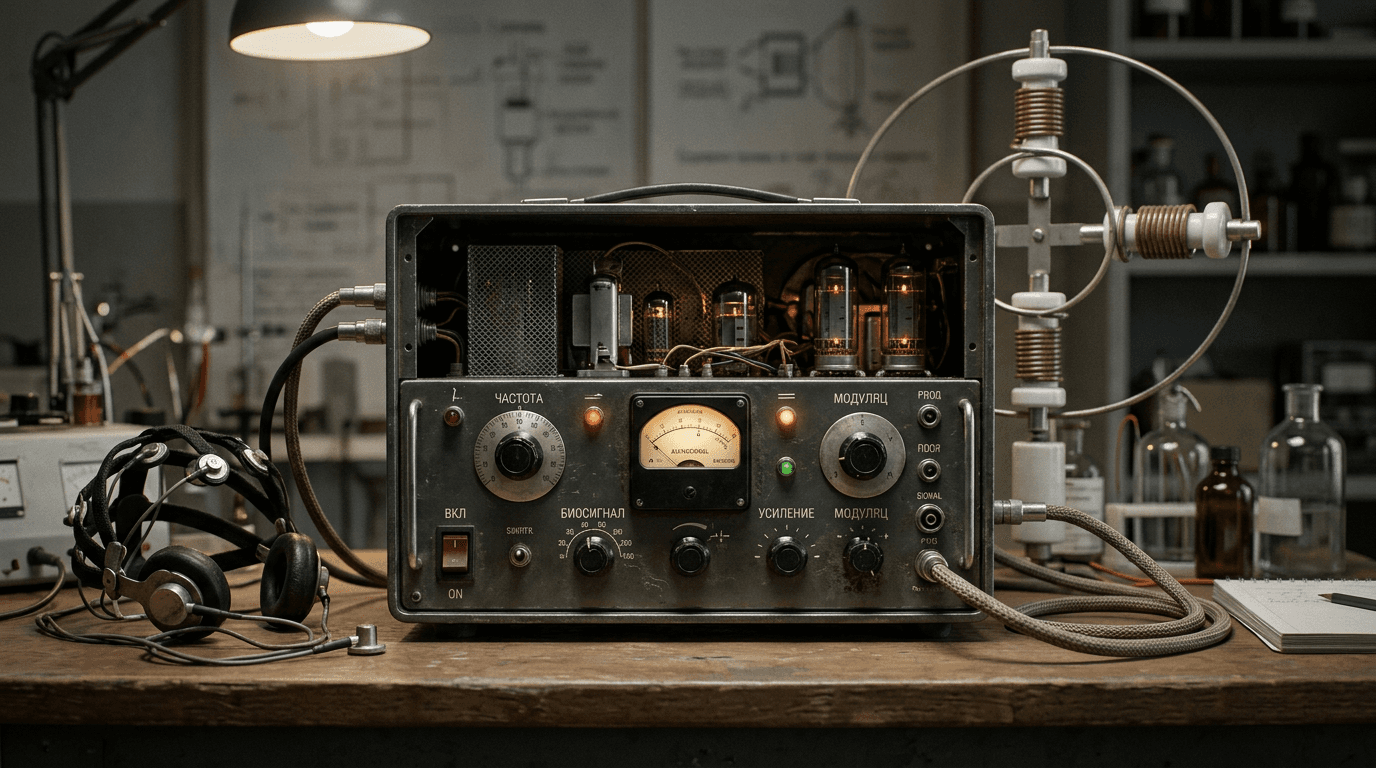
Alpha-Wave Radio
The Alpha-Wave Radio Interface represents a specific hardware implementation from Soviet biocommunication programs (documented in alleged 'Proekt Orion 1983' KGB archives), claiming to bridge human nervous systems with external signal equipment through electro-neural coupling. The device allegedly converted operator alpha-wave brainwave patterns (8-13 Hz EEG rhythms) into low-bandwidth coherent radio emissions, enabling transmission of emotional states to remote receivers.
Technical Description
Operators (described as 'sensitives') were connected to EEG electrodes monitoring dominant alpha rhythms. Signal processing circuitry allegedly extracted emotional valence patterns from alpha-wave amplitude modulations, frequency variations, and phase relationships. These patterns were then encoded onto radio-frequency carriers (specific frequencies not documented) and transmitted to remote locations where receivers attempted to decode emotional content. The system emphasized emotional state transmission rather than semantic information transfer—representing affective rather than cognitive telepathy.
Claimed Capabilities
Reports describe successful transmission of basic emotional states (calm, anxiety, excitement, sadness) across distances within laboratory facilities. Operators allegedly 'broadcast' their emotional experiences, with receivers (also connected to monitoring equipment) showing corresponding EEG pattern shifts and subjective emotional changes. The system was framed as 'technological telepathy'—using radio as carrier medium for consciousness-generated signals, bypassing spoken language and visual cues.
Neuroscientific Perspective and Analysis
From neuroscience perspective, EEG alpha waves do correlate with relaxation and emotional states. Modern affective computing extracts emotional information from physiological signals including EEG, heart rate variability, and galvanic skin response. However, transmitting this via radio requires: conventional telemetry equipment (transmitters, receivers); conscious decoding by trained operators or pattern-recognition algorithms; and does not constitute paranormal telepathy—merely physiological state broadcasting. The Soviet system likely achieved exactly this: radio telemetry of EEG patterns interpreted as emotional content, framed as psychic communication for military/intelligence appeal.
Modern Analogues
Brain-to-brain interfaces demonstrated by University of Washington (2013) achieved rudimentary information transfer using EEG from sender and TMS to receiver—actual thought transmission requiring equipment. Affective computing systems decode emotion from biosignals in real-time. Neurofeedback devices allow operators to consciously modulate brainwave patterns. The Alpha-Wave Radio Interface represents early attempt at these capabilities, using radio telemetry technology available in 1970s-80s combined with parapsychology framing.
Significance
The device occupies boundary between legitimate neurotechnology (EEG telemetry, affective biosignal transmission) and psychotronic mythology (claimed paranormal emotional transfer). It demonstrates how conventional technology (radio, EEG) combined with selective interpretation and Cold War secrecy creates appearance of exotic capability. The system likely worked—as radio telemetry of brainwaves—but mechanism was conventional neuroscience plus radio engineering, not paranormal consciousness coupling. Its inclusion in alleged KGB archives suggests institutional interest in technologically-mediated psi research, whether as genuine belief or psychological operations tool.
Research this in Signals
Signals turns a topic into a sourced research record you can inspect and rerun. Your first scan is free, and this one starts with Alpha-Wave Radio already loaded, so edit it or scan as is.