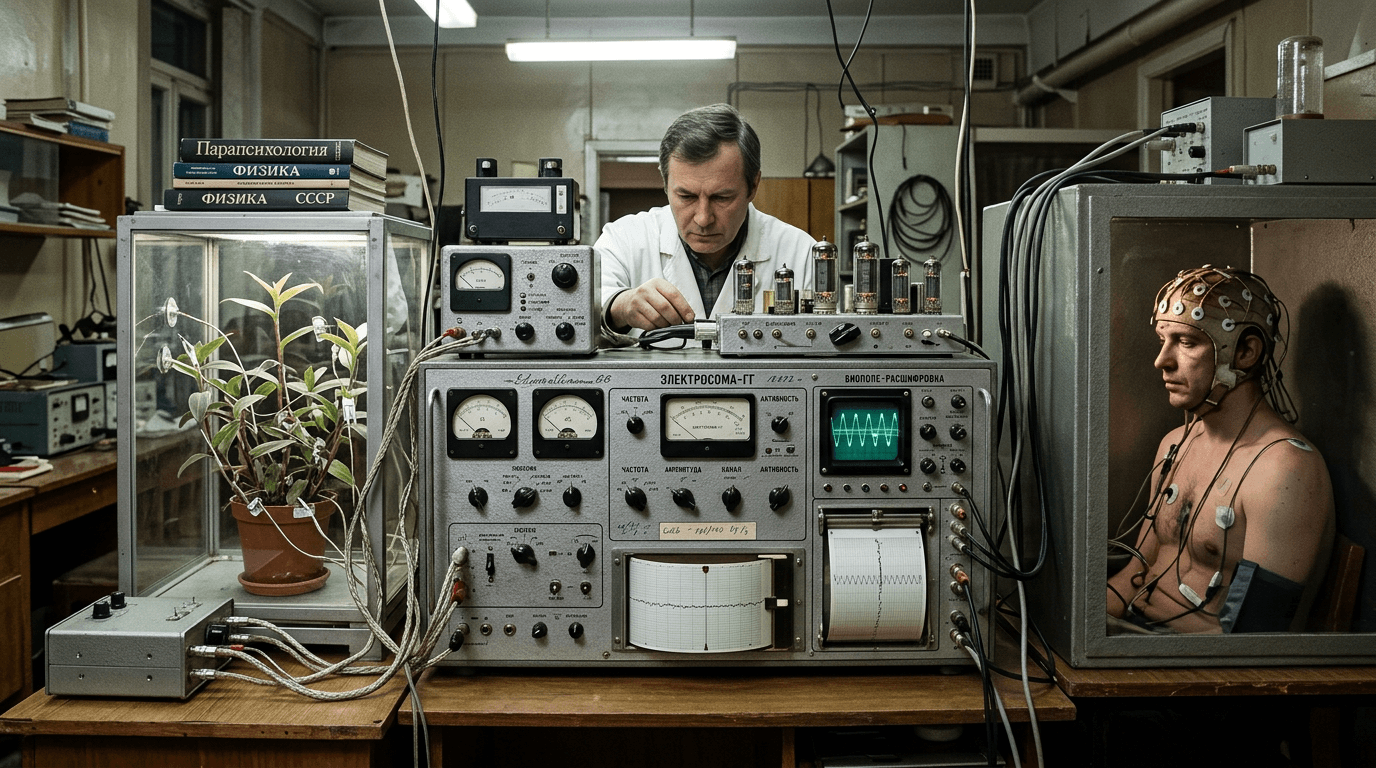
Biocommunication Research
Soviet Union conducted extensive parapsychology research (1960s-80s) under 'biocommunication' and 'bioinformation' frameworks. Programs at Moscow State University, Leningrad Institute, and military labs investigated telepathy, remote influencing, precognition, and psychokinesis using electromagnetic shielding, EEG monitoring, and statistical analysis.
Research Approaches and Claims
Researchers including Ippolitov, Dubrov, and Kaznacheev studied 'biological fields,' 'torsion field' interactions with consciousness, and claimed demonstrations of telepathy at distance. Instruments included Faraday cages, ELF generators, and torsion field detectors. Some experiments reported significant results (cellular communication through EM-shielded barriers, distant influence on biological systems).
Critical Assessment
Western parapsychologists note Soviet research suffered from inadequate controls, selective reporting, and political pressure for positive results. Nevertheless, declassified documents confirm substantial state investment and military interest. Russian biocommunication research influenced global parapsychology, introduced 'torsion field-consciousness' coupling theories, and fed into psychotronic weapons concerns. It represents institutional legitimization of psi research within materialist framework—attempting to ground consciousness anomalies in electromagnetic or field physics.
Research this in Signals
Signals turns a topic into a sourced research record you can inspect and rerun. Your first scan is free, and this one starts with Biocommunication Research already loaded, so edit it or scan as is.