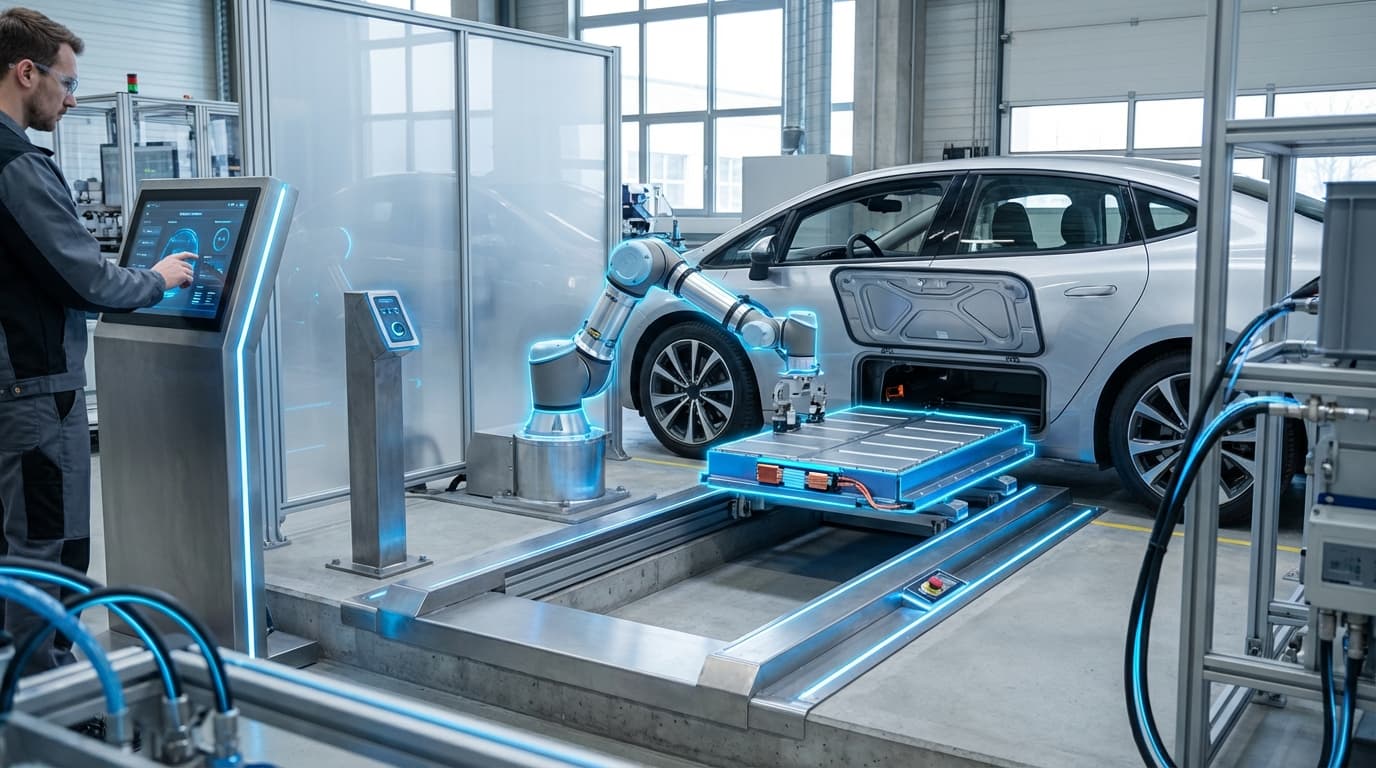
Battery Swapping Stations
Battery swapping stations represent a paradigm shift in electric vehicle infrastructure, offering an alternative to traditional plug-in charging by enabling rapid battery exchanges through automated systems. The technology operates through a network of purpose-built facilities equipped with robotic mechanisms that can remove a depleted battery pack from an EV and replace it with a fully charged unit in approximately three to five minutes—a timeframe comparable to conventional gasoline refueling. The process typically involves the vehicle driving onto a platform where automated lifts and precision robotics access the battery compartment from beneath, disconnect the depleted pack, and install a charged replacement. These stations maintain inventories of pre-charged batteries that are continuously cycled through charging bays, ensuring availability for incoming vehicles. The standardisation of battery form factors and connection interfaces is critical to the system's operation, requiring coordination between vehicle manufacturers and infrastructure providers to ensure compatibility across different models and brands.
The primary challenge this infrastructure addresses is range anxiety and charging time limitations that have historically hindered widespread EV adoption, particularly for commercial fleets and long-distance travel scenarios. Traditional fast-charging stations, while improving, still require 20 to 40 minutes for meaningful charge replenishment, creating bottlenecks during peak travel periods and limiting the operational efficiency of commercial vehicles that cannot afford extended downtime. Battery swapping eliminates this constraint by reducing the refueling process to a duration indistinguishable from conventional vehicles. Furthermore, this model enables a battery-as-a-service business structure where vehicle ownership is decoupled from battery ownership. Consumers can purchase EVs at significantly reduced upfront costs since the expensive battery pack—often representing 30 to 40 percent of a vehicle's total price—remains the property of the service provider. This separation also addresses concerns about battery degradation, as users are not tied to a single aging battery but instead receive whichever unit is available at the swap station, with the service provider managing battery health and replacement cycles across the entire fleet.
Early deployments in Asian markets, particularly in China, have demonstrated the commercial viability of this approach, with networks expanding to thousands of stations serving both private vehicles and commercial fleets such as taxis and delivery vans. The model shows particular promise in dense urban environments where parking space for charging infrastructure is limited and in commercial applications where vehicle utilisation rates demand minimal downtime. Industry analysts note that the success of battery swapping depends heavily on achieving sufficient network density to provide convenient access, standardisation across manufacturers to maximise station utilisation, and economies of scale in battery procurement and management. As the global EV market matures, battery swapping stations represent a complementary infrastructure approach alongside traditional charging networks, offering flexibility in how different user segments and use cases address their energy needs while potentially accelerating the transition away from internal combustion engines.
Related Organizations

Operator of the world's largest battery swapping network for electric scooters and two-wheelers.

NIO
China · Company
Leading EV manufacturer that has deployed the world's largest network of automated battery swapping stations (Power Swap).

Develops modular battery swapping stations that can work with different vehicle models by using modular battery blocks.

The world's largest battery manufacturer, actively deploying Sodium-ion batteries commercially.

A major Chinese battery swapping operator serving taxi fleets and partnering with multiple OEMs like SAIC and BAIC.

Automotive giant that launched the 'Livan' brand dedicated to battery swapping EVs and operates its own station network.

Indian energy infrastructure company providing battery swapping services for buses, three-wheelers, and two-wheelers.

Australian company converting diesel prime movers to electric and utilizing a proprietary exchangeable battery system.

Developer of the 'Honda Mobile Power Pack', a standardized swappable battery for motorcycles and small mobility devices.

Berlin-based startup offering multi-modal battery swapping stations for micro-mobility (scooters, cargo bikes).
Supporting Evidence
Research this in Signals
Signals turns a topic into a sourced research record you can inspect and rerun. Your first scan is free, and this one starts with Battery Swapping Stations already loaded, so edit it or scan as is.