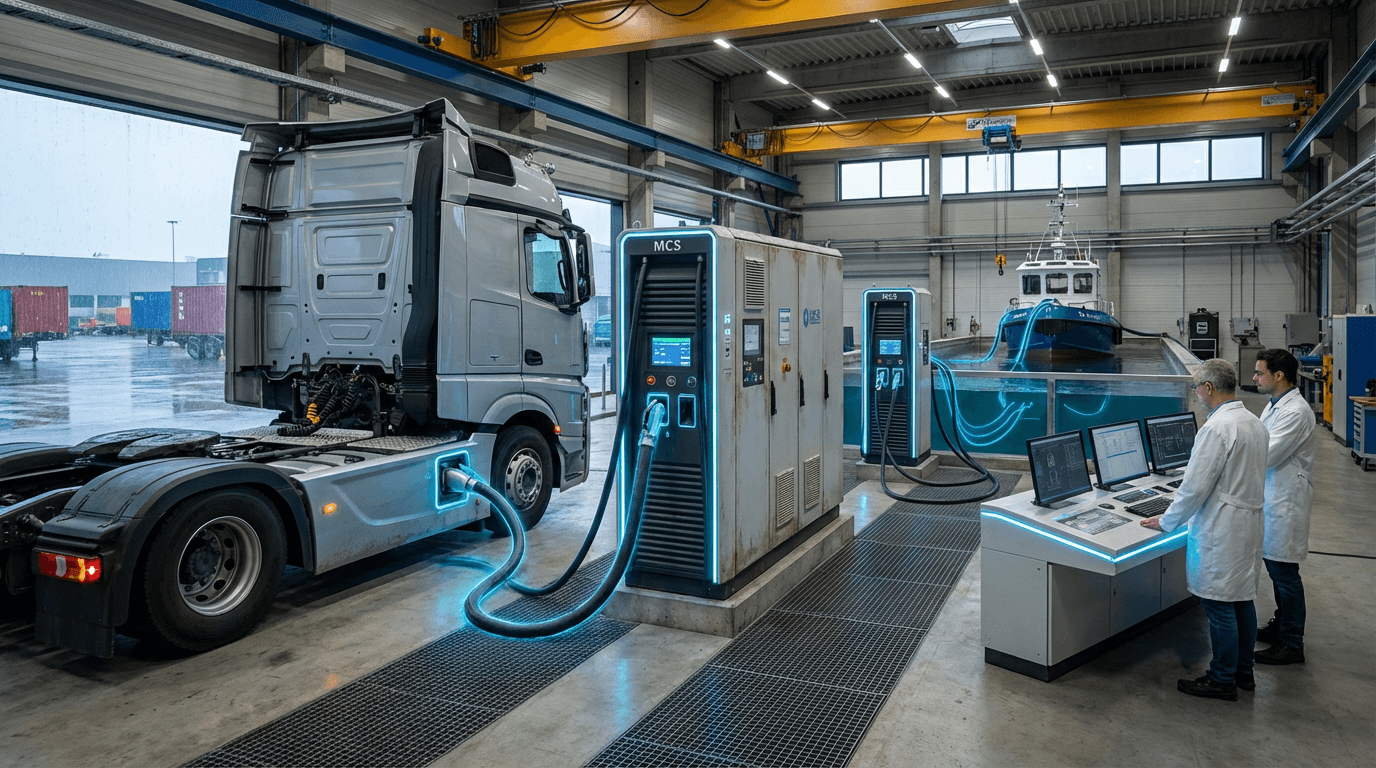
Megawatt Charging Systems (MCS)
The electrification of heavy-duty transportation faces a fundamental challenge: the massive battery capacities required for long-haul operations demand charging speeds far beyond what current infrastructure can provide. Megawatt Charging Systems (MCS) represent a new charging standard specifically engineered to address this bottleneck, capable of delivering up to 3.75 megawatts of power—roughly ten times the capacity of the fastest passenger vehicle chargers. This technology employs advanced cooling systems and high-voltage architectures, typically operating at 1,000 volts or higher, to safely transfer enormous amounts of energy in compressed timeframes. The charging interface itself incorporates liquid-cooled cables to manage the substantial heat generated during power transfer, while sophisticated communication protocols ensure compatibility across different vehicle manufacturers and charging station operators. By establishing a unified standard for megawatt-level charging, MCS creates the technical foundation necessary for battery-electric heavy-duty vehicles to compete with diesel-powered alternatives on operational efficiency.
The freight and maritime industries have long viewed electric propulsion as impractical for long-distance operations, primarily due to charging time constraints that would severely impact vehicle utilization rates and driver productivity. MCS directly confronts this limitation by enabling electric trucks to replenish significant portions of their battery capacity during mandatory rest breaks—typically 30 to 45 minutes under transportation regulations in many jurisdictions. This alignment between regulatory requirements and charging capabilities transforms what was once a critical weakness into a viable operational model. For port operations and short-sea shipping, MCS infrastructure supports the electrification of harbor vessels and ferries, which often operate on predictable routes with scheduled layovers. The technology also enables new business models around charging-as-a-service, where logistics companies can optimize route planning around strategically placed MCS stations, potentially reducing total cost of ownership compared to diesel alternatives when factoring in fuel savings and lower maintenance requirements.
Early deployments of MCS infrastructure are already underway at strategic freight corridors and logistics hubs, with several pilot programs testing the technology's real-world performance under demanding commercial conditions. Industry analysts note that the rollout of MCS stations is following a hub-and-spoke model, concentrating initial installations at major distribution centers, ports, and along high-traffic freight routes before expanding to secondary corridors. This phased approach allows charging networks to develop in tandem with the gradual adoption of electric heavy-duty vehicles, avoiding the chicken-and-egg problem that has hindered previous alternative fuel infrastructures. The technology aligns with broader decarbonization efforts in the transportation sector, as heavy-duty vehicles account for a disproportionate share of emissions despite representing a smaller fraction of total vehicle numbers. As battery energy density continues to improve and MCS infrastructure becomes more widespread, the technology positions electric trucks and vessels as increasingly competitive alternatives, particularly for applications where predictable routes and scheduled stops can be leveraged to optimize charging strategies without compromising operational efficiency.
Related Organizations

Global association dedicated to promoting interoperability based on the Combined Charging System (CCS) and the Megawatt Charging System (MCS).

Joint venture between Daimler Truck, TRATON GROUP, and Volvo Group to build a high-performance public charging network for heavy-duty trucks in Europe.

Global supplier of electrical and optical connectivity solutions, specializing in the cooled cable systems required for megawatt-level power transfer.

Finnish manufacturer of rapid DC charging solutions known for their modular, scalable power satellite architecture.

Maintains the efficiency charts for solar cells and conducts foundational research on perovskite stability.

Major manufacturer of heavy trucks and buses, actively testing MCS on their next-generation electric trucks.

Specializes in fast charging solutions for heavy-duty vehicles and public transport, developing MCS-ready power cabinets.

Developing a network of heavy-duty electric truck charging stations in California, incorporating MCS readiness into their infrastructure.

Engineering group designing power connection and electrification systems for ports, airports, and industrial applications.
Supporting Evidence
Research this in Signals
Signals turns a topic into a sourced research record you can inspect and rerun. Your first scan is free, and this one starts with Megawatt Charging Systems (MCS) already loaded, so edit it or scan as is.