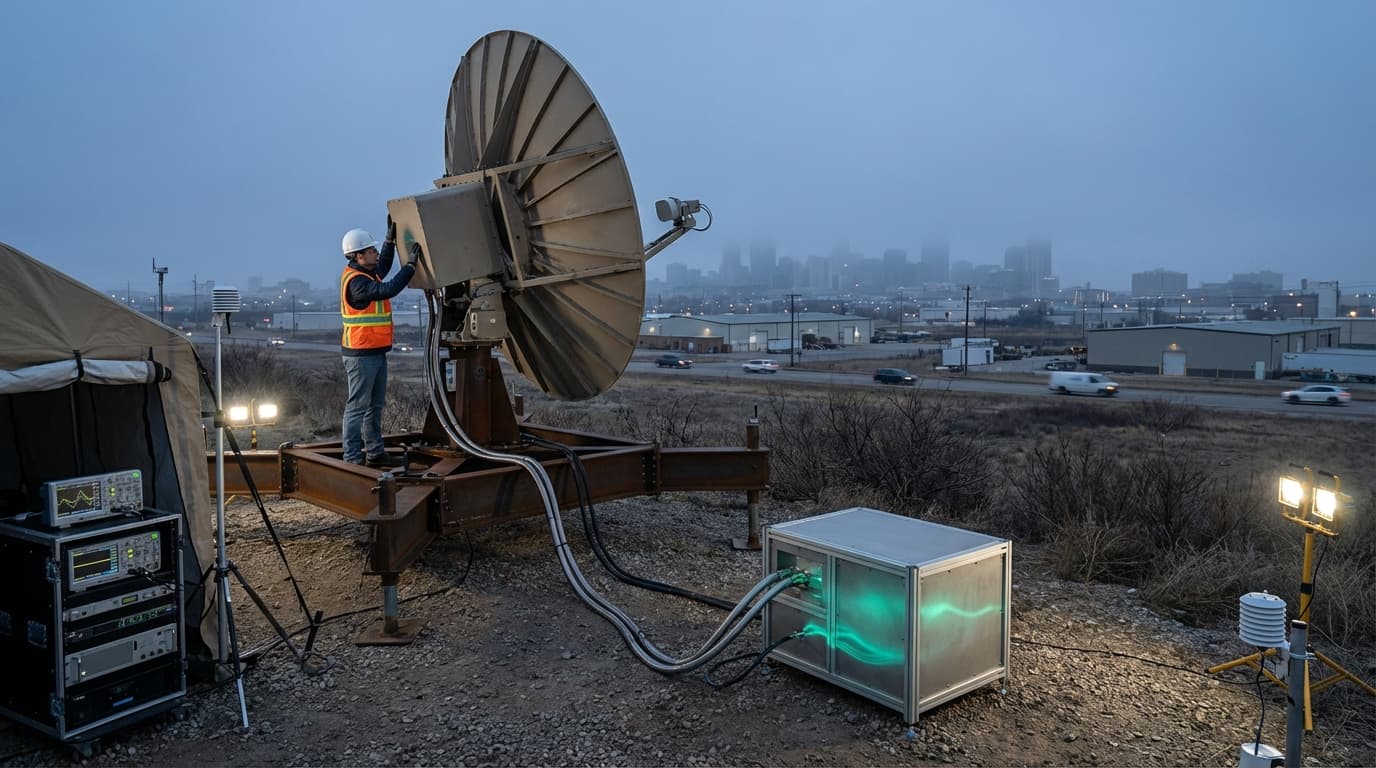
Quantum Illumination Radar Systems
Quantum illumination radar systems are radar systems that use entanglement-enhanced detection (quantum entanglement to improve signal detection) by transmitting entangled photon pairs (pairs of photons with quantum entanglement) and correlating detections on return (analyzing returned signals using quantum correlations), promising higher signal-to-noise ratios (better ability to detect weak signals in noise) for stealth aircraft tracking (detecting aircraft designed to avoid radar) and maritime surveillance (monitoring ships and submarines). National defense labs are trialing tabletop (laboratory) and over-the-air (field) demonstrations at TRL 3 to 4 (technology readiness levels indicating early-stage development), exploring whether quantum entanglement can provide advantages over classical radar in detecting targets in noisy environments, potentially enabling detection of stealthy targets that are difficult for classical radar to find.
This innovation addresses the challenge of detecting stealthy targets, where classical radar struggles. By using quantum entanglement, these systems could provide better detection. Defense research labs are developing these systems.
The technology is particularly significant for defense applications, where better radar could provide strategic advantages. As stealth technology improves, quantum radar becomes increasingly interesting. However, ensuring practical advantages, managing complexity, and achieving field deployment remain significant challenges. The technology represents an interesting research direction, but requires extensive development to prove practical advantages. Success could enable better radar detection, but the technology must prove it provides real advantages over classical radar. Quantum illumination radar remains largely experimental, with practical advantages still being investigated.
Related Organizations
Austria · Research Lab
Home to Shabir Barzanjeh's group, which successfully demonstrated microwave quantum illumination for radar applications.
China · Company
State-owned defense conglomerate that claimed to have developed a prototype quantum radar capable of detecting stealth aircraft.
United States · Company
Participant in IARPA's C3 (Cryogenic Computing Complexity) program.
Canada · University
Researchers at IQC have conducted significant experiments in quantum illumination and microwave quantum sensing.

Researchers at the York Centre for Quantum Technologies have developed prototypes for microwave quantum radar.

Finnish university with strong research groups in superconducting circuits and microwave quantum optics relevant to radar.
A German defense electronics company that has publicly claimed research into quantum radar technology for stealth detection.
Italy · Government Agency
Italian metrology institute participating in research on quantum illumination and entanglement-enhanced sensing.

Major defense contractor developing Reciprocal Quantum Logic (RQL) for cryogenic computing.
Supporting Evidence
Research this in Signals
Signals turns a topic into a sourced research record you can inspect and rerun. Your first scan is free, and this one starts with Quantum Illumination Radar Systems already loaded, so edit it or scan as is.