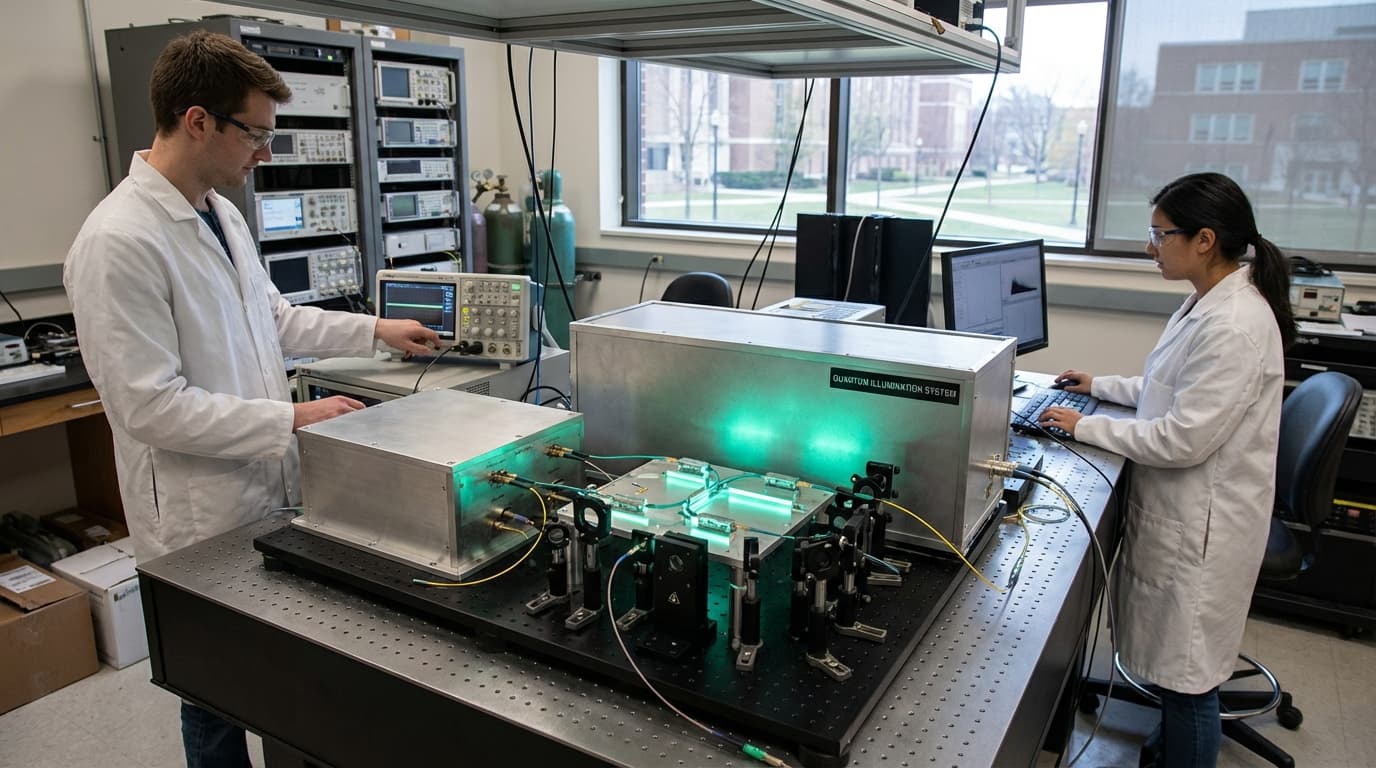
Quantum Illumination (Radar)
Quantum illumination (radar) enhances target detection in noisy environments using entangled photons (photons with quantum entanglement), where quantum radar uses entangled photon pairs—one sent out (transmitted toward a target), one kept back (retained for comparison)—to detect objects. Due to quantum correlations (the quantum entanglement between photons), it can distinguish the reflected signal from background noise much better than classical radar (providing better signal-to-noise ratio), even if the entanglement is broken on reflection (the entanglement doesn't need to survive the reflection), making it potentially useful for detecting weak signals in noisy environments. This has major implications for stealth detection (finding aircraft designed to avoid radar) and biomedical imaging (medical imaging using quantum effects), potentially enabling detection of targets that are difficult for classical radar to find.
This innovation addresses the challenge of detecting targets in noisy environments, where classical radar struggles. By using quantum entanglement, these systems could provide better detection. Defense research labs are developing these systems.
The technology is particularly significant for defense applications, where better radar could provide strategic advantages. As stealth technology improves, quantum radar becomes increasingly interesting. However, ensuring practical advantages, managing complexity, and achieving field deployment remain significant challenges. The technology represents an interesting research direction, but requires extensive development to prove practical advantages. Success could enable better radar detection, but the technology must prove it provides real advantages. Quantum illumination radar remains largely experimental, with practical advantages still being investigated.
Research this in Signals
Signals turns a topic into a sourced research record you can inspect and rerun. Your first scan is free, and this one starts with Quantum Illumination (Radar) already loaded, so edit it or scan as is.