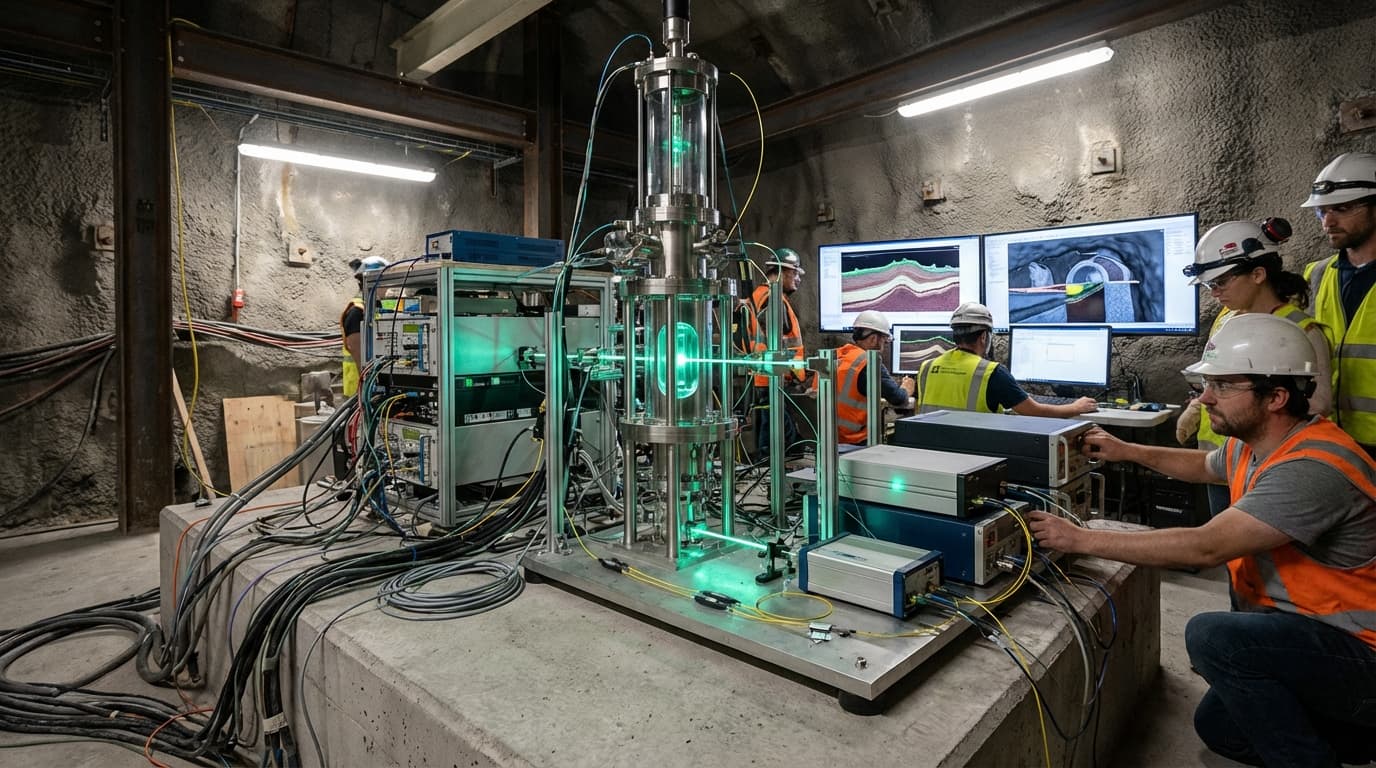
Quantum Gravimetry
Quantum gravimetry uses atom interferometry (using the wave nature of atoms to create interference patterns) for precise underground mapping and civil engineering, where quantum gravimeters (devices that measure gravity) use the interference of matter waves (the wave nature of atoms) to measure local gravity with extreme precision (detecting tiny variations in gravitational pull). Unlike other quantum applications, this technology works now (is already practical and deployed), and is used to map underground aquifers (water reservoirs), detect hidden magma chambers (underground molten rock), and find voids under city streets (empty spaces that could cause problems) without digging (avoiding expensive excavation), making it a practical quantum technology that is already providing value in real-world applications, enabling non-invasive exploration and monitoring of underground structures.
This innovation addresses the need for non-invasive underground exploration, where traditional methods require digging. By using quantum sensors, these systems can detect underground features without excavation. Companies and research institutions are developing and deploying these systems.
The technology is particularly significant for underground exploration, where non-invasive methods are valuable. As the technology improves, it could enable new applications. However, ensuring accuracy, managing complexity, and achieving widespread deployment remain challenges. The technology represents a mature application of quantum sensing, with commercial systems available. Success is already being achieved, with quantum gravimeters being used in various applications. Quantum gravimetry is one of the most mature quantum sensing technologies, with practical applications already deployed.
Related Organizations
France · Company
Produces the Absolute Quantum Gravimeter (AQG), the first commercially available atom interferometry gravimeter.

Leads the UK Quantum Technology Hub in Sensors and Timing, focusing on gravity sensing for civil engineering.

Specializes in atom optic sensors, including high-precision quantum gravimeters and gradiometers.

Building 'Gravio', a cold atom interferometry sensor for resource exploration and underground mapping.

Develops advanced laser systems and quantum gravimeters/accelerometers for navigation and sensing.

Develops compact quantum sensors for gravimetry and accelerometry in field environments.

The French aerospace lab developing mobile quantum gravimeters for airborne and maritime applications.
United States · Company
Develops cold atom hardware and sensors, including inertial sensors based on atom interferometry.

Develops subsystems and vacuum packages for cold atom quantum sensors, including gravity sensors (CASPA project).
Supporting Evidence
Research this in Signals
Signals turns a topic into a sourced research record you can inspect and rerun. Your first scan is free, and this one starts with Quantum Gravimetry already loaded, so edit it or scan as is.