Integrated Sensing and Communication (ISAC)
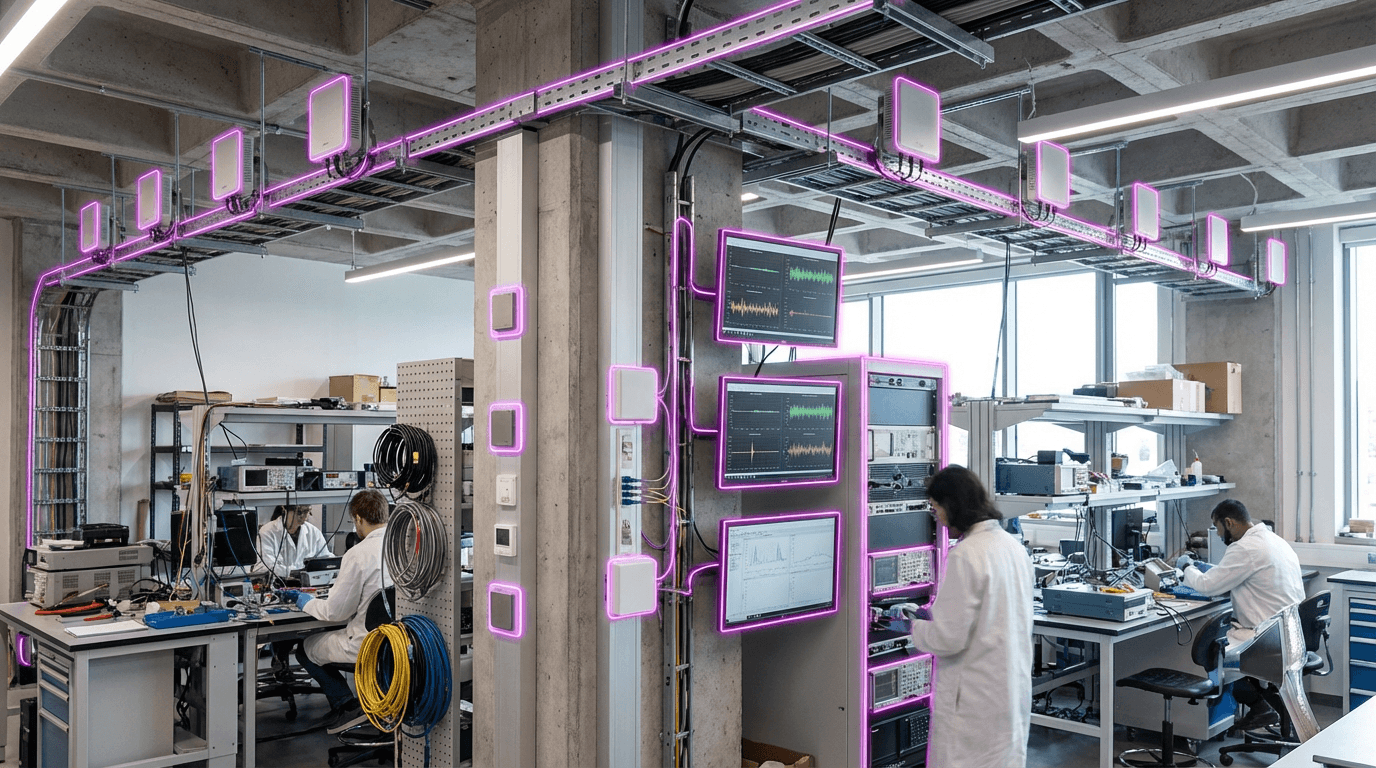
Modern telecommunications networks have traditionally served a single purpose: transmitting data between devices. However, the radio waves that carry our phone calls, internet traffic, and streaming content also interact with the physical environment in measurable ways. Integrated Sensing and Communication (ISAC) exploits this fundamental property by designing network signals to simultaneously transmit information and gather environmental data. The technology works by analysing how transmitted radio waves reflect, scatter, or attenuate when they encounter objects, weather patterns, or even human activity. Advanced signal processing algorithms can extract detailed information about the physical world from these interactions—measuring distances, velocities, and material properties—while the same waveforms continue to carry conventional data traffic. This dual-use approach transforms cellular base stations, Wi-Fi routers, and other communication infrastructure into a distributed sensor network that operates continuously across entire urban areas without requiring additional hardware deployment.
The infrastructure implications of ISAC are particularly compelling for cities and regions facing the escalating costs of deploying and maintaining dedicated sensor networks. Traditional approaches to environmental monitoring require installing, powering, and maintaining separate radar systems, weather stations, traffic sensors, and surveillance equipment—each with its own infrastructure requirements and operational expenses. ISAC addresses this challenge by leveraging the communication infrastructure that already blankets urban environments, effectively providing sensing capabilities as a byproduct of normal network operations. This convergence enables new applications that were previously impractical or prohibitively expensive: real-time traffic flow monitoring without roadside cameras, precipitation mapping at street-level resolution, detection of structural vibrations in bridges and buildings, and even contactless vital sign monitoring in healthcare facilities. For network operators, ISAC represents an opportunity to generate additional value from existing spectrum allocations and infrastructure investments, potentially opening new revenue streams in smart city services, environmental monitoring, and public safety applications.
Early research deployments have demonstrated ISAC's viability across various frequency bands, from sub-6 GHz cellular networks to millimetre-wave 5G systems, with each offering different trade-offs between sensing range, resolution, and communication capacity. Pilot programs are exploring applications ranging from automotive safety—where vehicle-to-everything (V2X) communications could simultaneously enable collision avoidance sensing—to precision agriculture, where rural communication towers might monitor soil moisture and crop health. The technology aligns with broader industry trends toward network densification and the proliferation of connected devices, both of which increase the spatial coverage and granularity of potential sensing capabilities. As 6G network standards begin taking shape, industry researchers are advocating for ISAC as a core design principle rather than an afterthought, suggesting that future wireless infrastructure may be fundamentally conceived as dual-purpose systems. The convergence of sensing and communication represents a shift toward infrastructure that doesn't merely connect devices but actively perceives and responds to the physical world, transforming telecommunications networks into a foundational layer of environmental intelligence for smart cities and regions.
Related Organizations

European standards organization that launched the Industry Specification Group on Reconfigurable Intelligent Surfaces (ISG RIS).

Industrial research lab with a history of fundamental research in condensed matter physics relevant to topological phases.

Offers the Quantum Engineering Toolkit (QET) and Labber software for instrument control and pulse generation.

International electronics group specializing in test equipment, broadcast & media, and cybersecurity.

Host of the 6G Flagship, the world's first major 6G research program.

German research institute developing advanced algorithms for 3D Human Body Reconstruction and volumetric video coding.


Mobile technology research and development company that licenses its innovations.
Supporting Evidence
Research this in Signals
Signals turns a topic into a sourced research record you can inspect and rerun. Your first scan is free, and this one starts with Integrated Sensing and Communication (ISAC) already loaded, so edit it or scan as is.