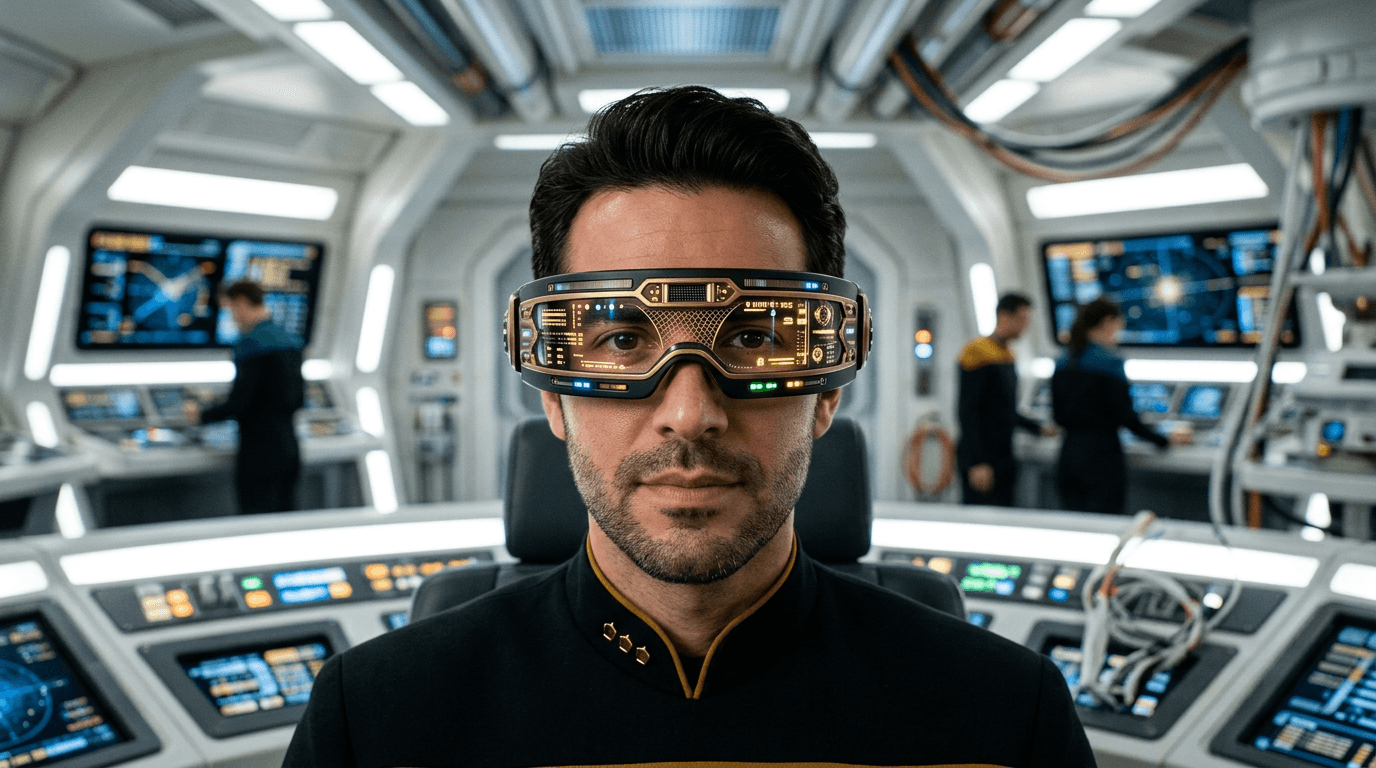
VISOR (Visual Instrument and Sensory Organ Replacement)
The VISOR represents a conceptual leap in sensory augmentation technology, imagined as a neural prosthetic that would restore and dramatically expand visual perception for individuals with blindness. The device is envisioned as a curved visor worn across the eyes, housing an array of sensors capable of detecting electromagnetic radiation across an extraordinarily broad spectrum—from low-frequency radio waves through microwave, infrared, visible light, ultraviolet, and potentially into X-ray and gamma ray frequencies. This sensory data would be processed through sophisticated pattern recognition algorithms and transmitted directly to the visual cortex via neural interface points at the temples, bypassing damaged or absent biological visual pathways entirely. The concept assumes breakthroughs in several areas: miniaturised multi-spectrum sensors, real-time signal processing capable of translating diverse electromagnetic inputs into coherent visual representations, and bidirectional neural interfaces that can safely deliver complex sensory information to the brain without tissue damage or rejection.
Within speculative technology discourse and science fiction narratives, the VISOR serves as an exploration of how disability might be reframed not merely as restoration to baseline human function, but as an opportunity for sensory enhancement beyond biological norms. The device appears in discussions about the future of assistive technology, transhumanism, and the potential convergence of medical prosthetics with augmentation technologies. Its narrative appeal lies in the tension between capability and cost—users would theoretically perceive reality in ways impossible for unaugmented humans, detecting thermal signatures, electromagnetic fields, and structural compositions invisible to natural vision, yet this expanded perception comes with significant trade-offs. The constant processing of such vast sensory input is imagined to cause neural strain, chronic discomfort, or even pain, raising questions about the psychological and physiological adaptation required for radically expanded perception. This positions the VISOR within broader conversations about human-machine integration, the nature of sensory experience, and whether technological enhancement inevitably involves compromise.
Current neuroscience and biomedical engineering suggest that while rudimentary visual prosthetics exist—such as retinal implants that provide limited light perception or cortical implants offering basic pattern recognition—the VISOR concept remains firmly speculative. Real-world challenges include the fundamental difficulty of translating non-visible electromagnetic frequencies into meaningful visual experiences, the bandwidth limitations of current neural interfaces, and the brain's limited plasticity in interpreting entirely novel sensory inputs. Existing visual prosthetics typically provide resolution measured in hundreds of pixels rather than the rich, multi-spectrum perception the VISOR envisions. Significant advances would be required in biocompatible electrode arrays, signal processing algorithms that can meaningfully compress vast spectral data, and our understanding of how the visual cortex might be trained to interpret such information. The concept's plausibility would increase substantially with breakthroughs in brain-computer interfaces, neuroplasticity research, and miniaturised sensor technology, though the full-spectrum capabilities described remain constrained by both physics and neurobiology. The imagined evolution toward fully implanted ocular replacements reflects real trends in medical technology toward more integrated, less obtrusive prosthetics, though such devices currently remain limited to restoring partial function rather than providing superhuman capabilities.
Research this in Signals
Signals turns a topic into a sourced research record you can inspect and rerun. Your first scan is free, and this one starts with VISOR (Visual Instrument and Sensory Organ Replacement) already loaded, so edit it or scan as is.