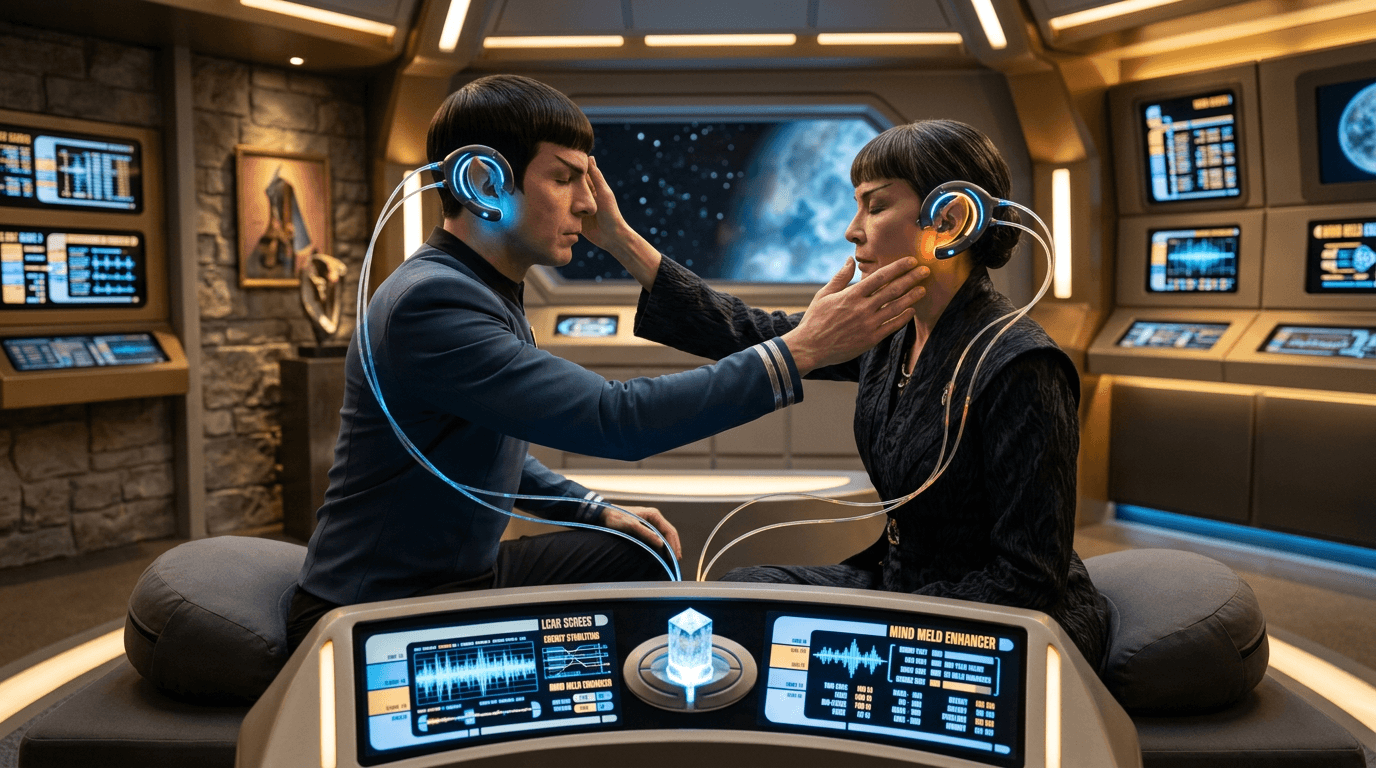
Mind Meld Enhancers
Mind Meld Enhancers represent a speculative class of neurotechnological devices imagined to amplify, stabilize, or extend the range of telepathic connections beyond what biological neural systems could sustain independently. In fictional frameworks where telepathy exists as a measurable phenomenon—often depicted as direct neural synchronization between conscious minds—these enhancers function as intermediary systems that compensate for signal degradation, cognitive incompatibility, or the physiological strain of sustained mental fusion. The conceptual mechanism typically involves some form of neural interface that monitors brainwave patterns, detects synchronization failures, and applies corrective signals to maintain coherent information transfer between linked minds. While telepathy itself remains outside established neuroscience, the notion of technological mediation for neural communication draws loose parallels to emerging brain-computer interface research, where external devices already facilitate rudimentary signal translation between human neural activity and digital systems.
Within science fiction narratives and speculative scenario planning, Mind Meld Enhancers serve multiple strategic functions. They address the narrative problem of biological limitations in telepathic species, allowing characters to overcome distance barriers, species incompatibility, or the cognitive damage that might result from prolonged mental contact. This technology appears frequently in contexts involving interspecies diplomacy, emergency medical intervention, or intelligence gathering where direct mind-to-mind communication offers advantages over conventional methods. The concept also intersects with real-world research trajectories in neuroprosthetics and brain-to-brain interfaces, where laboratories have demonstrated primitive forms of thought transmission between individuals using electroencephalography and transcranial magnetic stimulation. While these experiments involve simple signal patterns rather than complex thought transfer, they establish a conceptual foundation that speculative technologies like Mind Meld Enhancers might theoretically build upon, assuming radical advances in neural decoding and information theory.
The plausibility of such devices depends entirely on assumptions about consciousness, information encoding in neural tissue, and the physical mechanisms by which thoughts could be transmitted between brains. Current neuroscience offers no evidence for telepathy as a natural phenomenon, meaning any enhancer technology would first require the existence of detectable telepathic signals to amplify. If we assume a fictional universe where such signals exist—perhaps as quantum entanglement effects, electromagnetic emissions, or some undiscovered field interaction—then enhancement technology becomes more conceptually tractable, though still requiring breakthroughs in real-time neural decoding, signal processing, and biocompatible interfaces far beyond present capabilities. The primary constraints would involve preventing neural damage from artificial signal amplification, maintaining the coherence of complex thought patterns during transmission, and managing the cognitive load on both participants. For such technology to move from pure speculation toward plausibility, we would need fundamental discoveries about how subjective experience maps to physical brain states, methods for translating those states between different neural architectures, and safety protocols for direct brain-to-brain communication that preserve individual identity and consent.
Research this in Signals
Signals turns a topic into a sourced research record you can inspect and rerun. Your first scan is free, and this one starts with Mind Meld Enhancers already loaded, so edit it or scan as is.