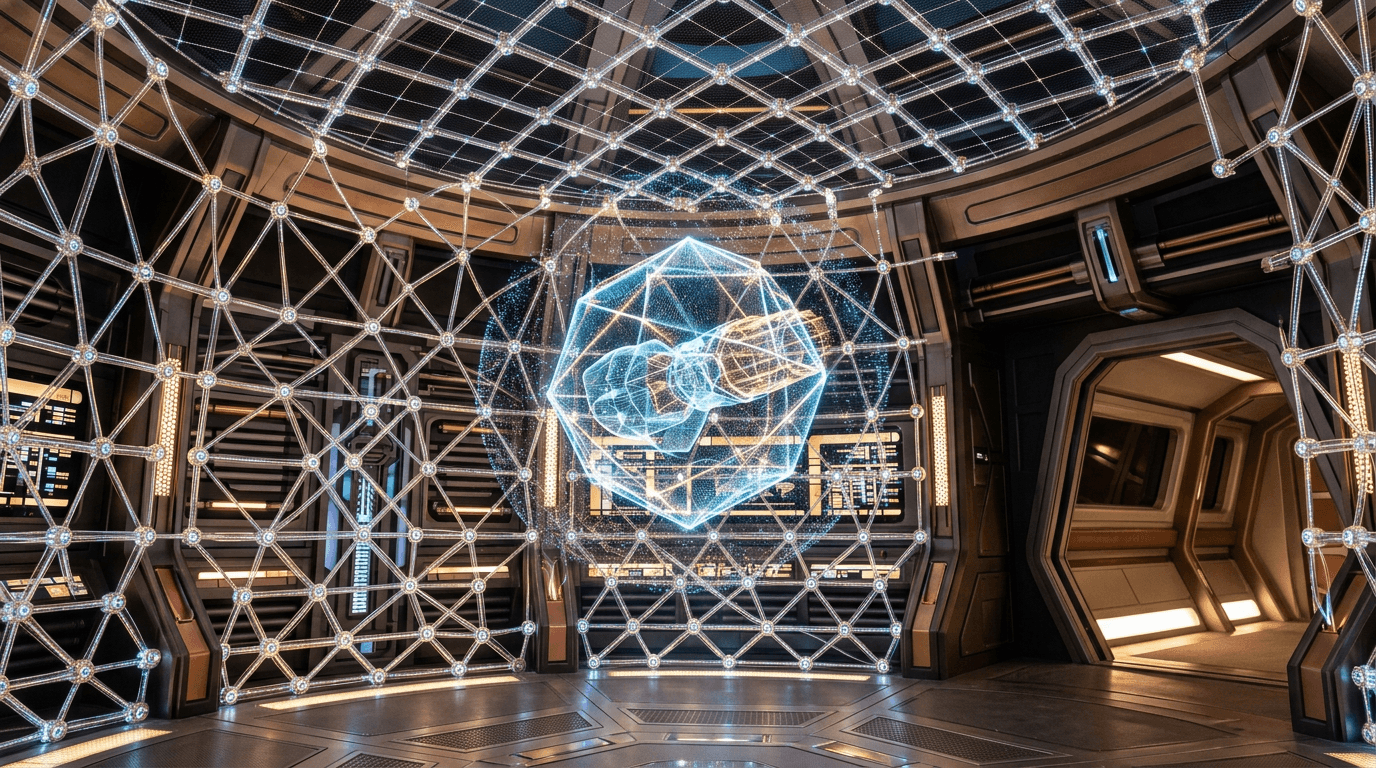
Holographic Emitter Grid
The holographic emitter grid represents a speculative convergence of advanced photonics, volumetric display technology, and force-field generation systems designed to create interactive three-dimensional environments where projected images possess tangible physical properties. Unlike conventional holographic displays that produce purely visual phenomena, this concept envisions a distributed network of emitters embedded throughout a defined space—walls, ceiling, floor—that work in concert to generate phase-conjugate light fields while simultaneously projecting localized force fields. The theoretical mechanism relies on precise spatial coordination between photonic projectors that create volumetric images through interference patterns and haptic feedback systems that provide tactile resistance when users interact with projected objects. Safety protocols would theoretically limit the maximum force output and energy transfer to prevent injury, creating the illusion of solidity without dangerous impulse delivery. This architecture appears prominently in science fiction narratives as the foundation for immersive simulation environments and advanced medical visualization systems.
The strategic appeal of such technology in speculative scenarios centers on its potential to revolutionize training, entertainment, design visualization, and surgical planning by collapsing the boundary between digital information and physical interaction. Military and aerospace organizations have long explored immersive simulation for complex procedural training, while medical researchers investigate volumetric imaging systems that could allow surgeons to manipulate three-dimensional representations of anatomy before making incisions. The holographic emitter grid concept extends these existing research directions into a fully realized interactive environment where users could physically engage with digital constructs. In narrative contexts, this technology serves as a powerful metaphor for the malleability of reality and the increasing integration of virtual experiences into daily life, raising questions about perception, presence, and the nature of authentic experience.
From a scientific plausibility standpoint, several fundamental challenges separate current capabilities from the envisioned system. While researchers have demonstrated acoustic levitation, optical trapping of microscopic particles, and volumetric display prototypes using various techniques, scaling these phenomena to room-sized environments with human-interactive force levels remains speculative. The energy requirements for generating sustained, spatially precise force fields across large volumes would be substantial, and no known physical mechanism currently provides the combination of photonic projection and haptic feedback at the scales described. Advances in metamaterials, phased-array acoustics, and computational holography suggest possible pathways toward limited implementations, but the "solid-feeling hologram" remains firmly in the realm of narrative technology rather than near-term engineering. Any movement toward plausibility would require breakthroughs in energy-efficient force generation, real-time spatial computing at unprecedented scales, and safety systems capable of preventing harmful interactions in dynamically changing environments.
Research this in Signals
Signals turns a topic into a sourced research record you can inspect and rerun. Your first scan is free, and this one starts with Holographic Emitter Grid already loaded, so edit it or scan as is.