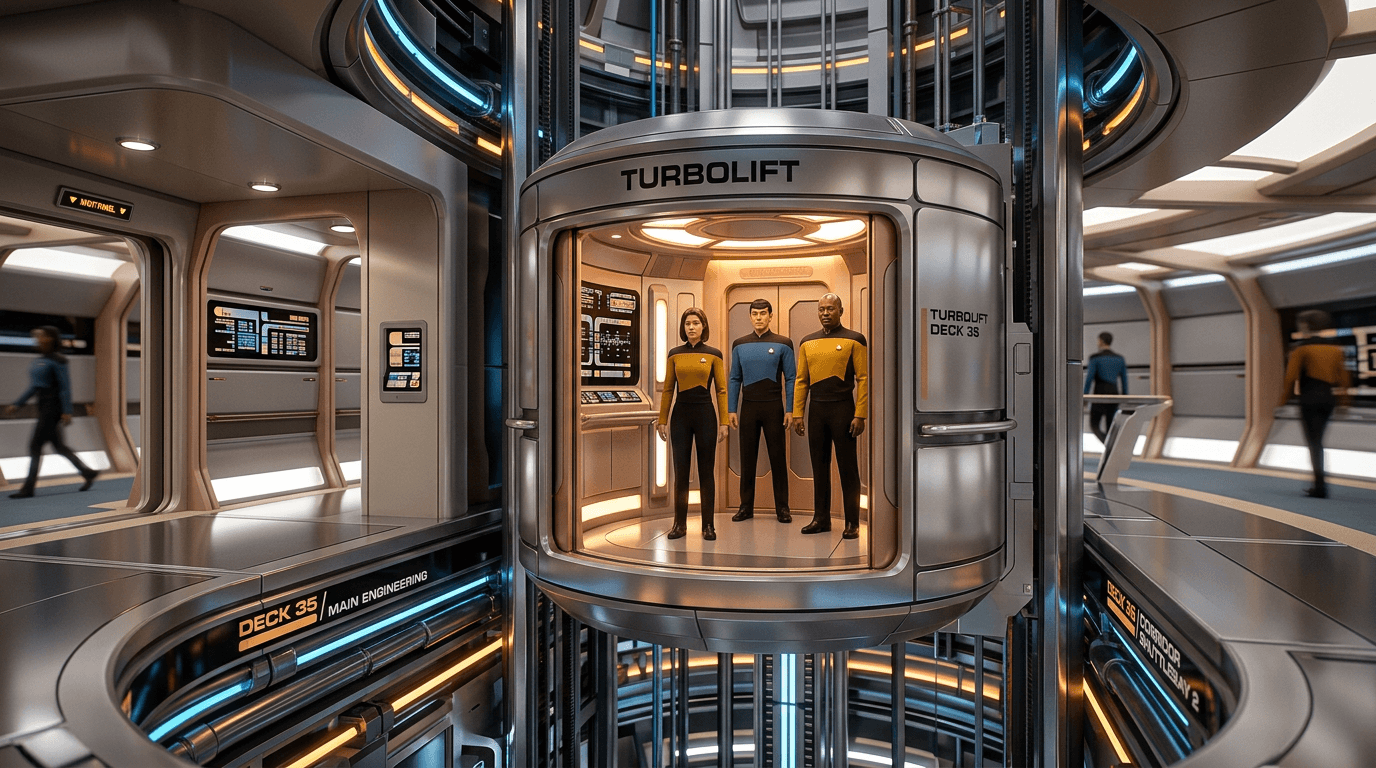
Turbolift
Turbolifts represent an advanced internal transportation concept that extends beyond conventional elevator systems by incorporating both vertical and horizontal movement through interconnected shaft networks. In science fiction narratives, particularly within the Star Trek universe, these systems are imagined to use electromagnetic propulsion combined with inertial dampening technology to transport personnel rapidly throughout massive starships and space stations. The conceptual mechanics involve computer-controlled cars that can switch between vertical and horizontal shafts, sharing pathways through sophisticated traffic management algorithms. This multi-directional capability addresses a fundamental challenge in large-scale space architecture: how to efficiently move crew members across vessels that may span hundreds of meters in multiple dimensions. The voice-activated interface and automated routing reflect broader science fiction themes of seamless human-computer interaction, where complex navigation decisions are handled transparently by artificial intelligence systems.
Within speculative space infrastructure design, turbolifts serve a critical narrative function by enabling the rapid scene transitions and operational tempo that define modern space opera storytelling. The technology appears in strategic discussions about future space station architecture and large spacecraft design, where conventional elevator systems would create significant bottlenecks in crew movement. Real-world research into maglev elevator systems and multi-directional elevator concepts, such as MULTI by thyssenkrupp, demonstrates early movement toward horizontal elevator travel, though these implementations remain far simpler than fictional turbolift networks. The concept also connects to broader questions in space habitat design about how to efficiently organize three-dimensional living and working spaces when traditional architectural assumptions about "up" and "down" become less relevant in microgravity or rotating habitat environments.
The plausibility of turbolift systems depends heavily on several unresolved engineering challenges. While electromagnetic propulsion for vertical transport exists in current elevator technology, the seamless integration of horizontal travel, high-speed shaft switching, and the inertial dampening required to prevent passenger discomfort at rapid acceleration rates remain speculative. The computational demands of coordinating hundreds of vehicles through shared pathways would be substantial, though advances in real-time optimization algorithms suggest this aspect may be more achievable than the physical infrastructure itself. The concept assumes energy availability and structural engineering capabilities beyond current spacecraft design, where mass and power constraints severely limit such amenities. Development of rotating space stations, advances in electromagnetic propulsion efficiency, and breakthroughs in compact inertial compensation systems would all be necessary precursors to practical turbolift implementation, making this technology a longer-term possibility contingent on fundamental advances in space infrastructure capabilities.
Research this in Signals
Signals turns a topic into a sourced research record you can inspect and rerun. Your first scan is free, and this one starts with Turbolift already loaded, so edit it or scan as is.