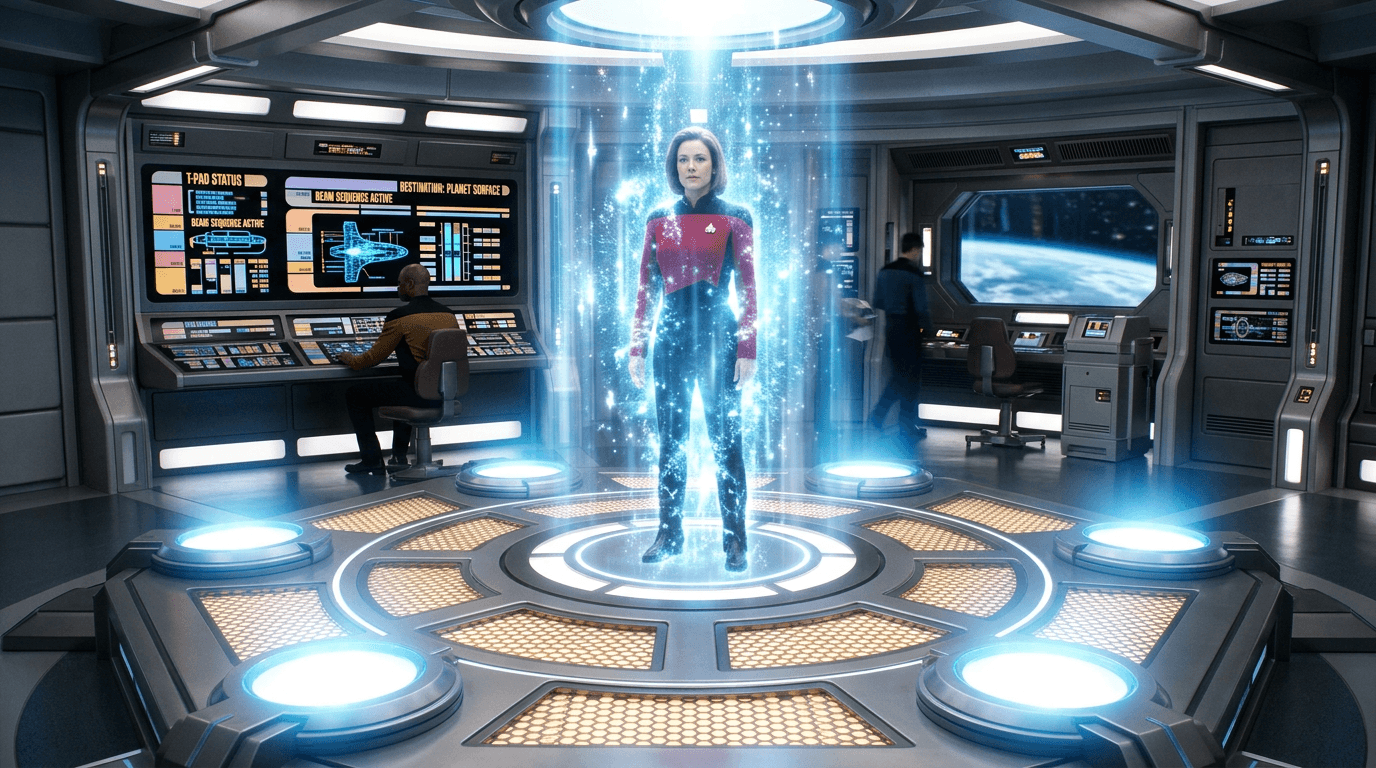
Transporter
The transporter represents one of science fiction's most ambitious technological concepts: a system that disassembles matter at the quantum level, converts it into an energy pattern, transmits that pattern across space, and reconstructs the original object or person at a distant location. The theoretical mechanism involves scanning an object at the subatomic level to create a complete quantum state description, then using matter-energy conversion principles derived from Einstein's mass-energy equivalence to transform physical matter into a transmissible form. This energy pattern would theoretically be beamed to the destination coordinates, where the process reverses—energy reconverts to matter following the stored quantum blueprint. The concept assumes several speculative breakthroughs: the ability to scan and store the quantum state of every particle in a macroscopic object (violating current understanding of the Heisenberg uncertainty principle), technology to convert matter to energy and back with perfect fidelity, and the capacity to transmit this information faster than conventional communication while maintaining coherence.
Within science fiction narratives, transporters serve as crucial plot devices that eliminate the constraints of conventional travel, enabling rapid deployment, dramatic rescues, and exploration scenarios that would otherwise require extensive transit sequences. The technology appears prominently in strategic discussions about future logistics, military mobility, and space exploration, though typically as a thought experiment rather than a development goal. Real-world research in quantum teleportation has successfully transmitted quantum states of photons and small particles across distances, but this process transfers information about quantum states rather than the particles themselves—a fundamentally different phenomenon from the matter transmission envisioned in transporter concepts. Adjacent fields like quantum computing, quantum entanglement research, and advanced scanning technologies provide genuine scientific foundations, yet remain separated from fictional transporters by vast conceptual and practical chasms.
The plausibility of matter transporters faces formidable constraints rooted in fundamental physics. Quantum mechanics suggests that perfectly scanning an object's quantum state would destroy the original (the no-cloning theorem), raising philosophical questions about whether a transported person would truly be the same individual or merely an identical copy. The energy requirements for matter-energy conversion at macroscopic scales would be astronomical—converting a human body would theoretically require energy equivalent to multiple nuclear weapons. Information storage and transmission present additional barriers: encoding the quantum state of a human body would require data storage exceeding all current computing capacity by many orders of magnitude. Current quantum teleportation experiments operate at the scale of individual particles under carefully controlled laboratory conditions, and scaling to macroscopic objects would require revolutionary advances in quantum mechanics, energy manipulation, and information theory. While research in quantum entanglement and particle physics continues to reveal surprising phenomena, the transporter as depicted in fiction remains firmly in the realm of speculation, serving more as a narrative convenience and philosophical thought experiment than a plausible near-term or even distant-future technology.
Research this in Signals
Signals turns a topic into a sourced research record you can inspect and rerun. Your first scan is free, and this one starts with Transporter already loaded, so edit it or scan as is.