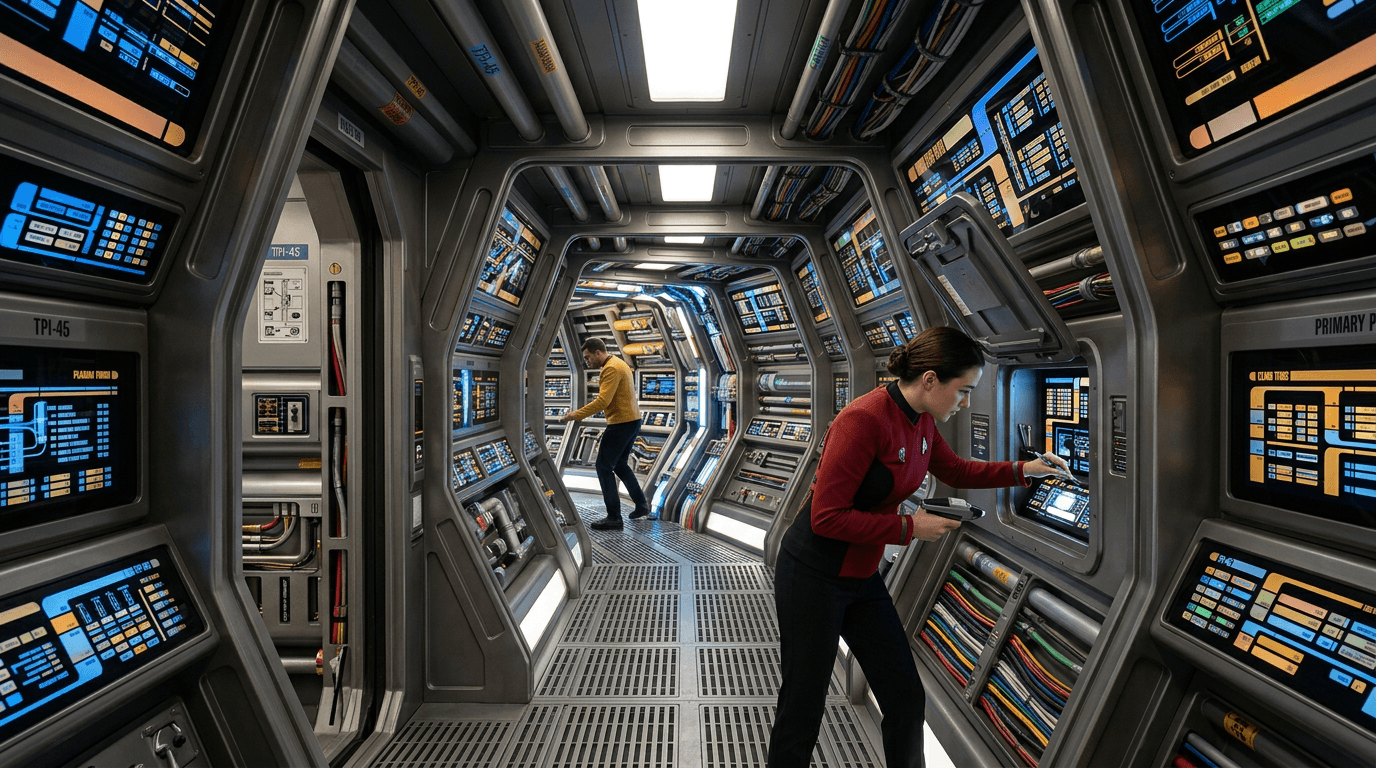
Jefferies Tubes
Jefferies tubes represent a ubiquitous architectural feature in fictional spacecraft design, particularly within the Star Trek universe, where they serve as narrow maintenance conduits threading through the vessel's infrastructure. These crawlspaces are conceived as a secondary circulation system running parallel to primary corridors, providing direct physical access to critical ship systems that would otherwise be sealed behind bulkheads and structural elements. The concept imagines a network of passages sized for human traversal in cramped conditions—typically requiring crawling or crouching—that grants engineering personnel routes to electro-plasma system (EPS) conduits, optical data network (ODN) trunks, environmental control systems, and coolant distribution loops. Within the narrative framework, these tubes incorporate manual override stations, emergency cut-off valves, and bypass mechanisms that become essential during combat situations when automated systems fail or primary access routes are compromised by hull breaches and structural damage.
The strategic role of Jefferies tubes in science fiction storytelling extends beyond mere technical plausibility to serve crucial dramatic functions. They provide confined settings for tense sequences involving emergency repairs under time pressure, create opportunities for characters to bypass security systems or navigate damaged sections of ship, and reinforce the industrial, submarine-like aesthetic that distinguishes certain fictional spacecraft from sleeker, less mechanically grounded designs. This architectural choice reflects real-world naval and aerospace engineering principles, where maintenance access is a fundamental design consideration. Modern naval vessels, submarines, and large aircraft incorporate similar service passages, cable runs, and equipment access points, though rarely as extensively interconnected as fictional depictions suggest. The concept also appears in discourse around space station design and generation ship proposals, where long-duration missions would necessitate comprehensive maintenance infrastructure accessible without depressurising habitable areas.
From an engineering plausibility standpoint, the Jefferies tube concept contains both practical elements and speculative assumptions. Real spacecraft and stations do incorporate maintenance access—the International Space Station features equipment racks designed for removal and service, while proposed deep-space vessels include plans for accessible systems routing. However, the extensive crawlspace networks depicted in fiction face significant constraints: every cubic meter dedicated to access passages represents mass and volume unavailable for habitation, cargo, or functional systems. In microgravity environments, the distinction between "crawlspace" and "corridor" becomes less meaningful, as personnel can navigate any adequately-sized passage regardless of orientation. The concept's viability increases with vessel scale—larger structures can more readily accommodate redundant access systems—but remains challenged by modern trends toward modular, replaceable components rather than in-situ repair of integrated systems. Future developments in spacecraft architecture may incorporate some aspects of this vision, particularly for long-duration missions where comprehensive repair capability justifies the mass penalty, though likely in forms quite different from the cramped tunnels of fictional depiction.
Research this in Signals
Signals turns a topic into a sourced research record you can inspect and rerun. Your first scan is free, and this one starts with Jefferies Tubes already loaded, so edit it or scan as is.