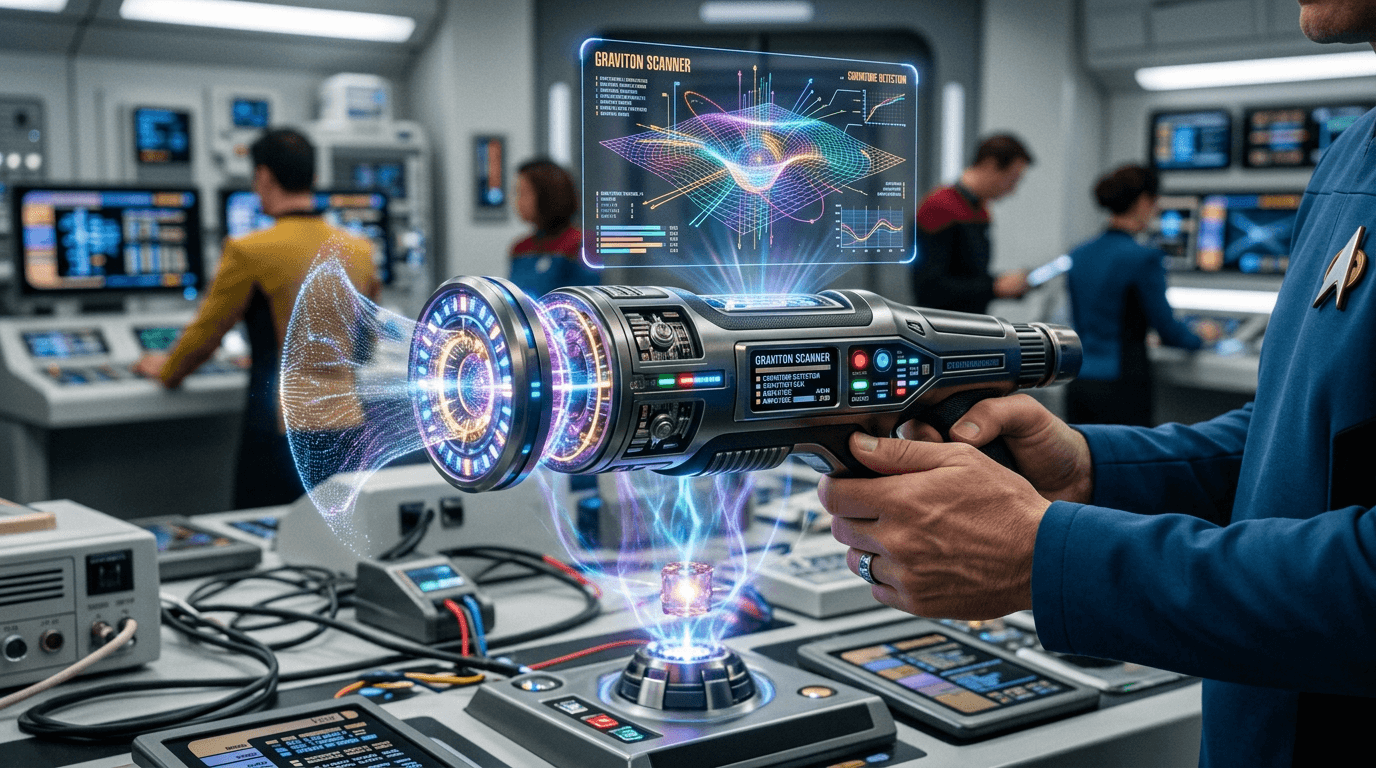
Graviton Scanner
A graviton scanner is a speculative sensor technology conceived to detect and measure gravitational wave emissions, spacetime curvature variations, and theoretical graviton particles—the hypothetical quantum carriers of gravitational force. In science fiction narratives, particularly those involving faster-than-light travel or advanced propulsion systems, these devices are imagined to function by detecting minute fluctuations in local spacetime geometry, allowing operators to map gravitational fields with unprecedented precision. The theoretical basis draws from general relativity's description of gravity as curved spacetime and quantum field theory's prediction of force-carrying particles, though gravitons remain undetected in real physics. Such scanners would theoretically measure gradient differentials in spacetime curvature, identify anomalous mass distributions, and detect the gravitational signatures of exotic phenomena like wormholes, artificial gravity wells, or cloaked vessels that might distort background gravitational fields even while remaining optically invisible.
Within speculative military and exploration scenarios, graviton scanners serve multiple strategic functions that address fundamental challenges of operating in deep space or near massive celestial bodies. They appear in narratives as navigation aids when approaching neutron stars, black holes, or other extreme gravitational environments where conventional sensors might fail or provide insufficient warning of tidal forces. The technology also features prominently in detection scenarios, where adversaries might employ visual cloaking or stealth technologies—graviton scanners would theoretically reveal such hidden objects through their unavoidable gravitational signatures or through micro-lensing effects they create in background starlight. Additionally, these devices are depicted as diagnostic tools for monitoring the structural integrity of spacecraft operating artificial gravity systems or warp field generators, detecting field leakage or instabilities before catastrophic failure occurs. This narrative role reflects broader themes in science fiction about the impossibility of truly hiding mass-energy and the strategic importance of detecting what cannot be seen through electromagnetic means.
The plausibility of graviton scanners remains firmly in the realm of speculation, constrained by fundamental gaps between current physics and the imagined technology. While gravitational wave detectors like LIGO have successfully measured ripples in spacetime from cosmic events, these instruments require kilometer-scale interferometers and can only detect extraordinarily powerful sources like merging black holes. Scaling such sensitivity down to a shipboard scanner capable of detecting individual vessels or mapping local gravitational topology would require breakthroughs in quantum gravity theory, the confirmed existence and detectability of individual gravitons, and sensor technologies orders of magnitude more sensitive than anything currently conceivable. The concept assumes a unified quantum theory of gravity that remains elusive despite decades of theoretical work. For graviton scanners to transition from narrative device to plausible technology would require not merely incremental improvements but revolutionary advances in our understanding of spacetime itself, along with materials and detection methods that can measure quantum gravitational effects at practical scales and timescales.
Research this in Signals
Signals turns a topic into a sourced research record you can inspect and rerun. Your first scan is free, and this one starts with Graviton Scanner already loaded, so edit it or scan as is.