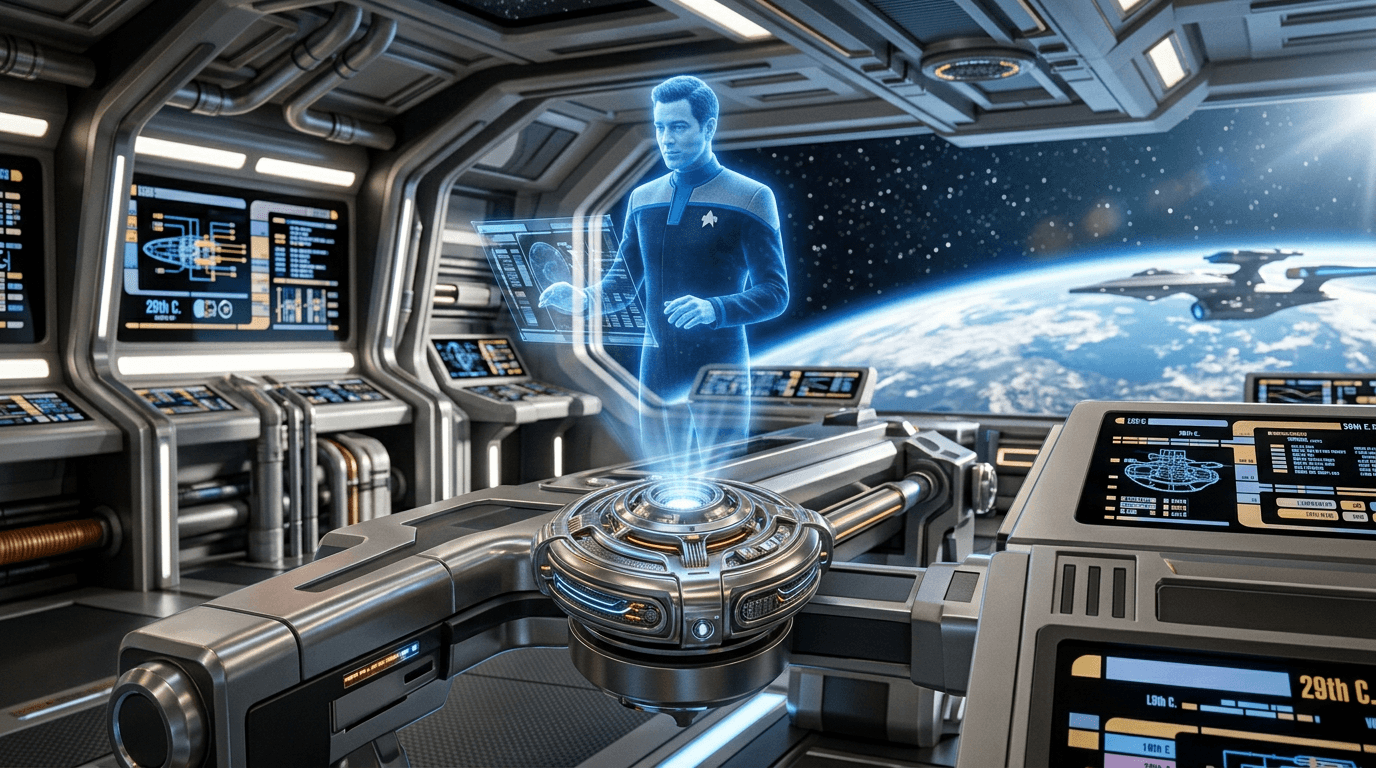
Mobile Holographic Emitter
The mobile holographic emitter represents a conceptual breakthrough in projected matter technology, imagined as a self-contained device that generates and sustains a complete holographic matrix independent of external infrastructure. In fictional depictions, particularly within Star Trek's narrative universe, this 29th-century technology solves a fundamental constraint of holographic systems: their dependence on fixed emitter arrays and environmental controls. The device theoretically combines several advanced capabilities into a compact unit—autonomous power generation sufficient to maintain complex photonic matrices, quantum field manipulation to create tangible light-based structures, and sophisticated computing systems capable of processing the immense data requirements of a sentient holographic entity. Unlike contemporary holographic projection, which requires carefully controlled environments with wall-mounted emitters and force field generators, the mobile emitter would function as a complete holographic ecosystem in miniature, projecting stable, interactive light constructs anywhere its user travels.
Within science fiction narratives, the mobile emitter serves as a narrative device that liberates holographic characters from spatial constraints, transforming them from location-bound programs into autonomous entities capable of participating fully in storylines beyond designated holo-environments. This technology appears most prominently in scenarios exploring artificial consciousness and the rights of synthetic beings, where granting physical mobility to holographic intelligences raises questions about personhood, agency, and the boundaries between organic and artificial life. The concept connects tangentially to real-world research in volumetric displays, light field technology, and plasma-based aerial projection systems, though current implementations remain orders of magnitude less sophisticated—limited to simple shapes, requiring significant external equipment, and incapable of producing the tactile feedback or autonomous operation depicted in fictional accounts. The mobile emitter also intersects with broader speculative discussions about miniaturized fusion power, quantum computing, and the theoretical limits of information density.
From a plausibility standpoint, the mobile emitter concept faces extraordinary physical and engineering constraints that place it firmly in the realm of far-future speculation. Current holographic technology relies on interference patterns, projection surfaces, or suspended particles, none of which approach the "hard light" constructs imagined in fiction. Creating tangible holographic matter would require manipulating electromagnetic fields at intensities and precisions beyond present capabilities, while the power requirements for maintaining a complex, mobile holographic matrix would demand energy storage densities far exceeding anything in contemporary battery or reactor technology. The computational challenge of real-time rendering and physical simulation for a sentient holographic being would require processing capabilities that dwarf current quantum computing prototypes. Significant breakthroughs in multiple fundamental physics domains—particularly in electromagnetic confinement, energy miniaturization, and perhaps entirely new approaches to matter-energy interaction—would be prerequisites for anything resembling functional mobile holographic emitters. While the concept remains valuable for exploring philosophical questions about consciousness and embodiment in speculative contexts, the technology itself represents an aspirational endpoint rather than a near-term development trajectory.
Research this in Signals
Signals turns a topic into a sourced research record you can inspect and rerun. Your first scan is free, and this one starts with Mobile Holographic Emitter already loaded, so edit it or scan as is.