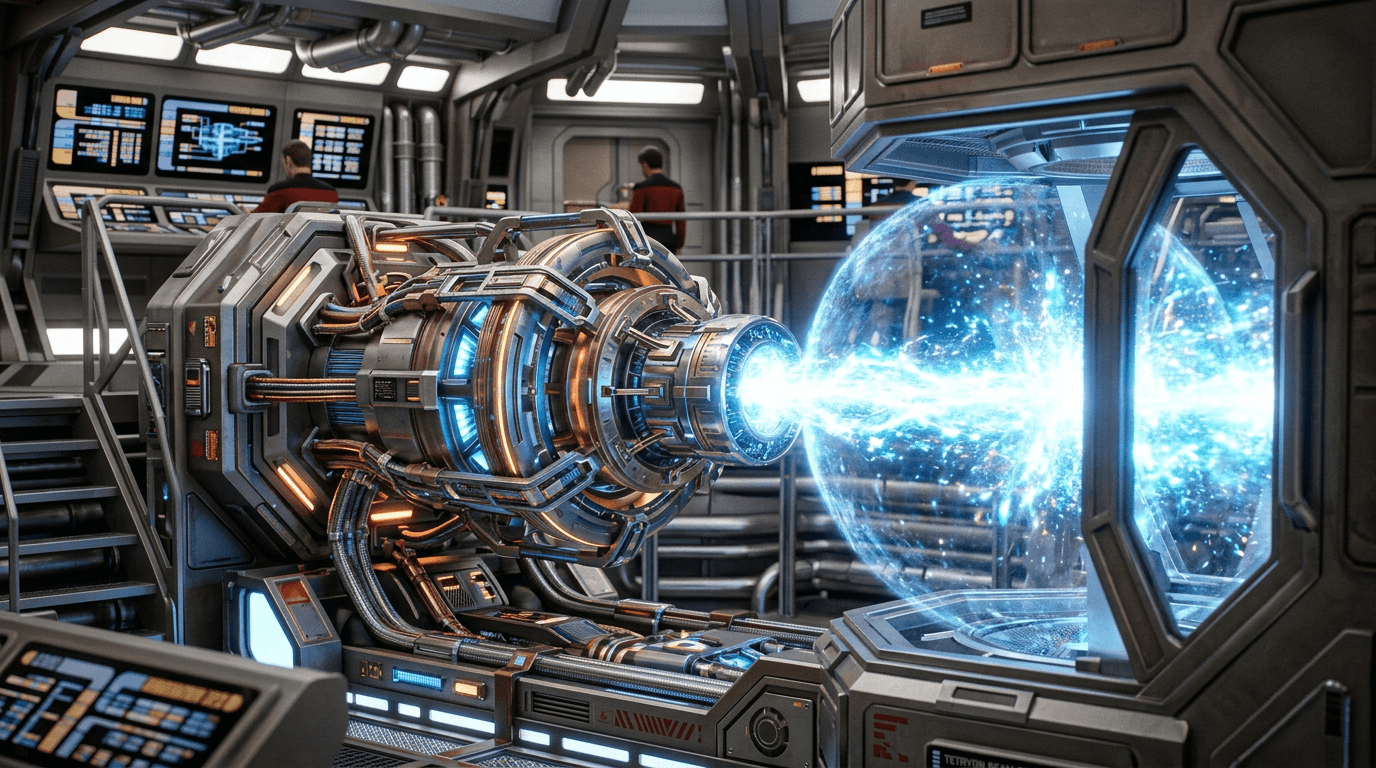
Tetryon Beam Emitter
The Tetryon Beam Emitter represents a speculative directed-energy weapon concept rooted in the fictional physics of subspace interaction. Unlike conventional particle beams that rely on accelerated baryonic matter (protons, neutrons, or ions), this system is imagined to generate and project tetryons—hypothetical non-baryonic particles that exist partially within normal space and partially within subspace layers. The proposed mechanism involves creating a controlled subspace field fluctuation that generates these exotic particles, then channeling them through a focusing array that maintains their coherence across distances. The tetryon particles are theorized to possess unique properties that allow them to bypass or destabilize conventional electromagnetic shielding by exploiting the boundary between normal space and subspace, creating cascading energy disruptions in defensive systems. This concept appears primarily in science fiction narratives exploring advanced space combat, where it serves as a counterpoint to traditional energy weapons and provides tactical variety in fictional military engagements.
Within speculative military frameworks and narrative contexts, the tetryon beam concept addresses a recurring strategic challenge: the escalating effectiveness of defensive technologies that render conventional weapons obsolete. Science fiction universes frequently depict arms races between shield technology and weapons development, and the tetryon emitter occupies a niche as a shield-penetrating or shield-degrading system. Its narrative role often emphasizes environmental dependency—the weapon's effectiveness increases dramatically in regions where subspace boundaries are already weakened, such as nebulae with high concentrations of exotic particles, areas near subspace anomalies, or zones affected by previous weapons fire. This environmental sensitivity creates tactical depth in fictional scenarios, rewarding commanders who can exploit terrain advantages. The concept also appears in technology assessment exercises that explore how hypothetical physics breakthroughs might reshape strategic calculations, even when those breakthroughs remain firmly in the realm of speculation.
From a scientific plausibility standpoint, tetryon beam emitters face fundamental obstacles rooted in our current understanding of physics. The concept requires the existence of stable non-baryonic particles with controllable properties, a form of accessible subspace or extra-dimensional space, and mechanisms to generate and direct such particles with precision—none of which have experimental support. While real-world physics includes non-baryonic matter in the form of dark matter and various exotic particles predicted by theoretical frameworks, these do not behave as the tetryon concept suggests, and no known process could weaponize them in the manner described. The technology would require revolutionary advances in our understanding of spacetime structure, the development of entirely new physical theories that predict and describe subspace phenomena, and engineering breakthroughs in exotic particle generation and containment. Current directed-energy weapon research focuses on lasers, particle accelerators, and microwave systems—all operating within well-understood physics—with no parallel development path toward subspace-coupled weapons. The tetryon beam emitter remains a narrative device that explores the tactical implications of hypothetical physics rather than a technology with foreseeable development pathways, serving primarily as a thought experiment in how exotic physical phenomena might reshape strategic thinking if fundamental physics were radically different from our current models.
Research this in Signals
Signals turns a topic into a sourced research record you can inspect and rerun. Your first scan is free, and this one starts with Tetryon Beam Emitter already loaded, so edit it or scan as is.