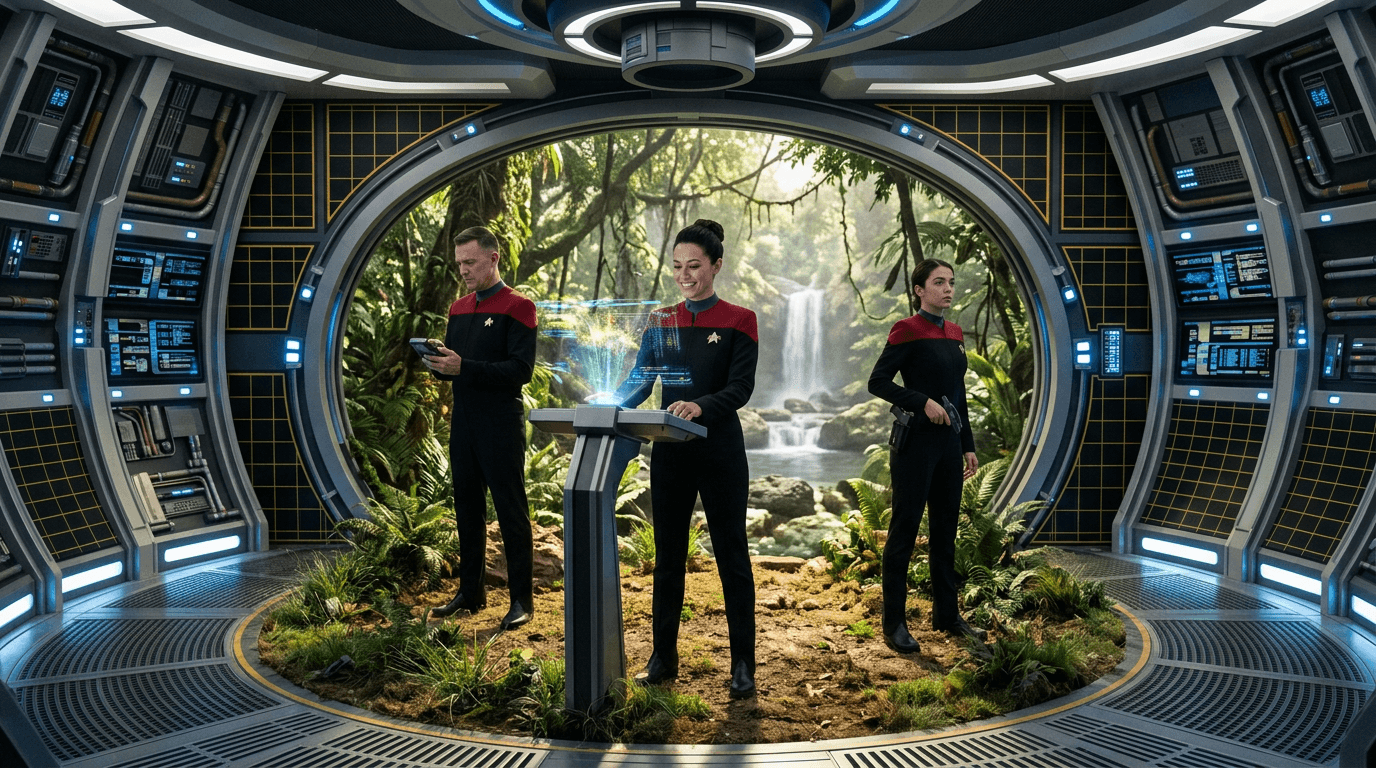
Holodeck
The holodeck represents one of science fiction's most ambitious visions for immersive simulation technology, combining multiple speculative systems into a single integrated environment. As depicted in narrative frameworks, particularly Star Trek, the concept relies on three theoretical pillars: advanced holographic projection capable of creating three-dimensional images indistinguishable from reality, force field generation that provides tactile feedback and physical resistance, and matter replication systems that can temporarily manifest objects with genuine mass and substance. The imagined mechanics suggest that photons and force fields work in concert to create convincing visual and physical experiences, while sophisticated computer systems manage the simulation's responsiveness to user actions. In some fictional implementations, the technology can even replicate food, clothing, and other consumable items, though these typically dissipate when removed from the holodeck environment. The system's theoretical architecture would require extraordinary computational power to maintain real-time physics simulations, render photorealistic environments, and coordinate multiple simultaneous users within a shared virtual space.
Within speculative technology discourse, the holodeck serves as a thought experiment for exploring the boundaries between physical and virtual experience. Defense analysts and training specialists have long been interested in the concept's potential applications for tactical preparation, allowing personnel to rehearse complex scenarios without real-world risk or resource expenditure. The narrative function of safety protocols—programmable limits that prevent simulated threats from causing actual harm—raises genuine questions about how future immersive systems might balance realism with user protection. Current research in virtual reality, haptic feedback systems, and spatial computing represents incremental progress toward holodeck-like capabilities, though each component remains far from the seamless integration depicted in fiction. Experimental haptic technologies can provide limited tactile sensations, while volumetric display research explores methods for creating three-dimensional images without headsets, yet these efforts remain constrained by fundamental physical and engineering limitations.
The plausibility of holodeck technology depends on breakthroughs that currently exist only in theoretical physics or remain entirely speculative. Force field generation as depicted—creating solid surfaces from energy alone—has no demonstrated real-world equivalent and would require manipulation of fundamental forces in ways not currently understood. Matter replication through transporter-like systems confronts both the enormous energy requirements of matter-energy conversion and unresolved questions about quantum information transfer. While augmented and virtual reality technologies continue advancing, creating experiences that feel increasingly immersive, the gap between current capabilities and holodeck-level simulation remains vast. The concept's enduring appeal in futures thinking stems less from near-term feasibility than from its value as a design target, encouraging researchers to imagine what truly seamless human-computer interaction might eventually achieve. Any path toward holodeck-like systems would likely involve decades of incremental progress across multiple scientific disciplines, assuming no fundamental physical barriers prevent such integration entirely.
Research this in Signals
Signals turns a topic into a sourced research record you can inspect and rerun. Your first scan is free, and this one starts with Holodeck already loaded, so edit it or scan as is.