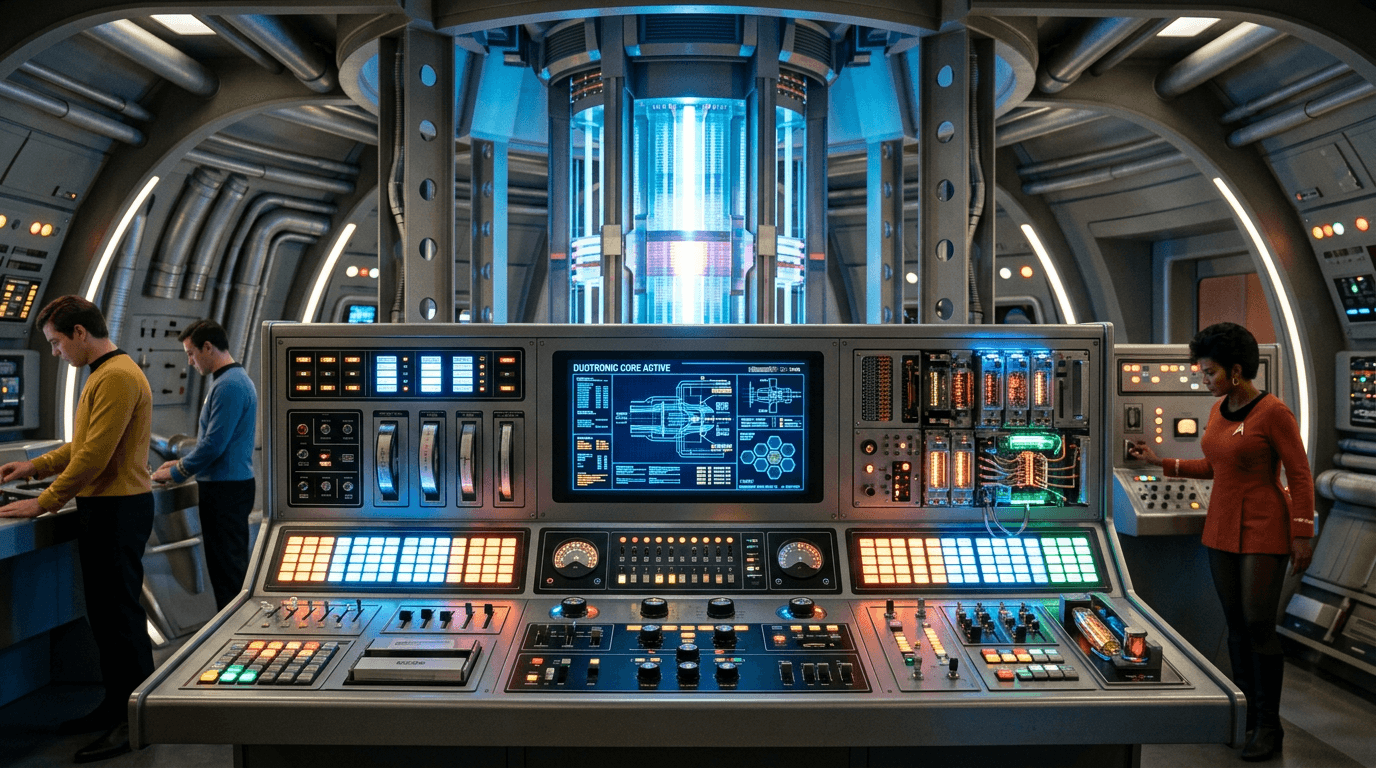
Duotronic Computer
Duotronic computing represents a conceptual architecture from science fiction narratives, specifically the Star Trek universe, characterized by dual-pathway logic processing that enabled early starship operations and station management. The imagined system relies on paired processing channels—hence "duo"—that theoretically allow for redundant verification of computational results and fault-tolerant operation in environments where system failure could prove catastrophic. Unlike contemporary binary computing, which processes information through single sequential pathways, duotronic architecture is envisioned as inherently parallel, with multiple logic streams operating simultaneously across crystalline or solid-state substrates. This fictional framework established standardized interfaces across diverse spacecraft and facility types, suggesting a universal computing platform that could support everything from navigation and life support to tactical systems and scientific analysis. The concept emerged during a period when real-world computing was transitioning from vacuum tubes to transistors, and the narrative extrapolation imagined what massively parallel, miniaturized systems might eventually enable.
Within the narrative context of speculative technology analysis, duotronic systems serve as a bridge concept between recognizable computing paradigms and more exotic future architectures. The fictional technology appears in scenarios requiring reliable, high-performance computation in isolated environments—deep space vessels, remote outposts, and exploration platforms where repair and replacement options are severely limited. This narrative role reflects genuine concerns in aerospace and defense computing: radiation hardening, fault tolerance, and the need for systems that can operate for extended periods without ground support. Real-world research into parallel processing, redundant architectures, and space-qualified computing shares some conceptual overlap with these fictional requirements, though the specific implementation of "duotronic pathways" remains purely speculative. The concept also establishes a technological progression narrative, positioning itself as a stepping stone toward even more advanced fictional systems like optical data processing and biological neural networks.
From a plausibility standpoint, duotronic computing as depicted exists entirely within fictional frameworks and should not be confused with actual deployed technologies. The core challenge lies in the unspecified mechanism by which "duotronic pathways" would function—whether through optical, quantum, or exotic material properties remains narratively ambiguous. Real parallel computing architectures do exist and continue to advance, from multi-core processors to distributed computing networks, but these operate on fundamentally different principles than the fictional duotronic model suggests. Any movement toward such systems would require breakthroughs in materials science, error correction at unprecedented scales, and novel approaches to heat dissipation in densely packed processing environments. The concept's value lies not in its technical feasibility but in its role as a thought experiment about computing evolution, standardization across complex systems, and the infrastructure requirements of future exploration scenarios. As with many speculative technologies, duotronic computing serves primarily as a narrative device to explore questions about technological dependency, system reliability, and the relationship between computational capability and operational scope.
Research this in Signals
Signals turns a topic into a sourced research record you can inspect and rerun. Your first scan is free, and this one starts with Duotronic Computer already loaded, so edit it or scan as is.