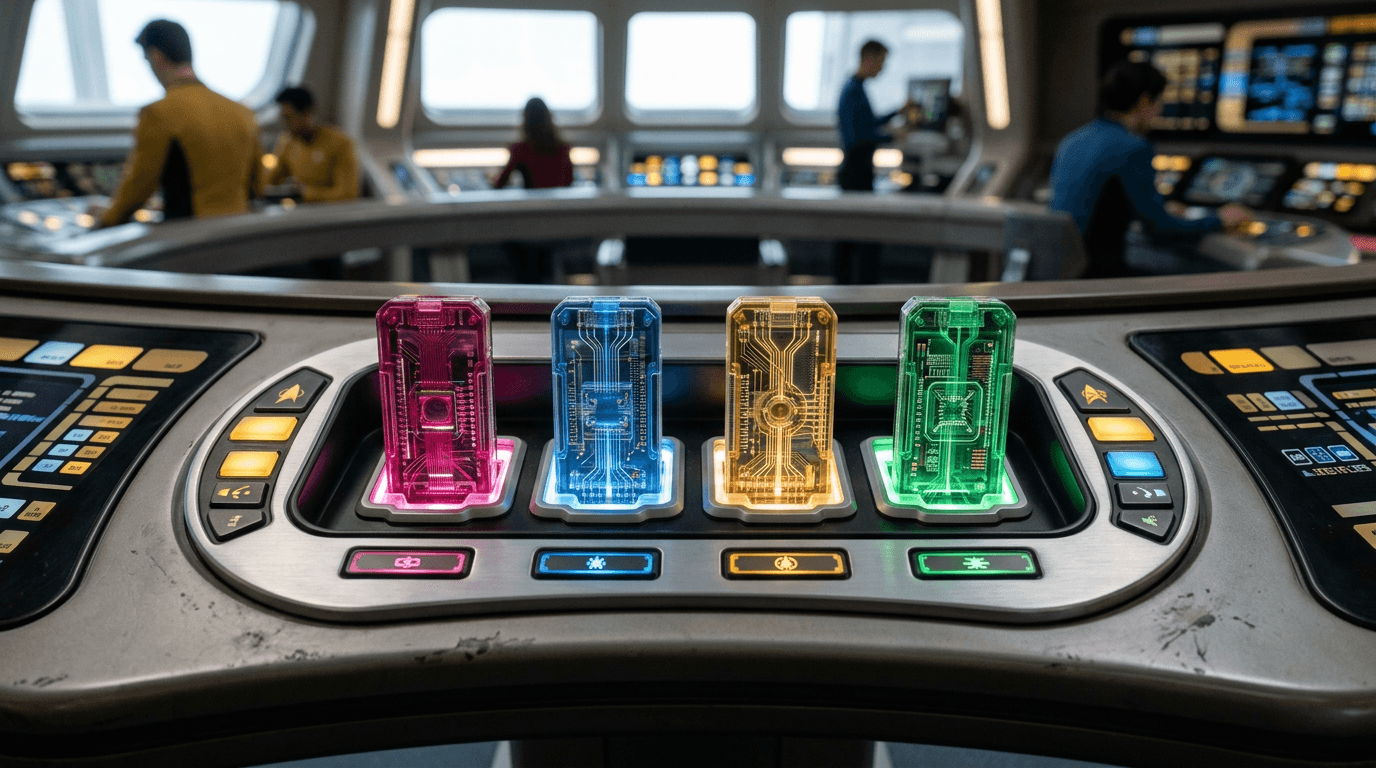
Isolinear Chips
Isolinear chips represent a speculative data storage architecture that appears prominently in science fiction narratives, particularly within Star Trek's technological framework. The concept envisions a crystalline or optical medium where data is encoded along linear pathways using light rather than electrical current. Unlike conventional silicon-based computing, isolinear circuitry theoretically operates through optical switching, where information flows through transparent substrates in discrete, parallel channels. This architecture suggests a fundamental departure from binary electronic logic, instead leveraging the properties of photons—such as wavelength, polarization, and phase—to encode vastly more information per unit volume. The "isolinear" designation implies that data pathways remain isolated from one another, preventing crosstalk while enabling multiple simultaneous read-write operations. In fictional depictions, these chips appear as small, removable modules that can store entire databases, ship systems, or complex programs, suggesting storage densities orders of magnitude beyond current solid-state technology.
Within narrative contexts, isolinear chips serve as a plot device that makes advanced starship operations plausible while remaining comprehensible to audiences. Their hot-swappable nature allows characters to physically manipulate ship systems, transfer data, or diagnose problems in ways that create dramatic tension and visual storytelling opportunities. This concept reflects broader science fiction themes about the miniaturization and acceleration of computing power, projecting forward from the trajectory of Moore's Law toward a future where petabytes of information fit in palm-sized objects. The technology also appears in strategic discussions about future computing paradigms, as real-world research into optical computing, photonic integrated circuits, and holographic data storage explores similar principles of using light for information processing. However, the fictional isolinear chips bypass numerous practical challenges that current optical computing research confronts, including thermal management, manufacturing precision, and the fundamental physics of light-matter interactions at nanoscale dimensions.
The plausibility of isolinear-like technology depends on several unresolved scientific and engineering challenges. While optical data transmission already dominates long-distance communications, creating stable, room-temperature optical logic gates and memory cells remains difficult. Current photonic research has demonstrated basic optical switches and waveguides, but achieving the integration density implied by isolinear chips would require breakthroughs in materials science, three-dimensional photonic crystals, and quantum optical phenomena. The fictional chips' apparent immunity to electromagnetic interference and radiation damage suggests exotic material properties not yet demonstrated in laboratory settings. For such technology to approach viability, advances would be needed in non-linear optical materials, ultra-precise nanofabrication, and perhaps room-temperature quantum effects that could enable the massive parallelism these devices imply. The concept remains firmly in the speculative realm, serving more as an aspirational vision for post-silicon computing than a near-term engineering target, though it continues to inspire researchers exploring the fundamental limits of information density and processing speed.
Research this in Signals
Signals turns a topic into a sourced research record you can inspect and rerun. Your first scan is free, and this one starts with Isolinear Chips already loaded, so edit it or scan as is.