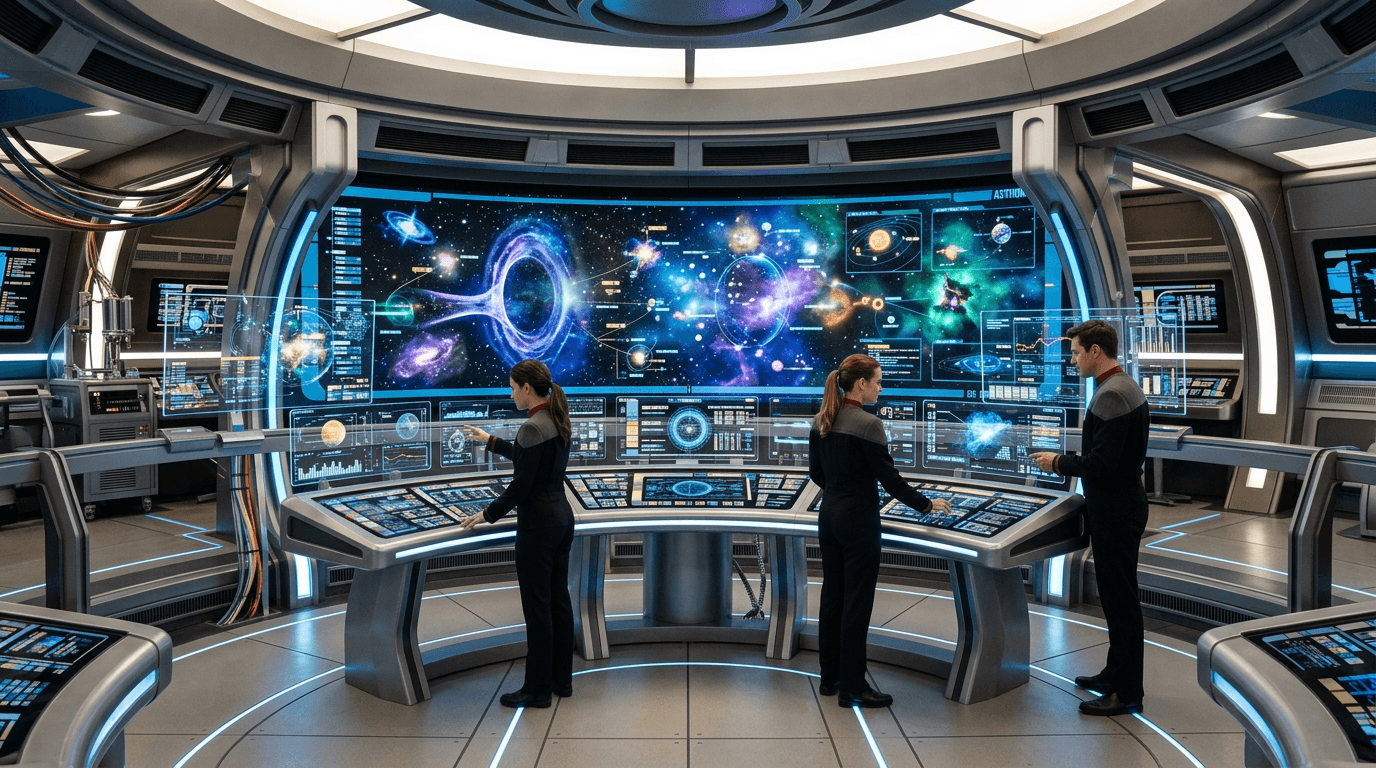
Astrometrics Lab
The astrometrics laboratory represents a specialized integration of sensor technology, computational analysis, and spatial visualization designed to map and understand the three-dimensional structure of stellar regions. Unlike traditional two-dimensional star charts, these facilities process multispectral data from telescopes, gravitational sensors, and electromagnetic detectors to construct dynamic models of space. The core concept involves correlating positional data from multiple observation points, accounting for relativistic effects and stellar motion, then rendering this information in formats that allow human operators to perceive spatial relationships across vast distances. While real-world astronomy relies on similar principles through facilities like radio telescope arrays and space-based observatories, the fictional astrometrics lab typically features real-time data synthesis and interactive three-dimensional displays that exceed current technological capabilities. The system's ability to rapidly update maps based on new sensor readings and model gravitational fields, subspace distortions, or other exotic phenomena remains largely speculative, though research in computational astrophysics and data visualization continues to advance.
Within science fiction narratives, particularly space exploration scenarios, the astrometrics laboratory serves as a critical decision-making hub where navigation routes are plotted, spatial anomalies are investigated, and tactical assessments are conducted. This facility appears frequently in strategic contexts because it addresses a fundamental challenge of interstellar travel: understanding the dynamic, three-dimensional nature of space where traditional navigation concepts break down. The lab's role extends beyond simple mapmaking to include predictive modeling of stellar phenomena, identification of safe passage routes through hazardous regions, and analysis of unusual spatial structures. Real-world parallels exist in mission control centers and astronomical research facilities, where teams synthesize data from multiple sources to track spacecraft, map asteroid fields, or study galactic structures. However, the fictional version typically assumes sensor technologies and computational speeds that allow near-instantaneous analysis of regions spanning light-years, a capability that remains beyond current reach.
The plausibility of advanced astrometrics facilities depends on several technological developments, some more achievable than others. Current astronomy already employs sophisticated data fusion techniques, combining observations from radio, optical, and gravitational wave detectors to build comprehensive models of cosmic structures. Advances in computational power, machine learning algorithms for pattern recognition, and volumetric display technology suggest that more sophisticated visualization systems could emerge within decades. The primary constraints involve the fundamental physics of observation—light-speed delays mean that any map of distant regions necessarily depicts the past, and detecting certain phenomena requires sensor sensitivities that may face theoretical limits. Speculative elements like real-time mapping across interstellar distances would require either faster-than-light communication or a network of distributed sensors far exceeding current space infrastructure. As astronomical survey projects expand and computational methods improve, we can expect increasingly sophisticated tools for spatial analysis, though the gap between current capabilities and the seamless, instantaneous systems depicted in fiction remains substantial. The concept's value lies less in its immediate technical feasibility and more in highlighting how future space operations would require fundamentally new approaches to understanding and navigating three-dimensional space.
Research this in Signals
Signals turns a topic into a sourced research record you can inspect and rerun. Your first scan is free, and this one starts with Astrometrics Lab already loaded, so edit it or scan as is.