Return-to-Play Orchestration Systems
Athletic injuries represent one of the most complex challenges in sports medicine, requiring careful coordination between medical professionals, coaching staff, and athletes themselves. Traditional return-to-play decisions have often relied on fragmented communication, subjective assessments, and inconsistent application of protocols across different stakeholders. This fragmentation can lead to premature returns that risk re-injury, or overly conservative timelines that unnecessarily sideline athletes. Return-to-Play Orchestration Systems address these challenges by creating a unified digital framework that standardizes and coordinates the entire rehabilitation journey. These platforms encode evidence-based, sport-specific protocols into structured workflows that integrate multiple data streams—from medical imaging and laboratory results to functional movement assessments and psychological readiness indicators. By establishing objective criteria at each stage of recovery, these systems transform what was once a largely subjective process into a data-driven progression model that all stakeholders can access and understand in real time.
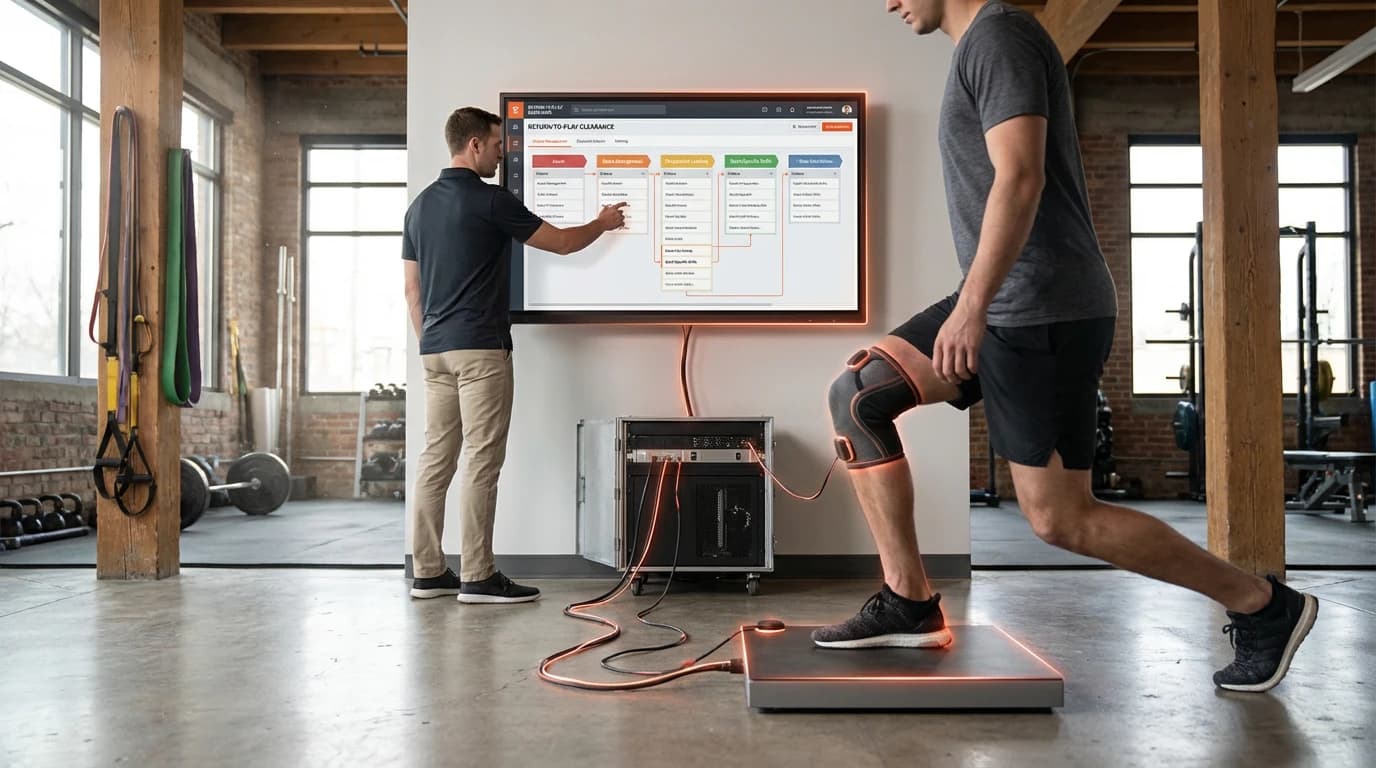
The core mechanism of these orchestration systems lies in their ability to aggregate disparate assessment modalities into a single decision-support framework. When an athlete sustains an injury, the platform automatically initiates the appropriate protocol based on injury type, severity, and sport-specific demands. As the athlete progresses through rehabilitation, the system tracks performance against predetermined benchmarks—such as range-of-motion thresholds, strength ratios between injured and uninjured limbs, neuromuscular control metrics from force plate testing, and sport-specific movement patterns captured through motion analysis. Each milestone serves as a gate that must be cleared before advancing to the next phase, ensuring that biological healing, functional capacity, and psychological confidence all align before clearance. The platform maintains a shared timeline visible to physicians, physical therapists, athletic trainers, strength coaches, and the athlete, eliminating the communication gaps that previously led to misaligned expectations or premature progression decisions.
Early implementations of return-to-play orchestration systems have emerged primarily in professional and collegiate sports environments, where the stakes of injury management are highest and resources for comprehensive monitoring are available. Research in sports medicine increasingly supports the value of objective, multi-factorial assessment over traditional time-based protocols, driving adoption among forward-thinking athletic departments and professional franchises. These systems are particularly valuable for concussion management, where invisible neurological recovery must be carefully tracked through cognitive testing, balance assessments, and exertion tolerance before contact clearance. As wearable sensor technology becomes more sophisticated and affordable, the potential exists to extend these orchestration platforms beyond elite athletics into youth sports and recreational contexts, where standardized injury management could significantly reduce re-injury rates and long-term complications. The trajectory points toward increasingly automated data collection, with real-time feedback during rehabilitation exercises and practice sessions informing dynamic protocol adjustments that personalize recovery timelines while maintaining safety standards.
Related Organizations

World leader in orthopedics and rheumatology.

The operating system for sports, integrating scheduling, communication, and performance data (via the acquisition of Smartabase) into a centralized hub.

Creator of measurement technologies like NordBord and ForceFrame used to screen for strength imbalances.

FDA-cleared markerless motion capture solution for musculoskeletal health and performance.

A FIFA Medical Centre of Excellence network specializing in sports rehabilitation.

Creators of Smartabase (now part of Teamworks), a human performance optimization platform.

Provides real-time tactical analysis via wearable sensors (UWB) and ball tracking, used heavily in the NBA and Handball.

Electronic Medical Record (EMR) platform designed specifically for athletic trainers.

Supporting Evidence
Research this in Signals
Signals turns a topic into a sourced research record you can inspect and rerun. Your first scan is free, and this one starts with Return-to-Play Orchestration Systems already loaded, so edit it or scan as is.