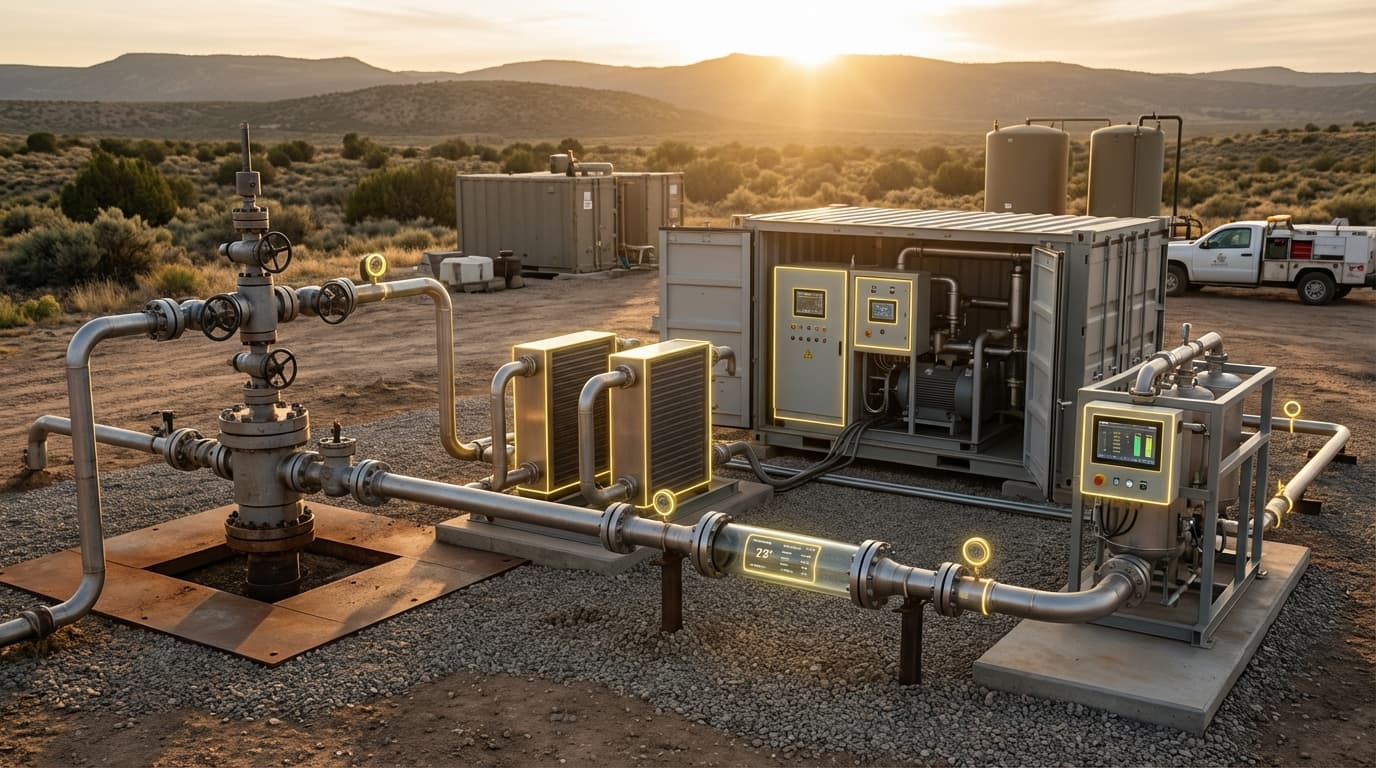
Geothermal Co-Production with Oil and Gas
The oil and gas industry faces mounting pressure to reduce carbon emissions while managing thousands of aging wells that continue to produce hot fluids alongside hydrocarbons. Geothermal co-production addresses this challenge by extracting usable energy and valuable minerals from the high-temperature brines that naturally accompany petroleum extraction. Rather than treating these hot fluids as waste requiring disposal, the technology captures their thermal energy through heat exchangers and binary cycle power systems, which use lower-boiling-point working fluids to drive turbines without directly exposing the brine to generating equipment. The process relies on the same subsurface reservoirs and wellbore infrastructure already in place, eliminating the substantial drilling and completion costs that typically make standalone geothermal projects economically marginal. By integrating thermal recovery systems into existing production facilities, operators can generate electricity for on-site operations, provide process heat for enhanced oil recovery or industrial applications, and extract dissolved minerals—particularly lithium, zinc, and rare earth elements—that command premium prices in battery and technology markets.
This dual-use approach solves several persistent problems in both the energy and extractives sectors. For oil and gas operators, it creates new revenue streams from assets that might otherwise be candidates for plugging and abandonment, extending field life and improving project economics even as hydrocarbon production declines. The technology also addresses the carbon intensity challenge by offsetting fossil fuel emissions with clean geothermal power generation, potentially reducing the lifecycle carbon footprint of produced oil and gas by 15 to 30 percent according to early field assessments. For regions dependent on extractive industries, co-production offers a pathway to economic diversification without wholesale abandonment of existing infrastructure and workforce expertise. Basin communities can transition petroleum engineering skills toward geothermal operations while maintaining employment and tax revenues. Additionally, the mineral recovery component addresses supply chain vulnerabilities in critical materials, particularly lithium for battery production, by creating domestic sources that don't require new mining operations or processing facilities built from scratch.
Pilot projects in mature oil fields across the Gulf Coast, California, and the Permian Basin have demonstrated technical feasibility, with some installations already delivering several megawatts of baseload power to regional grids. Research programs at national laboratories are refining brine chemistry management and scaling prevention techniques that have historically limited the lifespan of geothermal equipment exposed to mineral-rich fluids. The technology aligns with broader industry trends toward asset optimization and decarbonization, as major operators increasingly view thermal and mineral co-production as a hedge against volatile commodity prices and tightening emissions regulations. As battery demand intensifies and carbon pricing mechanisms expand, the economic case for retrofitting existing wells strengthens considerably. The approach represents a pragmatic bridge technology—one that acknowledges the continued role of hydrocarbon production while systematically reducing its environmental impact and building the technical foundation for eventual transition to pure geothermal systems once petroleum reserves are exhausted.
Related Organizations
Specializes in retrofitting existing oil and gas wells with closed-loop geothermal technology.
International energy producer utilizing geothermal co-production in Europe.

Develops GreenLoop technology to retrofit existing non-productive wells for geothermal power generation.

Federal agency funding energy research.

Develops advanced turbomachinery, including sCO2 compressors and turbines for NET Power and other applications.

Developing integrated lithium extraction and geothermal power in the Salton Sea.

Global technology company driving energy innovation.

Developing Zero Carbon Lithium extraction from geothermal brines in the Upper Rhine Valley.
Supporting Evidence
Research this in Signals
Signals turns a topic into a sourced research record you can inspect and rerun. Your first scan is free, and this one starts with Geothermal Co-Production with Oil and Gas already loaded, so edit it or scan as is.