Mineral Carbonation (CCU)
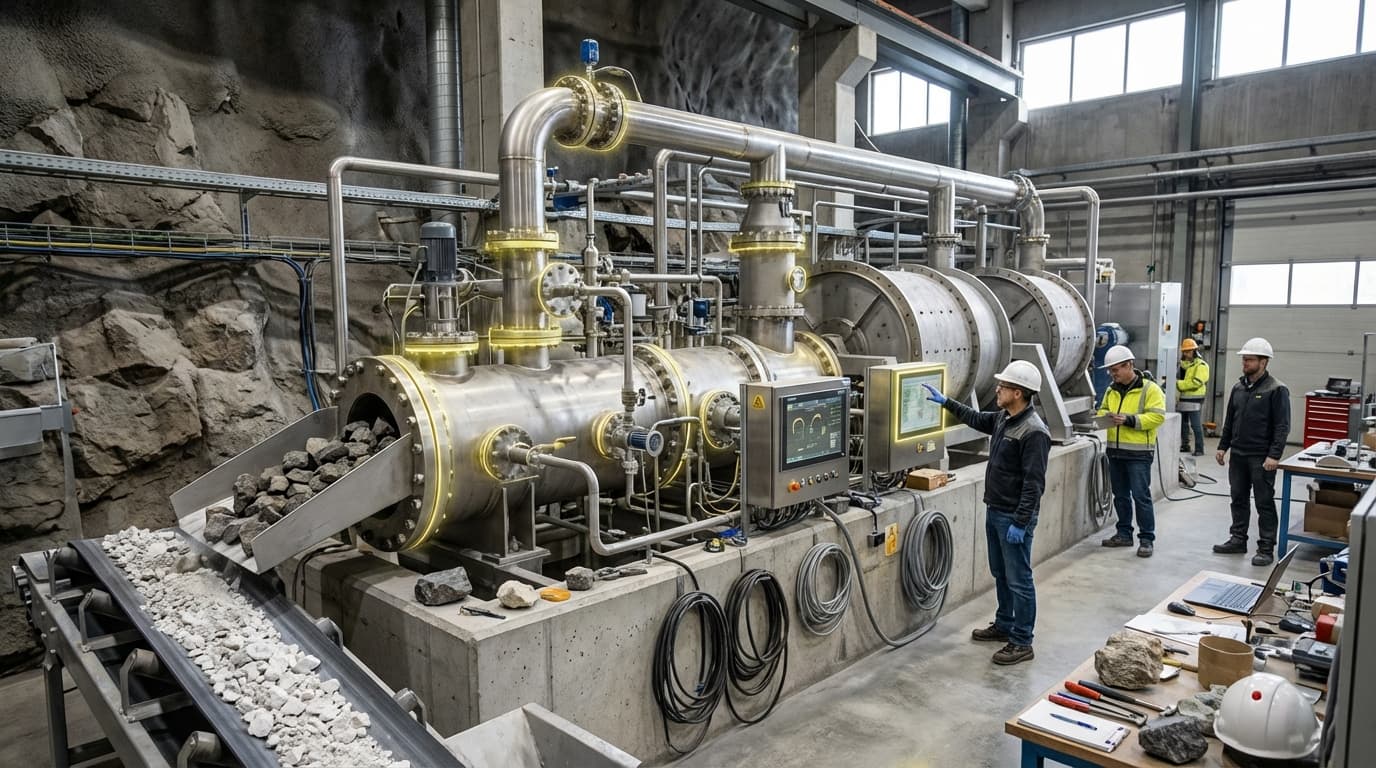
Mineral carbonation represents a promising approach to permanent carbon dioxide storage by mimicking natural geological processes that occur over millennia, but accelerating them to industrial timescales. The technology works by reacting captured CO2 with calcium or magnesium-rich minerals—often sourced from mining waste streams such as tailings, slag, or other industrial byproducts—to form stable carbonate compounds. When CO2 comes into contact with these alkaline materials under controlled conditions, chemical reactions occur that bind the carbon into solid mineral forms like calcite or magnesite. Unlike geological sequestration, which relies on underground storage and carries risks of leakage, mineral carbonation creates thermodynamically stable products that will not release CO2 back into the atmosphere, even over geological timescales. The process can be enhanced through various methods including direct aqueous carbonation, where minerals are dissolved in water before reacting with CO2, or gas-solid carbonation, where CO2 gas directly contacts crushed mineral feedstock at elevated temperatures and pressures.
For heavy industry sectors facing mounting pressure to decarbonize, mineral carbonation addresses multiple challenges simultaneously. Mining operations generate vast quantities of mineral waste that pose environmental liabilities, requiring long-term management and remediation. By transforming these tailings into carbon sinks, companies can offset their operational emissions while reducing the footprint and environmental risk of waste storage facilities. The technology is particularly relevant for hard-to-abate sectors like cement, steel, and mining itself, where process emissions are inherent to production and cannot be eliminated through electrification alone. Research suggests that the carbonate products formed through this process can possess properties suitable for construction applications, potentially creating revenue streams from materials that would otherwise represent disposal costs. This dual benefit—permanent carbon storage combined with waste valorization—makes mineral carbonation an attractive option for industries seeking both environmental compliance and operational efficiency.
Early deployments of mineral carbonation systems are emerging at mining sites and industrial facilities worldwide, with pilot projects demonstrating the technical feasibility of integrating these systems into existing operations. The construction industry has shown particular interest in carbonate products as supplementary cementitious materials or aggregates, though widespread adoption depends on developing consistent quality standards and scaling production. Industry analysts note that the economics of mineral carbonation improve significantly when co-located with both CO2 sources and abundant mineral feedstocks, making mining regions with nearby industrial emitters ideal candidates for deployment. As carbon pricing mechanisms strengthen and regulations around mine waste management tighten, mineral carbonation is positioned to become an increasingly important tool in the industrial decarbonization toolkit, offering a pathway to transform legacy environmental liabilities into climate solutions while supporting the transition toward circular economy principles in extractive industries.
Related Organizations

Eliminates CO2 by mineralizing it in peridotite rocks found in abundance in Oman.

Accelerates carbon mineralization in mine tailings, specifically ultramafic rock waste.

Provides the geological storage solution for DAC plants by dissolving CO2 in water and injecting it into basaltic rock for mineralization.
Develops technology to transform CO2 into building materials and other valuable industrial products via mineral carbonation.

Turns captured CO2 into permanent solid carbonate materials for use in the construction industry.

Home to leading research on carbon mineralization in mine tailings, led by researchers like Greg Dipple.

Uses SkyCycle technology to capture carbon and mineralize it into calcium carbonate.

Leads the 'CarbonVault' project to research the carbonation potential of kimberlite tailings.

Uses limestone (calcium carbonate) looping to capture CO2 from the air, aiming for low-cost, scalable removal.

Mining giant that operates 'AutoHaul', the world's first fully autonomous, heavy-haul, long-distance railway system.
Supporting Evidence
Research this in Signals
Signals turns a topic into a sourced research record you can inspect and rerun. Your first scan is free, and this one starts with Mineral Carbonation (CCU) already loaded, so edit it or scan as is.