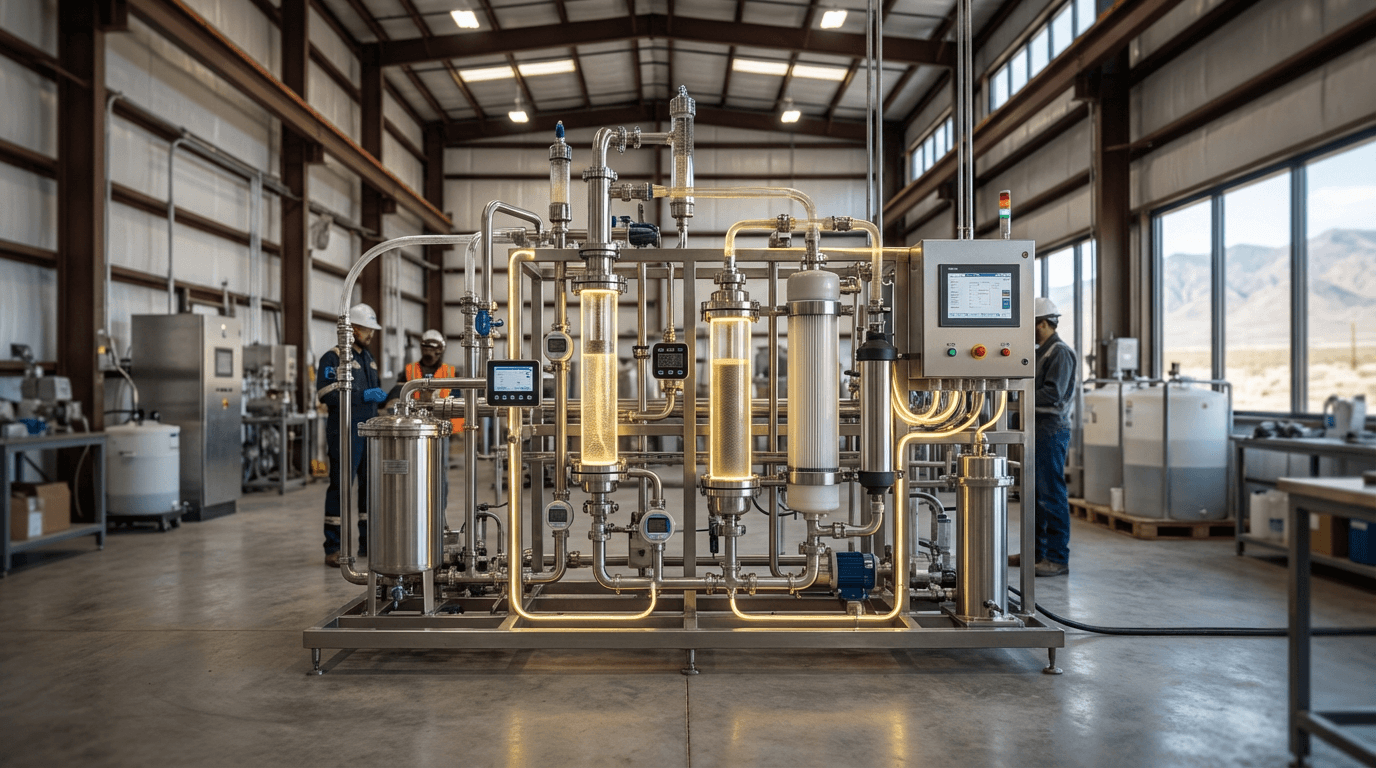
Direct Lithium Extraction (DLE)
Direct Lithium Extraction represents a fundamental shift in how lithium is recovered from brine sources, moving away from traditional evaporation pond methods that have dominated the industry for decades. Conventional extraction relies on pumping lithium-rich brines into vast shallow ponds where solar evaporation gradually concentrates the lithium over 12 to 18 months, a process that consumes enormous quantities of water and requires hundreds of acres of land. DLE technologies bypass this lengthy process entirely by employing selective separation mechanisms—including ion-exchange membranes, specialized adsorbent materials, or electrochemical systems—that can isolate lithium ions directly from brine solutions in a matter of hours or days. These systems work by exploiting the unique chemical properties of lithium ions, allowing them to pass through or bind to specific materials while rejecting other dissolved minerals like sodium, magnesium, and calcium that are typically present in much higher concentrations.
The mining and battery industries face mounting pressure to secure lithium supplies as electric vehicle production accelerates and grid-scale energy storage expands globally. Traditional evaporation methods are not only slow but also highly dependent on specific climatic conditions, limiting viable extraction sites to arid regions with consistent sunlight. Furthermore, conventional approaches typically recover only 30 to 50 percent of available lithium, leaving substantial resources untapped. DLE addresses these limitations by achieving recovery rates often exceeding 90 percent while operating independently of weather conditions. This efficiency unlocks previously uneconomical lithium resources, particularly in geothermal brines and oilfield co-produced waters where lithium concentrations may be lower or where evaporation ponds are geographically or environmentally impractical. The technology also dramatically reduces the environmental footprint of lithium production by minimizing water consumption—a critical consideration in water-scarce regions like Chile's Atacama Desert—and eliminating the need for massive surface disturbance associated with pond construction.
Several pilot facilities and early commercial operations have demonstrated DLE's viability across diverse geological settings, from the Salton Sea geothermal field in California to lithium-rich brines in Argentina. Industry analysts note that DLE could potentially double global lithium supply capacity within the next decade while addressing environmental and social concerns that have increasingly constrained traditional operations. The technology aligns with broader trends toward more sustainable and efficient resource extraction, offering a pathway to meet surging lithium demand without proportionally expanding the industry's water use and land footprint. As battery chemistry continues to evolve and alternative lithium sources gain economic viability, DLE positions itself as an essential bridge technology, enabling the extraction industry to respond more rapidly to market dynamics while reducing its environmental impact in regions where lithium resources and water scarcity intersect.
Related Organizations
Arcadium Lithium
United States · Company
Formed by the merger of Livent and Allkem; Livent has used a form of DLE commercially in Argentina for decades.

Developing LiTAS technology using mixed matrix membranes for direct lithium extraction.

Develops ion-exchange beads specifically designed to extract lithium from brine resources with minimal water loss.

Manufacturer of adsorption resins and provider of DLE turnkey systems, with commercial projects operating in China.

Developing Zero Carbon Lithium extraction from geothermal brines in the Upper Rhine Valley.

Uses nanotechnology to extract lithium from brine water with low energy consumption.

French mining group deploying its own DLE adsorption process at the Centenario project in Argentina.

Operating an industrial-scale DLE demonstration plant in Arkansas using the Smackover brine formation.
Develops liquid-liquid extraction technology for lithium recovery from brines.

Focuses on mobile, modular Direct Lithium Extraction plants designed for rapid deployment.
Supporting Evidence
Research this in Signals
Signals turns a topic into a sourced research record you can inspect and rerun. Your first scan is free, and this one starts with Direct Lithium Extraction (DLE) already loaded, so edit it or scan as is.