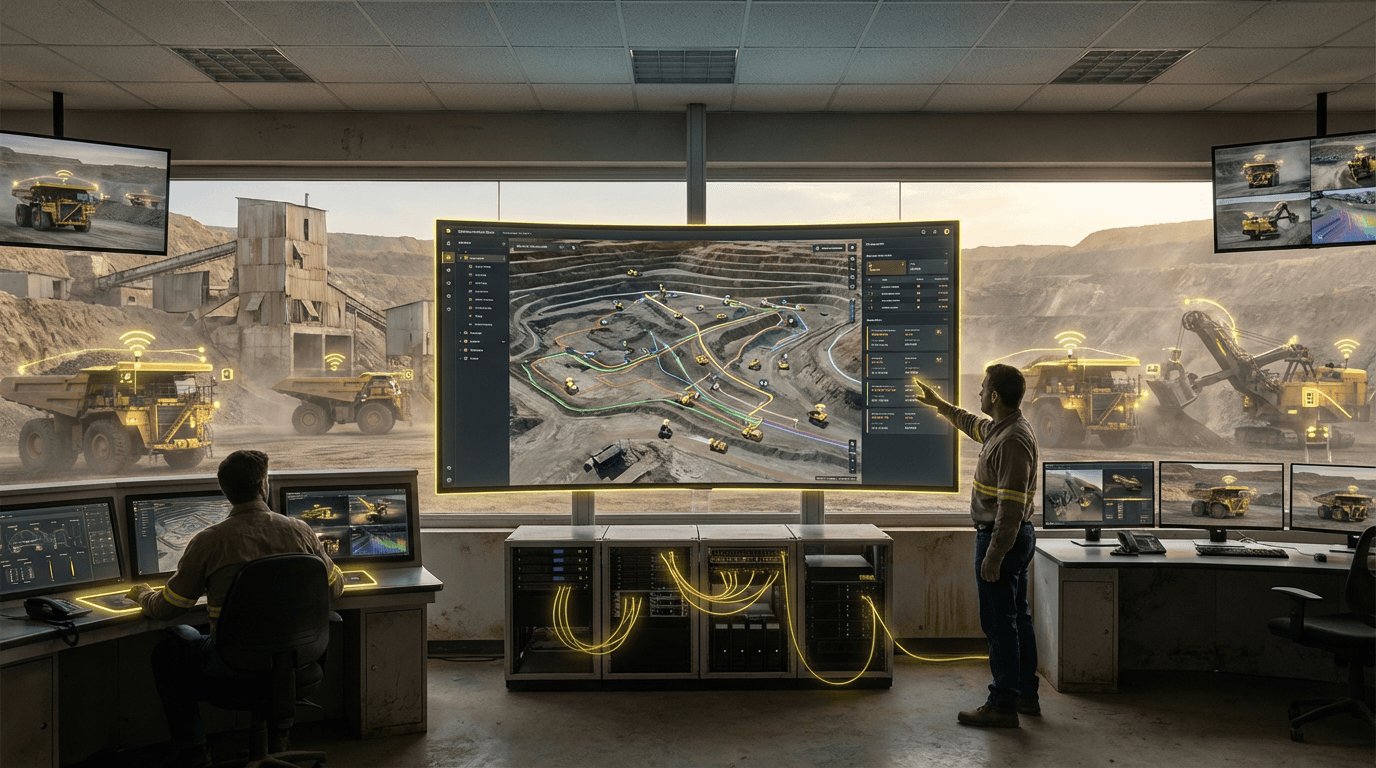
Autonomous Fleet Orchestration Software
Autonomous fleet orchestration software represents a sophisticated coordination layer designed to manage the complex interplay between autonomous and human-operated heavy equipment in mining and industrial environments. Unlike traditional fleet management systems that primarily track vehicle locations and fuel consumption, this technology actively plans and coordinates the movement, task allocation, and maintenance scheduling of diverse equipment types—from haul trucks and excavators to drilling rigs and support vehicles. The system operates through a central intelligence layer that processes real-time data from multiple sources: GPS positioning, equipment sensors, production schedules, geological models, and operator inputs. By synthesizing this information, the software generates dynamic route plans, optimizes loading sequences at pit faces, coordinates traffic at intersections and ramps, and schedules maintenance windows to minimize production disruption. The underlying algorithms must account for the fundamental differences between autonomous machines that follow programmed paths with precision and human operators whose behavior introduces variability, creating a hybrid operational environment that requires constant adaptation.
The mining and heavy industry sectors face mounting pressure to improve productivity while simultaneously enhancing safety and reducing operational costs. Traditional approaches to fleet coordination rely heavily on dispatcher expertise and radio communication, which become increasingly inadequate as operations scale and autonomous equipment proliferates. This orchestration software addresses the critical challenge of preventing conflicts between autonomous and manual equipment—a safety imperative that has historically slowed autonomous adoption in mixed fleets. By establishing digital traffic rules, virtual boundaries, and priority systems, the technology enables autonomous machines to operate at higher utilization rates while maintaining safe separation from human-operated equipment. The software also tackles the optimization problem inherent in large-scale operations: determining which truck should serve which shovel, when equipment should refuel, and how to respond when breakdowns or geological surprises disrupt planned sequences. Early deployments indicate that effective orchestration can increase equipment utilization by double-digit percentages while reducing fuel consumption and tire wear through more efficient routing.
Mining companies and heavy industrial operators are progressively implementing these systems as autonomous equipment becomes more prevalent in their fleets. The technology has moved beyond pilot programs at several major mining operations, where it manages fleets ranging from dozens to hundreds of machines across multi-kilometer sites. Current applications extend beyond simple point-to-point routing to encompass sophisticated scenarios such as coordinating blast schedules with equipment movements, managing congestion at crusher queues, and dynamically rebalancing fleet assignments as ore grades or equipment availability change throughout shifts. The software increasingly incorporates machine learning capabilities that refine operational strategies based on historical performance data, weather patterns, and equipment-specific characteristics. As the mining industry continues its trajectory toward higher levels of automation—driven by labor shortages, safety imperatives, and the pursuit of continuous operations—orchestration software is evolving into the central nervous system of modern mining operations. Future developments point toward tighter integration with mine planning systems, predictive maintenance platforms, and energy management solutions, creating a comprehensive digital ecosystem that optimizes not just individual equipment movements but entire value chains from extraction through processing.
Related Organizations
World's leading manufacturer of construction and mining equipment.
Industrial giant using thermoelectric generators via its subsidiary KELK to harvest waste heat in steel and manufacturing plants.
A developer of vendor-agnostic autonomous vehicle software and hardware systems for mining, farming, and automotive testing.


A major equipment manufacturer that has developed its own autonomous haulage solution, recently partnering with Fortescue to develop zero-emission autonomous trucks.

An autonomous driving startup focused on off-road and industrial environments, offering a simplified autonomy stack for haul trucks.
Provides autonomous vehicle software for mining and construction equipment.
Business area of Volvo Group dedicated to developing autonomous transport solutions for hub-to-hub freight.

A Hitachi Construction Machinery subsidiary providing open-standard fleet management systems.

Provides Universal Autonomy software applicable to industrial domains including mining and logistics.
Supporting Evidence
Research this in Signals
Signals turns a topic into a sourced research record you can inspect and rerun. Your first scan is free, and this one starts with Autonomous Fleet Orchestration Software already loaded, so edit it or scan as is.