










Cultivated meat
Cultured Meat Production
Growing animal meat from cells in bioreactors instead of raising livestock
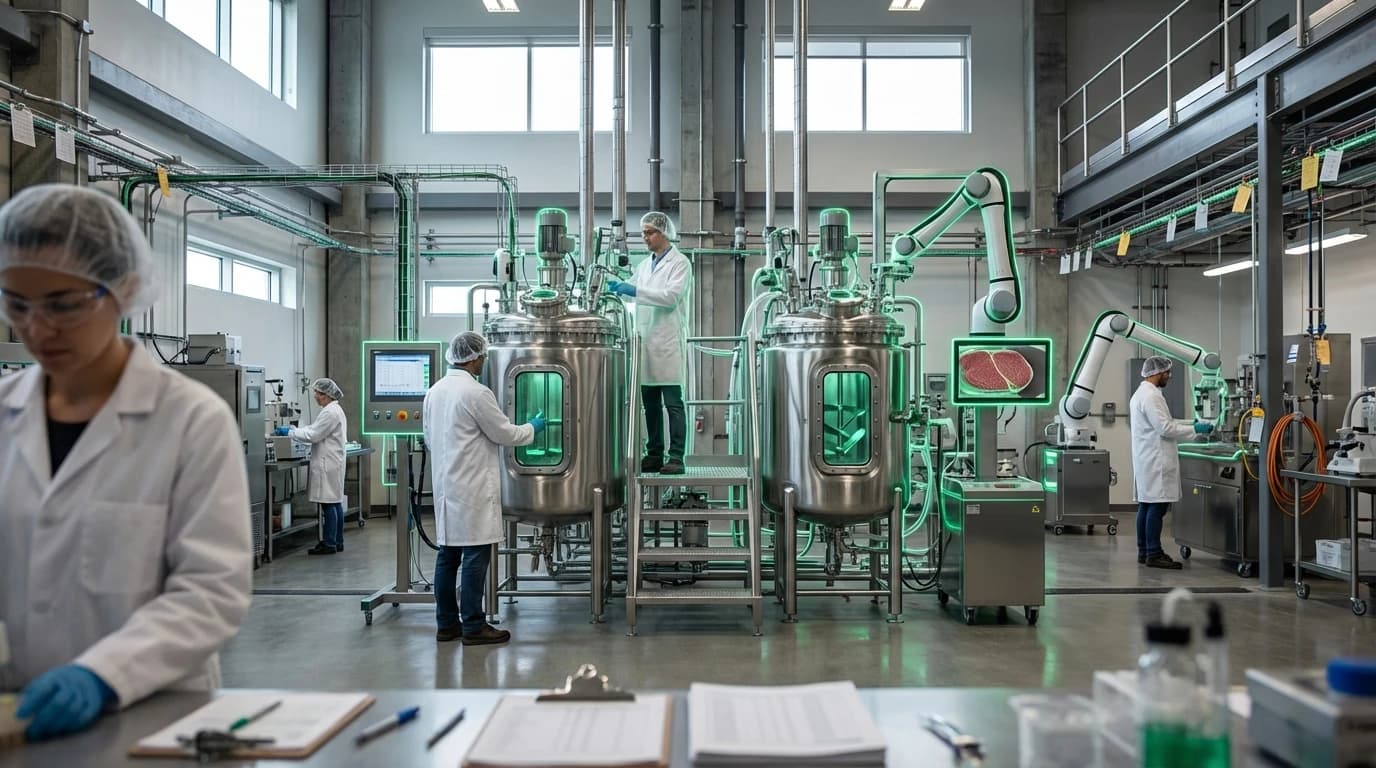
Cultured meat production represents a fundamental shift in how animal protein is manufactured, moving from traditional agriculture to controlled bioprocessing environments. The technology begins with the isolation of animal stem cells—typically muscle satellite cells or pluripotent stem cells—which are then expanded in carefully formulated serum-free culture media within industrial bioreactors. These cells grow on edible scaffolds or suspended microcarriers that provide the three-dimensional structure necessary for muscle tissue development. Advanced perfusion bioreactors continuously circulate fresh nutrients while removing metabolic waste, creating conditions that closely mimic the natural muscle development process inside an animal's body. Inline sensors monitor critical parameters such as glucose levels, lactate accumulation, pH, dissolved oxygen, and cell density in real time, enabling precise control over the cultivation environment. Cell-line banks maintain genetically consistent starter cultures, ensuring product uniformity and providing the traceability required by food safety regulators.
The primary challenge this technology addresses is the environmental and ethical burden of conventional livestock farming, which accounts for significant greenhouse gas emissions, land use, water consumption, and animal welfare concerns. Traditional meat production faces mounting pressure from climate targets, resource scarcity, and growing consumer awareness of industrial farming practices. Cultured meat production offers a pathway to decouple meat consumption from these impacts by producing genuine animal tissue without raising and slaughtering animals. Early commercial operations are focusing on hybrid products that combine cultivated fat cells with plant-based proteins, a strategy that reduces production costs while delivering the sensory experience consumers expect from meat. This approach also addresses one of the technology's most significant hurdles: the high cost of growth factors and culture media, which currently make pure cultivated meat substantially more expensive than conventional alternatives.
Regulatory approvals have begun in key markets, with Singapore becoming the first country to authorize cultured meat sales in 2020, followed by the United States granting clearance to producers in 2022 and 2023. Pilot-scale facilities operated by companies in this space are now producing thousands of kilograms annually, with expansion plans targeting bioreactor volumes in the tens of thousands of liters. These operations are exploring partnerships with established biopharma manufacturers who possess the sterile processing infrastructure and expertise needed for large-scale cell culture. Government support programs in Israel, the Netherlands, and elsewhere are funding research into cheaper media formulations, renewable energy integration for production facilities, and modular good manufacturing practice (GMP) systems that can be rapidly deployed in different regions. The path to mainstream adoption depends on continued cost reduction through economies of scale, development of animal-component-free growth factors, automation of harvesting and processing steps, and sustained consumer education efforts that build trust in this novel production method. As climate pressures intensify and global protein demand continues rising, cultured meat production stands positioned as a complementary technology within a diversified future food system that balances sustainability, nutrition, and consumer choice.
TRL
6/9Demonstrated
Impact
5/5
Investment
5/5
Category
Applications
Related Organizations
Division of Eat Just; the first company to sell cultivated meat commercially (in Singapore).
Developer
Dutch food technology company that created the world's first cultivated beef burger.
Developer
A leader in the cultivated meat industry, being the first to receive FDA green light for cultivated chicken in the US.
Developer
Focuses on growing high-quality cultivated beef steaks using 3D tissue engineering.
Developer
Formerly Future Meat Technologies, they are constructing one of the world's largest cultivated meat production facilities in North Carolina.
Developer
Uses opti-ox technology with pluripotent stem cells to produce cultivated pork and beef rapidly.
Developer
Develops cell-cultured seafood products, specifically focusing on high-value species like bluefin tuna.
Developer
Academic center dedicated to developing the scientific and engineering foundations of cellular agriculture.
Researcher
Australian company creating new food categories using cells from exotic animals (e.g., quail, mammoth DNA).
Developer
Cultivated chicken company operating a production-to-fork restaurant pilot in Tel Aviv.
Developer
Designs and engineers bioreactors specifically for the cultivated meat industry.
Developer
UK-based company developing cultivated pork and beef products.
Developer
What was expected
Published forecasts about this technology, graded against what happened in Hindsight.
Cultured Meat
Cultured Proteins
Lab-Grown Meat Is Going Mainstream
Biotech - Cultured or Artificial Tissue
This page is a narrower case of it.
Supporting Evidence
Evidence data is not available for this technology yet.
Research this in Signals
Scan Cultured Meat Production for yourself.
Signals turns a topic into a sourced research record you can inspect and rerun. Your first scan is free, and this one starts with Cultured Meat Production already loaded, so edit it or scan as is.