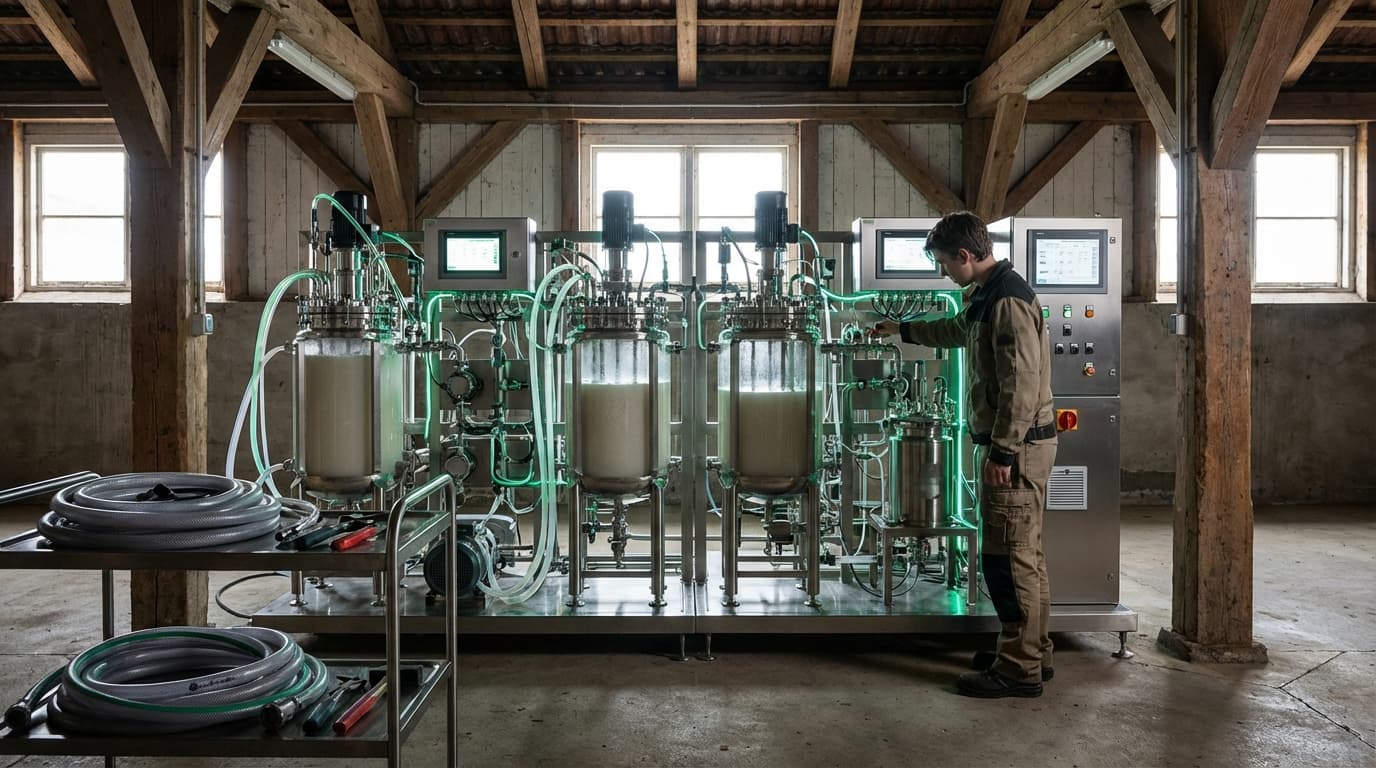
Advanced Fermentation Bioreactors
Advanced fermentation bioreactors are modular, continuous-flow systems equipped with perfusion loops, inline metabolite sensing, and automated sterility management, allowing operators to mimic microbial consortia or single-organism runs with minimal downtime. Skids plug into standard utilities, and software-defined recipes adjust oxygen transfer, impeller speed, and feedstock ratios in real time to maintain optimal growth kinetics for microbial proteins, mycelium biomass, or designer metabolites.
Food companies, bioplastics developers, and alternative leather startups deploy these systems to scale cellular agriculture without building greenfield stainless-steel plants. Platforms from companies like Prolific Machines, Solar Foods, and Quorn’s next-gen facilities demonstrate faster tech transfer from 5 L bench reactors to 50,000 L production by reusing standardized control software and single-use liners, cutting capex and contamination risk.
Looking ahead, integration with precision fermentation marketplaces and agricultural carbon credit schemes will let producers source feedstocks flexibly and monetize waste CO₂ utilization. Key bottlenecks involve sourcing bioreactor-grade enzymes, ensuring consistent sensor calibration across global fleets, and meeting stringent food safety audits. Continued advances in digital bioprocess twins and AI-guided control are expected to unlock broader localization of protein manufacturing.
Related Organizations

Offers cloud-connected bioreactors allowing companies to run high-throughput fermentation experiments remotely.

Develops the FAST (Fermentation Accelerated by Separation Technology) platform for continuous fermentation.

Operates an automated continuous fermentation platform to drive down the cost of biomanufacturing.

Building continuous fermentation manufacturing infrastructure to help biotech companies scale production.

Building a global network of automated fermentation facilities to enable industrial-scale biomanufacturing.

Liberation Labs
United States · Startup
Developing purpose-built precision fermentation biomanufacturing facilities.

A leading international partner of life science research and the biopharmaceutical industry, providing bioreactor hardware.

Produces Solein®, a protein made from air and electricity using gas fermentation (a subset of precision fermentation).

A financing and development platform for biomanufacturing infrastructure.
Supporting Evidence
Research this in Signals
Signals turns a topic into a sourced research record you can inspect and rerun. Your first scan is free, and this one starts with Advanced Fermentation Bioreactors already loaded, so edit it or scan as is.