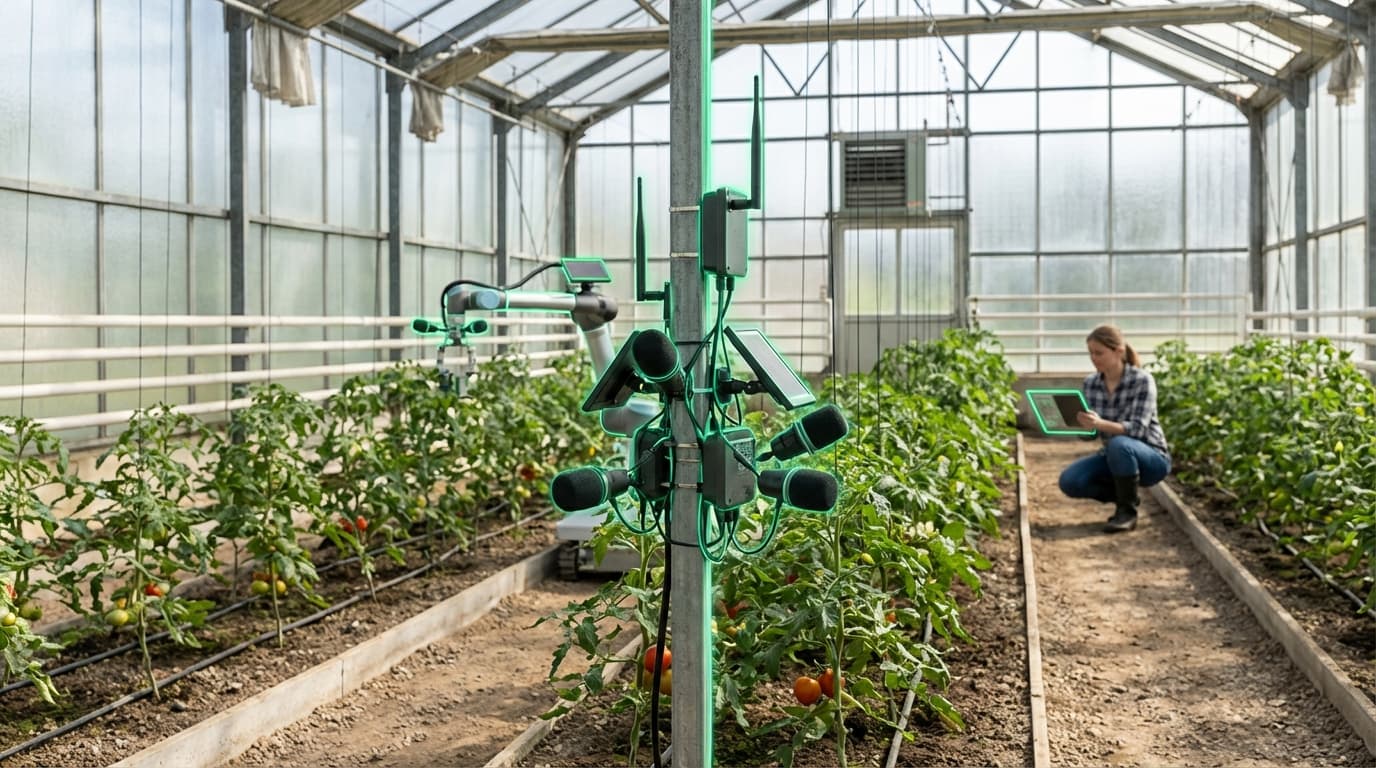
Acoustic Pest Monitoring Networks
Acoustic pest monitoring networks deploy distributed arrays of weatherproof microphones, piezoelectric vibration sensors, and on-device ML classifiers to identify insects by their wing-beat frequencies, mating calls, or chewing signatures. Nodes triangulate activity levels and transmit alerts to agronomists or autonomous sprayers, enabling interventions only where pest pressure crosses economic thresholds.
Horticulture operations, forestry agencies, and grain storage facilities use these systems to differentiate destructive pests from beneficial insects, schedule pheromone traps, or trigger biopesticide drones for hyper-targeted application. Field trials by firms like FaunaPhotonics and academic entomology labs show 60–80% reductions in broad-spectrum chemical sprays while preserving pollinators and natural predators.
Next-gen platforms will pair acoustic data with pheromone plume modeling and predictive analytics, but challenges remain in filtering wind or machinery noise, maintaining power for remote nodes, and curating regional sound libraries to keep ML models accurate. As acoustic signatures become part of integrated pest management playbooks, they will underwrite regenerative certifications and compliance reporting.
Related Organizations

Develops the 'Polly' device, a solar-powered acoustic sensor that listens for insect wingbeats to monitor pollinator and pest activity.

Created the FlightSensor, which uses optical sensors to detect the wingbeat frequency of insects entering a trap, classifying them in real-time.

Uses LIDAR-based sensors to detect insect wingbeat modulation and frequency in open fields.

The chief scientific in-house research agency of the U.S. Department of Agriculture.

Develops micro-drones that intercept pests, relying on advanced detection systems (infrared/acoustic principles) to locate targets.

A precision agriculture platform for permanent crops that deploys sensor networks (including camera/trap modules) to monitor pests.

A Spanish technical university with a dedicated research group focusing on acoustic sensors for early detection of Red Palm Weevil.

A data and insights company that acquired Spensa Technologies, the developers of the Z-Trap.

A global player in pollination and biological control that invests in and partners with high-tech monitoring startups (like Pats and AgriSound).

Provides automated pest monitoring traps that primarily use computer vision but are integrating multi-modal sensing.
Supporting Evidence
Research this in Signals
Signals turns a topic into a sourced research record you can inspect and rerun. Your first scan is free, and this one starts with Acoustic Pest Monitoring Networks already loaded, so edit it or scan as is.