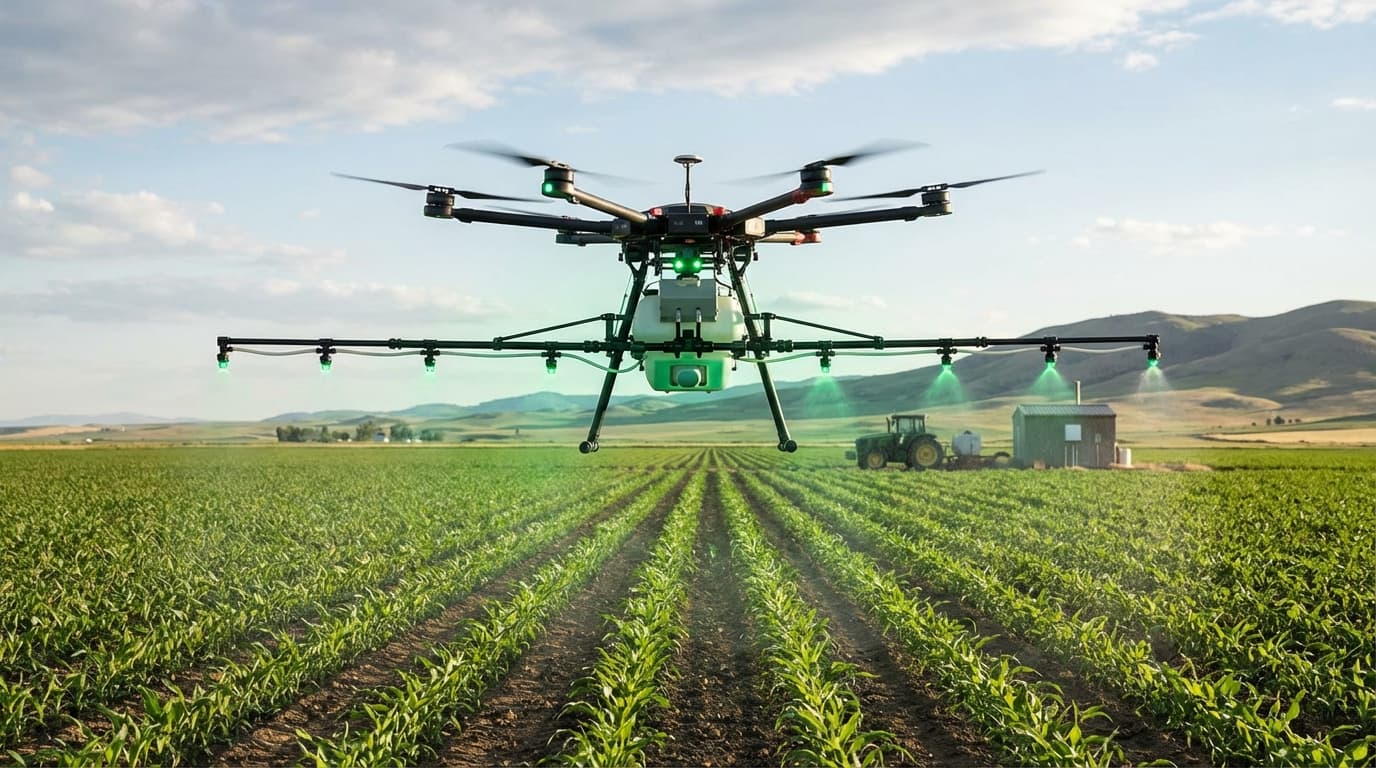
Drone-Based Crop Spraying
Drone-based crop spraying fleets combine high-payload UAVs (40–70 liter tanks), RTK navigation, terrain-following radar, and variable-rate nozzles to deliver pesticides, foliar feeds, biostimulants, or beneficial microbes exactly where needed. Mission planning software ingests digital elevation models and prescription maps, then dynamically adjusts droplet size, swath width, and spray height to maintain uniform coverage even over terraced or muddy fields off limits to tractors.
Custom applicators and cooperatives deploy these drones to complement or replace boom sprayers, reducing labor demand, chemical runoff, and soil compaction. Regulators in Asia, Latin America, and parts of Europe have already cleared night-time operations, and insurers are beginning to recognize the reduced drift risk when electrostatic nozzles and AI-based obstacle avoidance are used.
Future progress hinges on beyond-visual-line-of-sight approvals, autonomous battery swaps, and integration with biological inputs that require cold-chain handling. Challenges include training pilots, ensuring cybersecurity for fleet management platforms, and harmonizing airspace rules with crewed aviation. As these hurdles clear, drone spraying will become a standard tool for precision nutrient and crop protection management.
Related Organizations

The world's largest drone manufacturer, producing the Agras series of crop spraying drones.

Operates 'Community Notes' (formerly Birdwatch), the most prominent collaborative verification system at scale.

A Texas-based manufacturer of heavy-lift crop spraying drones and swarm control software.
Builds autonomous electric airplanes for crop protection and cargo transport.

A service platform connecting drone operators with farmers for legal, precise aerial application.

A global manufacturer known for its unmanned industrial helicopters used in agriculture.

India's leading manufacturer of agricultural drones, including the 'Agribot' sprayer.

A Brazilian drone company developing solutions for crop spraying and imaging.

German aircraft manufacturer specializing in multicopter designs like the VoloCity for inner-city flights.
Supporting Evidence
Research this in Signals
Signals turns a topic into a sourced research record you can inspect and rerun. Your first scan is free, and this one starts with Drone-Based Crop Spraying already loaded, so edit it or scan as is.