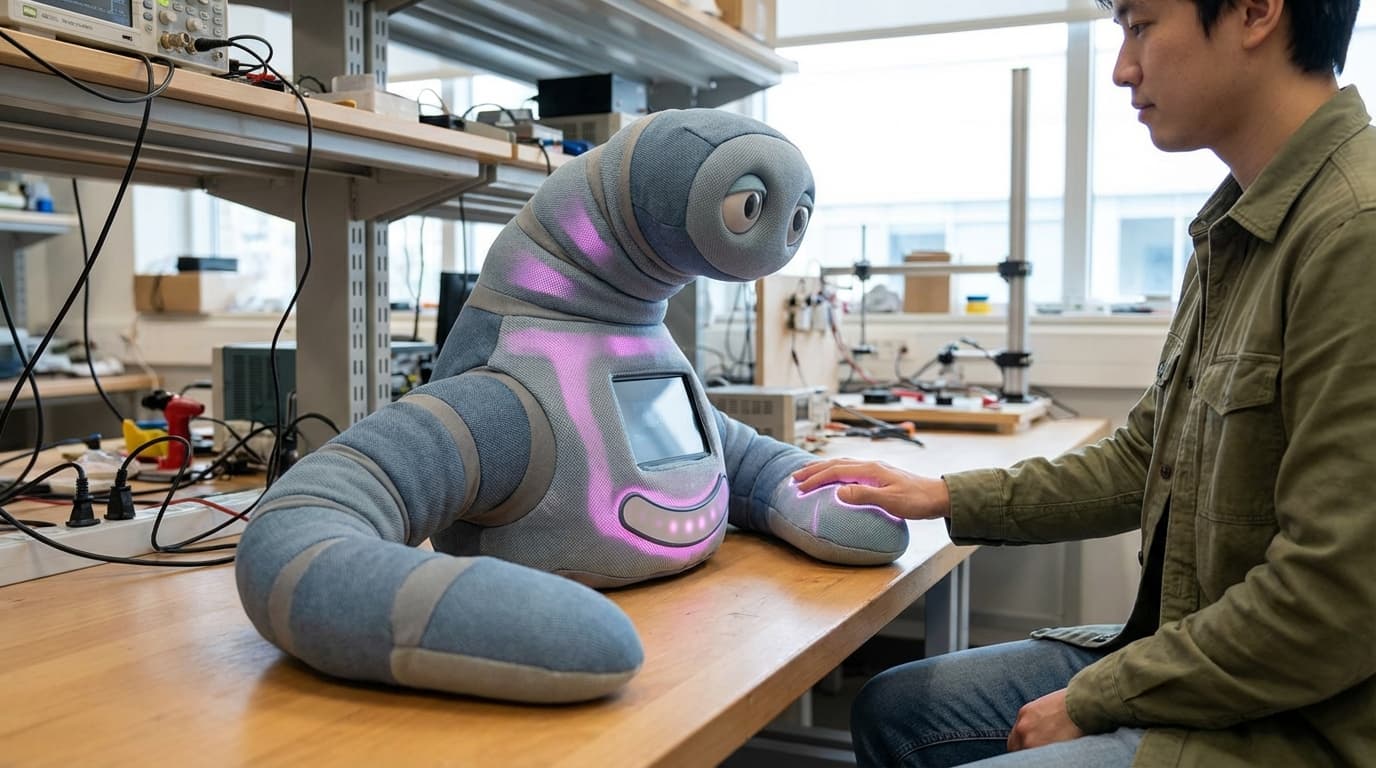
Soft Social Robots
Soft social robots represent a fundamental shift in robotic design philosophy, moving away from rigid metallic structures toward compliant, flexible materials that more closely mimic the properties of biological tissue. These systems employ elastomers, silicones, and other deformable materials in their construction, combined with pneumatic or hydraulic actuation systems that enable smooth, organic-like movements. Unlike traditional hard-bodied robots, soft social robots can deform and adapt their shape in response to external forces, making physical contact inherently safer and more comfortable for humans. The technical foundation draws from advances in materials science, particularly the development of soft actuators that can bend, stretch, and compress while maintaining precise control. This compliance allows the robots to navigate unpredictable human environments without the risk of injury from rigid components, while their tactile surfaces can incorporate pressure sensors and haptic feedback systems that enable responsive, gentle interactions.
The emergence of soft social robots addresses critical challenges in healthcare, eldercare, and therapeutic contexts where traditional rigid robots have proven inadequate or even counterproductive. Hard-surfaced robots can trigger anxiety or discomfort in vulnerable populations such as children, elderly individuals, or those with cognitive impairments, limiting their effectiveness in caregiving roles. Soft social robots overcome these barriers by presenting a less threatening physical presence that invites touch and close interaction. Research suggests that the tactile qualities of these robots—their warmth, softness, and yielding surfaces—can elicit more positive emotional responses and greater acceptance from users. This technology enables new possibilities in companion robotics, where the robot's primary function is social and emotional support rather than task completion. The compliant nature of these systems also allows them to operate safely in crowded or chaotic environments without extensive safety barriers, expanding the contexts in which human-robot collaboration can occur.
Early deployments of soft social robots have appeared in therapeutic settings, particularly for children with autism spectrum disorders and in eldercare facilities where they serve as companions for individuals experiencing loneliness or cognitive decline. These applications leverage the robots' approachable aesthetics and safe physical interaction capabilities to provide comfort, encourage social engagement, and support therapeutic interventions. The technology aligns with broader trends toward more human-centered design in robotics and the growing recognition that successful social robots must address emotional and psychological needs alongside functional capabilities. As materials science continues to advance and manufacturing costs decrease, soft social robots are positioned to play an increasingly important role in healthcare systems facing demographic pressures from aging populations. The integration of artificial intelligence with these physically compliant platforms promises robots that can not only move naturally but also respond empathetically to human emotional states, potentially transforming how we approach caregiving, therapy, and human-robot coexistence in shared spaces.
Related Organizations

Investigates soft robotics for safe human-robot interaction and expressive animatronics.

Developers of LOVOT, a companion robot designed to be loved and to nurture users' capacity for love.

A Japanese public research organization.

Major UK research center with a dedicated Soft Robotics group exploring biodegradable actuators and artificial muscles.

A research lab led by Rob Shepherd focusing on soft materials in robotics.

Research lab hosting Josh Tenenbaum's Computational Cognitive Science group, a leader in probabilistic programming and neuro-symbolic models.

German research institute actively developing exoskeleton test beds and evaluating human-machine interaction.

R&D arm of Toyota focusing on active safety, automated driving, and robotics.

Brussels Human Robotics Research Center.
Honda Research Institute
Japan · Research Lab
Honda's advanced research division.
Supporting Evidence
Research this in Signals
Signals turns a topic into a sourced research record you can inspect and rerun. Your first scan is free, and this one starts with Soft Social Robots already loaded, so edit it or scan as is.