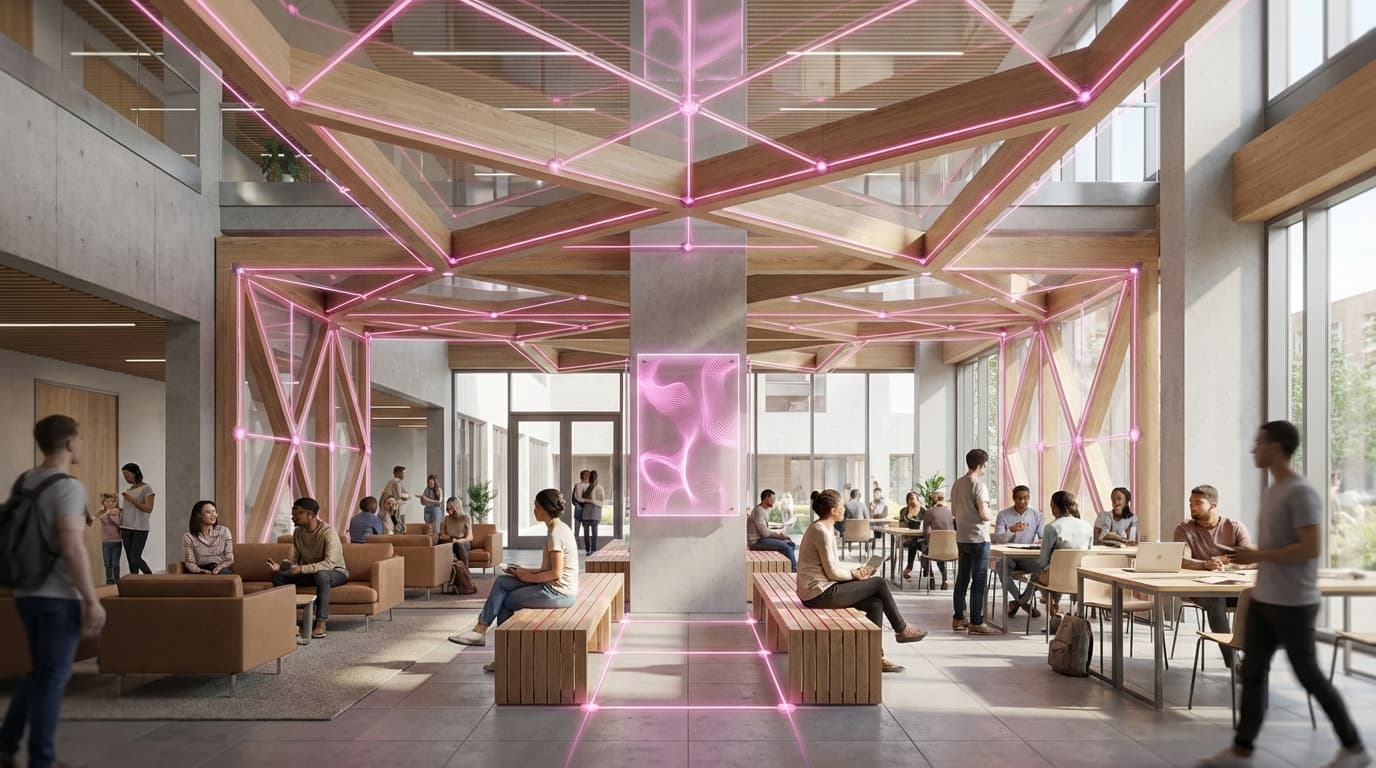
Ambient Affective Sensing Grids
Ambient Affective Sensing Grids represent a convergence of distributed sensor technologies designed to capture and interpret the collective emotional and social states of groups within defined physical spaces. Unlike traditional surveillance systems that focus on individual identification and tracking, these networks prioritize aggregate emotional signals and group dynamics. The technical architecture typically integrates multiple sensing modalities: acoustic sensors that detect vocal patterns, laughter, and conversation density without recording intelligible speech; radio frequency sensors that measure movement patterns and proximity clustering; environmental monitors tracking temperature, CO2 levels, and lighting conditions that correlate with comfort and stress; and in some implementations, opt-in wearable devices that contribute physiological data such as heart rate variability. Machine learning algorithms process these diverse data streams to generate real-time assessments of collective mood states—ranging from engagement and excitement to tension and discomfort—while deliberately avoiding the capture of personally identifiable information or individual-level tracking.
The fundamental challenge these systems address is the opacity of group emotional dynamics in shared spaces, a problem that affects workplace productivity, public safety, cultural programming, and urban design. Traditional methods of understanding how people experience spaces—surveys, focus groups, or manual observation—are resource-intensive, retrospective, and often fail to capture moment-to-moment shifts in collective sentiment. Organizations managing large facilities face particular difficulties: university administrators struggle to identify when student spaces foster connection versus isolation, museum curators lack feedback on which exhibits genuinely engage visitors versus which induce fatigue, and workplace designers have limited insight into whether open-plan offices enhance collaboration or generate stress. By providing continuous, aggregated feedback on the affective qualities of environments, these sensing grids enable responsive interventions—adjusting lighting, music, or spatial configurations in real-time—and inform longer-term design decisions about how physical spaces shape human experience and social interaction.
Early deployments of ambient affective sensing have emerged in controlled environments such as corporate innovation labs, university research facilities, and select cultural institutions, where organizations seek to optimize spaces for human flourishing while navigating privacy concerns. Research suggests that these systems can detect patterns invisible to human observers, such as gradual shifts in workplace tension preceding conflicts or the specific spatial configurations that correlate with spontaneous collaboration. The technology connects to broader movements toward human-centered design and the quantification of subjective experience, raising important questions about the ethics of emotion measurement and the potential for such systems to either enhance wellbeing or enable subtle forms of social control. As sensor costs decline and privacy-preserving techniques mature, the trajectory points toward more widespread integration into smart building systems, though adoption will likely depend on establishing clear governance frameworks that balance organizational insight with individual autonomy and the right to emotional privacy in shared spaces.
Related Organizations

Pioneering research group led by Rosalind Picard that develops systems to recognize, interpret, and simulate human affects, including adaptive interfaces.

Develops FaceReader, the standard software tool for automated analysis of facial expressions in scientific research.

A leader in eye tracking and driver monitoring systems that acquired Affectiva (the pioneer of Emotion AI) to integrate deep affective computing capabilities.

Developing an Empathic Voice Interface (EVI) that detects and responds to human emotion.

Develops light-field production tools and Realception software for processing volumetric video.

Uses webcams to measure attention and emotion in response to video advertising.


Industrial automation giant offering a line of mobile robots (LD/HD series).

Spatial intelligence platform delivering behavioral analytics for physical spaces using existing camera infrastructure.

Develops Vector Annealing, a quantum-inspired simulated annealing service running on high-performance vector supercomputers.
Supporting Evidence
Research this in Signals
Signals turns a topic into a sourced research record you can inspect and rerun. Your first scan is free, and this one starts with Ambient Affective Sensing Grids already loaded, so edit it or scan as is.