Federated Learning for Cross-Project AI Insights
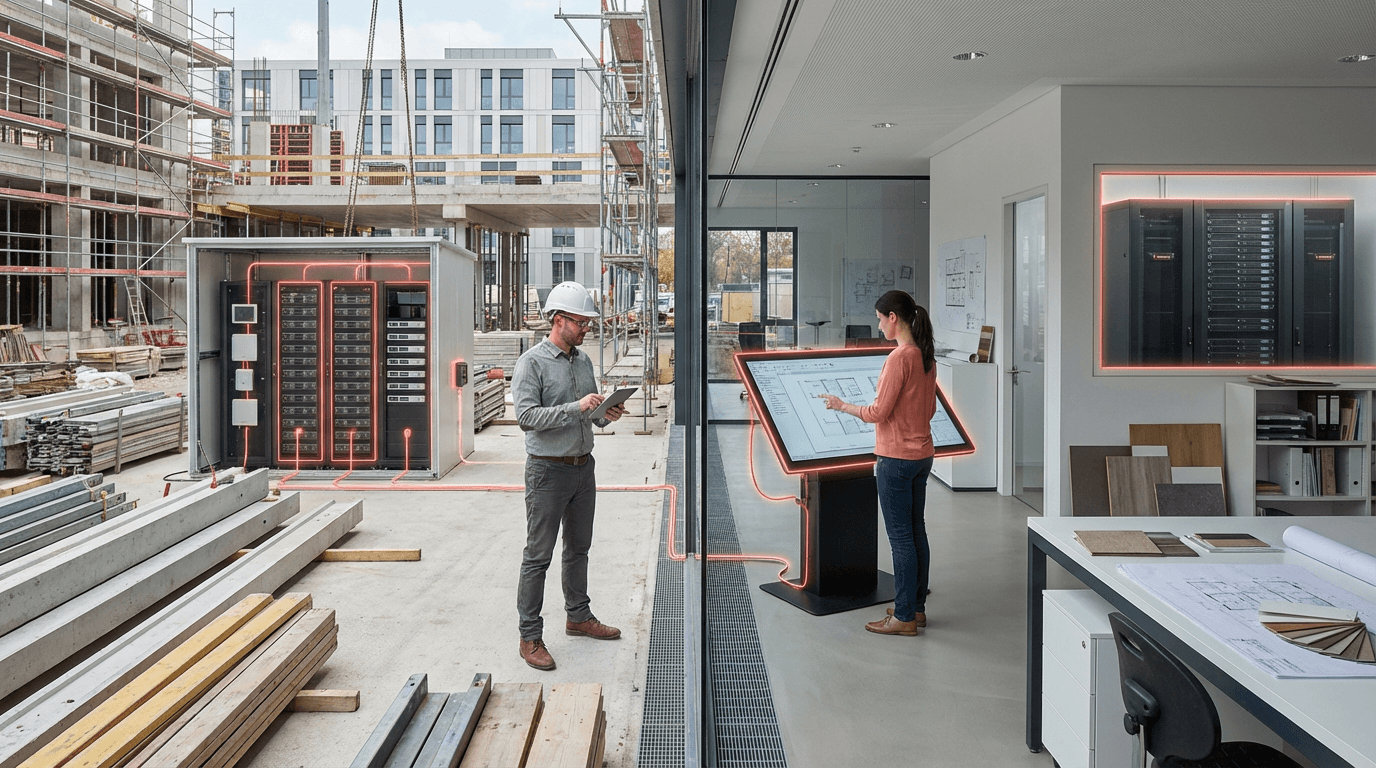
The construction industry generates vast amounts of project data—from cost estimates and scheduling metrics to safety incident reports and equipment performance logs—yet this valuable information often remains siloed within individual companies due to intellectual property concerns, competitive sensitivities, and contractual confidentiality requirements. Federated learning addresses this fundamental challenge by enabling multiple organizations to collaboratively train artificial intelligence models without ever sharing their raw data. Unlike traditional machine learning approaches that require centralizing datasets in a single location, federated learning works by distributing the training process itself. Each participating organization trains a shared model on their local data, then sends only the model updates—mathematical parameters that capture learned patterns—to a central server. This server aggregates these updates to improve the global model, which is then redistributed for another round of local training. The raw project data never leaves each company's secure environment, preserving confidentiality while still allowing the collective intelligence of multiple projects to enhance predictive capabilities. This technical architecture relies on sophisticated aggregation algorithms and encryption techniques to ensure that individual contributions cannot be reverse-engineered to expose proprietary information.
For construction companies and industry consortia, federated learning unlocks the potential to develop far more accurate and generalizable AI models than any single organization could achieve alone. A contractor working exclusively with their own historical data might struggle to predict cost overruns for novel project types or unusual site conditions simply because their experience base is limited. By participating in federated learning networks, that same contractor can benefit from patterns learned across hundreds or thousands of projects spanning different geographies, building types, and market conditions—all without compromising their competitive advantage or violating client confidentiality agreements. This approach proves particularly valuable for safety prediction models, where rare but catastrophic incidents may be underrepresented in any single company's dataset. Industry associations and large owner organizations are beginning to explore federated frameworks that allow general contractors, subcontractors, and specialty trades to pool their collective experience, creating predictive tools for schedule risk, quality issues, and resource optimization that reflect industry-wide best practices rather than individual organizational biases.
Early implementations of federated learning in construction have focused on specific use cases such as equipment failure prediction, where manufacturers and rental companies collaborate to improve maintenance scheduling, and cost estimation, where regional construction associations facilitate model training across member firms. Research initiatives suggest that federated approaches can achieve prediction accuracy comparable to centralized training while maintaining strict data governance requirements, making them particularly attractive for regulated environments or projects involving sensitive infrastructure. As the construction industry continues its digital transformation and accumulates larger volumes of sensor data, project management records, and building information modeling outputs, federated learning represents a pathway toward industry-wide intelligence that respects the competitive and legal realities of the sector. This technology aligns with broader trends toward collaborative innovation in construction, where shared standards and collective problem-solving are increasingly recognized as essential to addressing persistent challenges in productivity, safety, and sustainability that no single organization can solve in isolation.
Related Organizations

A partnership between the University of Cambridge and the UK government.

Conducts advanced research in bioelectronics and the interface between biological systems and electronic circuits.

Developing foundation models for robotics (Project GR00T) and vision-language models like VILA.

Provides a privacy-preserving AI platform that enables federated learning for data privacy and regulatory compliance.

Long-standing leader in neuro-symbolic AI, combining neural networks with logical reasoning for enterprise applications.

A company using machine learning to forecast the duration and risks of construction projects.

Develops silicon spin qubits using advanced 300mm wafer manufacturing processes.

Owner of the Arnold renderer, which integrates AI denoising to optimize high-end VFX workflows for film and TV.

Supporting Evidence
Research this in Signals
Signals turns a topic into a sourced research record you can inspect and rerun. Your first scan is free, and this one starts with Federated Learning for Cross-Project AI Insights already loaded, so edit it or scan as is.