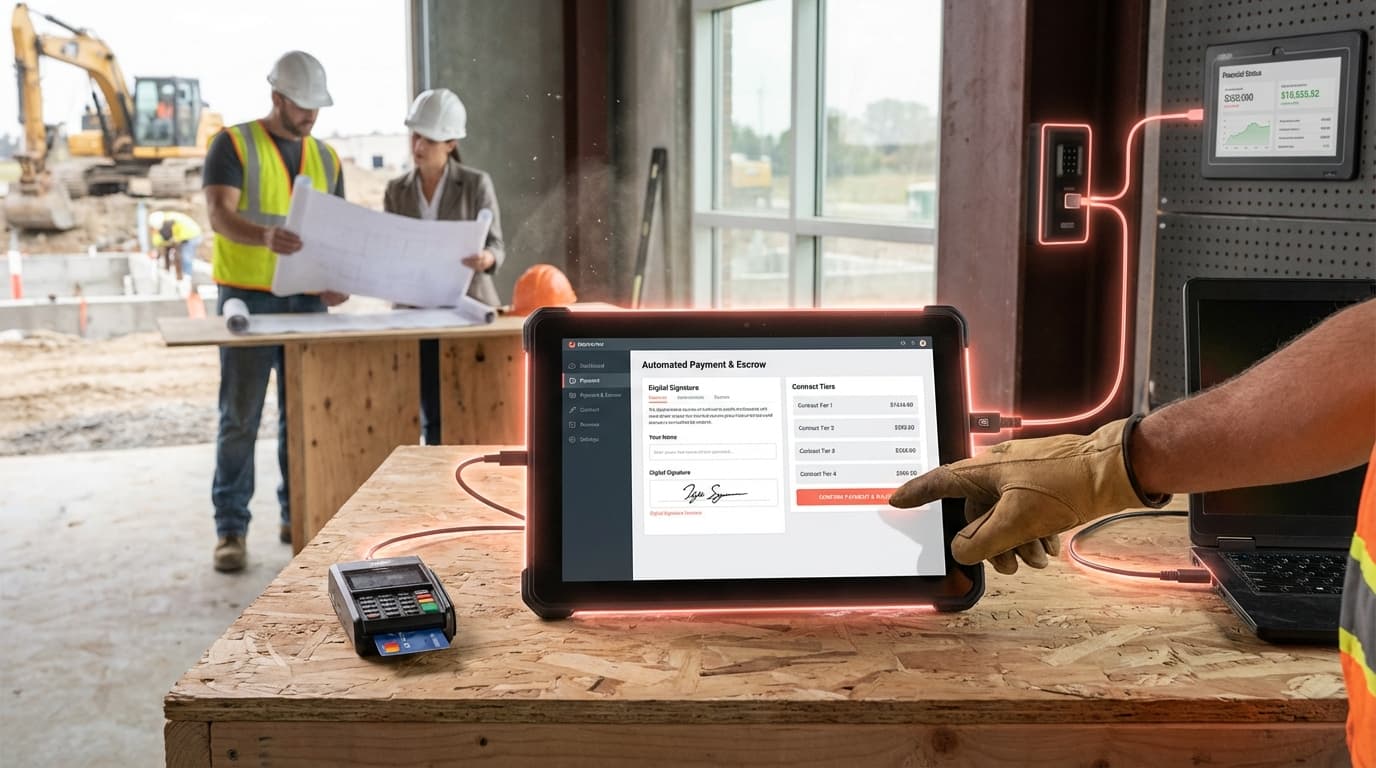
Digital Payments, Smart Escrow & Lien Automation
Construction projects are notoriously plagued by payment delays, disputes over retainage, and the administrative burden of managing lien waivers and compliance documents across multiple tiers of contractors and subcontractors. Traditional payment workflows in the industry rely heavily on manual processes—paper-based pay applications, physical signatures on lien releases, and fragmented communication between general contractors, subcontractors, and project owners. This friction in the financial supply chain creates significant working capital challenges, particularly for smaller subcontractors who may wait 60 to 90 days or longer for payment while still needing to cover payroll and material costs. The complexity is compounded by the legal requirements surrounding mechanic's liens, conditional and unconditional lien waivers, and retainage holdbacks, all of which vary by jurisdiction and require meticulous documentation to protect the rights of all parties involved.
Digital payment platforms are emerging to address these inefficiencies by automating the entire payment workflow from pay application submission through final lien release. These systems integrate compliance documentation directly into the payment process, automatically generating and tracking lien waivers that correspond to each payment tier, ensuring that upstream payments are contingent on downstream lien releases. Smart escrow functionality holds retainage in digital accounts with transparent rules governing release conditions, reducing disputes and providing subcontractors with greater visibility into when funds will become available. By digitising pay applications and enabling electronic signatures, these platforms compress payment cycles and reduce the administrative overhead that traditionally consumes significant project management resources. The automation of lien workflows is particularly transformative, as it ensures that all parties maintain proper lien protection without the manual tracking and follow-up that often leads to errors, missed deadlines, or costly legal disputes.
Early adoption of these platforms is occurring primarily among larger general contractors and developers seeking to streamline their payment operations and reduce project delivery risk. The technology is proving especially valuable on complex projects with multiple subcontractor tiers, where payment visibility and compliance tracking become exponentially more difficult to manage manually. Industry analysts note that improved payment transparency and reduced payment cycles can significantly enhance subcontractor cash flow, potentially reducing the cost of construction by lowering the risk premium that subcontractors build into their bids to account for payment uncertainty. As these platforms mature and integrate with existing construction management software and accounting systems, they represent a fundamental shift in how capital flows through construction projects, moving the industry toward a more transparent, efficient, and equitable financial ecosystem that benefits all stakeholders from project owners to the smallest specialty subcontractors.
Related Organizations

Provides software for construction finance, connecting lenders and contractors.

Software for construction lien management and payment compliance.

Provider of Aconex, a cloud-based collaboration solution for construction project management.
GCPay
United States · Company
Web-based platform for managing subcontractor pay applications and lien waivers.

Cloud-based collaboration platform for managing construction progress claims and approvals.

Billing software designed specifically for trade contractors to get paid faster.

Procurement and financing platform for general contractors and subcontractors.

Intelligent construction finance platform for lenders and developers.

Financial automation platform for construction that uses AI to process invoices and financial documents.
Supporting Evidence
Research this in Signals
Signals turns a topic into a sourced research record you can inspect and rerun. Your first scan is free, and this one starts with Digital Payments, Smart Escrow & Lien Automation already loaded, so edit it or scan as is.