Floating & Amphibious Construction
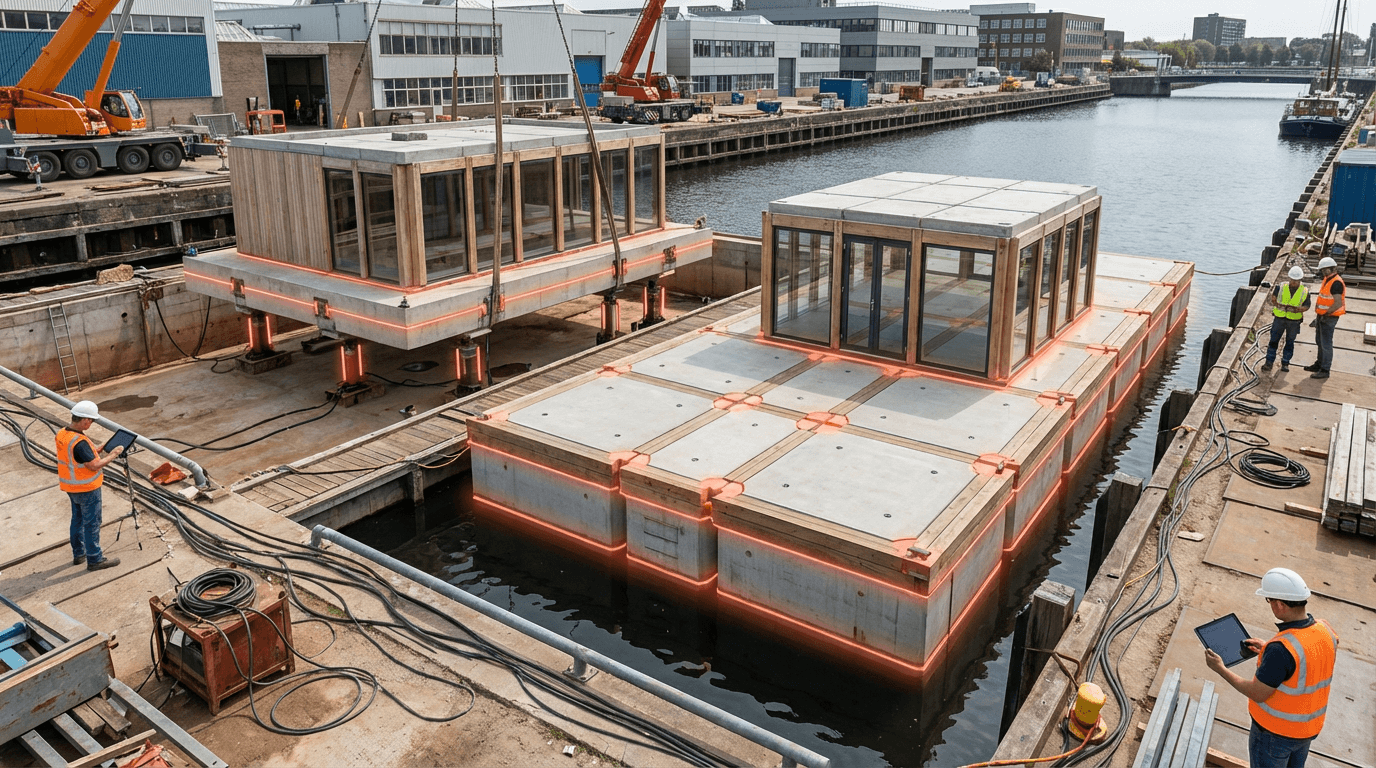
Floating and amphibious construction represents an architectural and engineering response to the increasing threat of flooding and sea-level rise in coastal and riverine communities worldwide. Unlike traditional static buildings that resist water through barriers and elevation, these structures work with water rather than against it. Amphibious buildings rest on conventional foundations during normal conditions but are equipped with buoyant foundations or flotation systems that allow them to rise vertically with floodwaters, remaining tethered to guide posts or flexible utility connections. Floating structures, by contrast, remain permanently buoyant, typically mounted on pontoons, barges, or other flotation platforms that distribute weight across the water's surface. Both approaches require careful consideration of structural stability, anchoring systems, and the integration of flexible utility connections for water, electricity, and sewage that can accommodate vertical movement or constant flotation.
The primary challenge these technologies address is the growing vulnerability of urban populations to flooding, whether from storm surges, river overflow, or rising sea levels. Traditional flood mitigation strategies such as levees, seawalls, and elevated construction often prove inadequate or prohibitively expensive in low-lying regions, particularly in developing nations where millions live in flood-prone deltas and coastal zones. Floating and amphibious construction offers a more adaptive approach, allowing communities to remain in place while reducing flood damage and displacement. This is particularly significant in regions where relocation is culturally unacceptable or economically unfeasible. The technology also enables new forms of urban development in areas previously considered unbuildable, potentially relieving pressure on overcrowded cities by expanding into waterfront and aquatic spaces. Furthermore, these structures can be designed to be modular and relocatable, offering flexibility as climate conditions and water levels continue to change over time.
Current implementations span diverse contexts and scales, from individual homes to entire neighborhoods and proposed city districts. In the Netherlands, floating residential communities have been developed in areas like IJburg and Schoonschip, demonstrating the viability of permanent water-based living in developed economies. Research in Southeast Asia has documented traditional amphibious housing techniques in Vietnam's Mekong Delta, where communities have long adapted to seasonal flooding through elevated living spaces and buoyant foundations. More ambitious proposals include floating city concepts for island nations facing existential threats from sea-level rise, though these remain largely in planning or early development stages. As climate change accelerates and urban populations in vulnerable areas continue to grow, floating and amphibious construction is likely to transition from niche application to mainstream building practice, particularly in delta cities, small island nations, and coastal megacities where conventional flood defense systems reach their practical and economic limits.
Related Organizations

An architectural firm exclusively dedicated to floating urbanization, designing floating foundations and modular structures for housing and public services.

A social enterprise and design firm focused on floating urban development and maritime technology to address climate change.

A blue tech company building floating cities, including a prototype in Busan, South Korea, designed to withstand floods and sea-level rise.

A research initiative at the University of Waterloo designing amphibious foundations that allow existing structures to float during floods.
Specialists in 'aquatecture', designing amphibious and floating buildings for flood zones.

Specializes in designing and constructing large floating foundations using EPS (Expanded Polystyrene) and concrete.

A nonprofit think tank promoting the creation of floating ocean communities with significant political and legal autonomy.

The United Nations programme for human settlements and sustainable urban development.

Architecture firm partnering with ICON and NASA on Project Olympus to design the layout and structure of 3D printed lunar bases.

Major construction firm researching the 'Luna Ring' concept and robotic lunar construction methods.
Supporting Evidence
Research this in Signals
Signals turns a topic into a sourced research record you can inspect and rerun. Your first scan is free, and this one starts with Floating & Amphibious Construction already loaded, so edit it or scan as is.