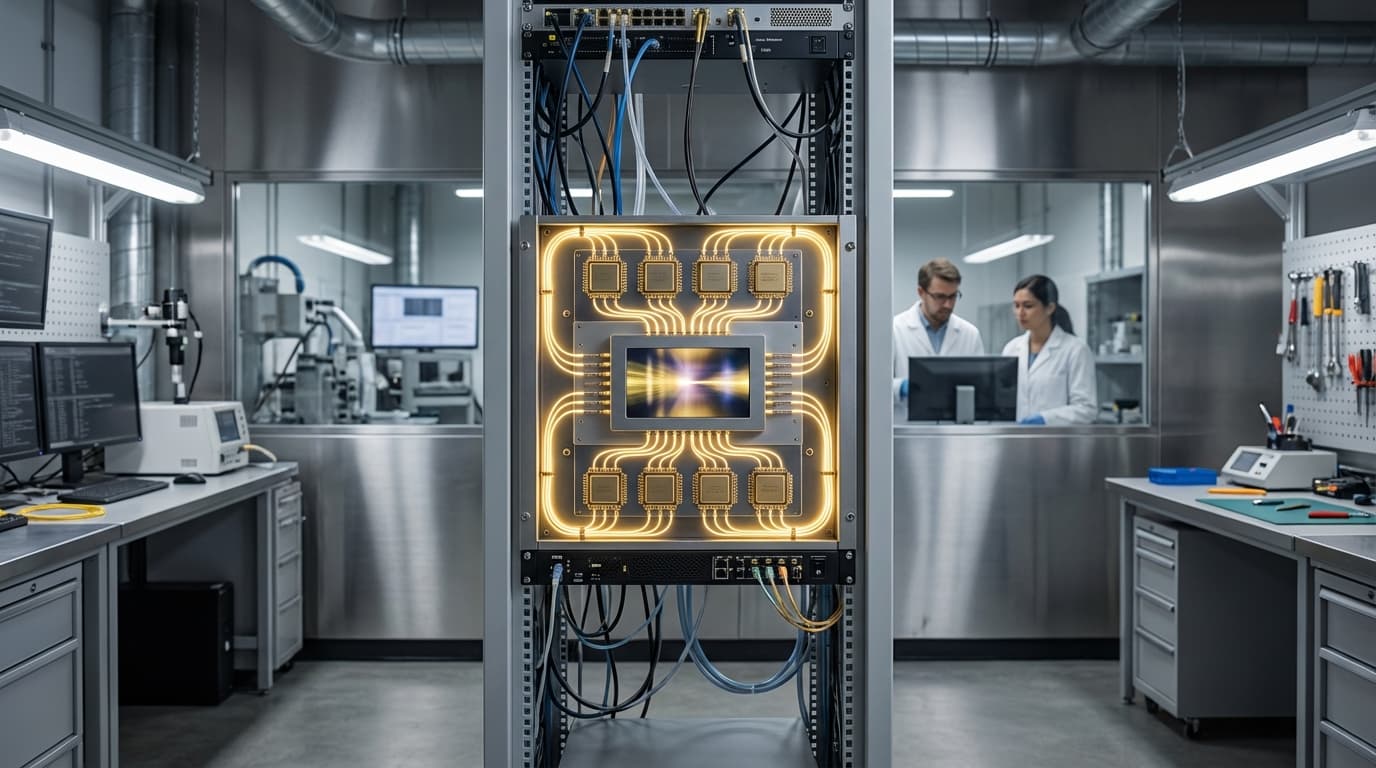
Photonic Computing Hardware
Photonic computing hardware represents a fundamental shift in how computational operations are performed, replacing traditional electronic transistors with optical components that manipulate photons instead of electrons. At its core, this technology leverages the unique properties of light—including its speed, parallelism, and low energy dissipation—to execute complex mathematical operations required for artificial intelligence workloads. Photonic processors typically employ integrated optical circuits containing components such as waveguides, modulators, photodetectors, and interferometers arranged to perform matrix multiplications and other tensor operations that form the backbone of neural network computations. Unlike conventional silicon chips where data moves through electrical circuits at speeds limited by resistance and capacitance, photonic systems can process multiple wavelengths of light simultaneously through the same physical pathway, enabling massive parallelization of calculations. The fundamental mechanism involves encoding data into optical signals, manipulating these signals through carefully designed optical interference patterns, and then converting the results back into electrical signals for further processing or output.
The manufacturing sector faces mounting pressure to deploy sophisticated AI capabilities directly on production equipment, robotics, and quality control systems, yet traditional computing architectures struggle to deliver the combination of speed, energy efficiency, and thermal management required for these demanding industrial environments. Edge AI applications in factories and warehouses require real-time decision-making with latencies measured in microseconds rather than milliseconds, particularly for tasks like defect detection on high-speed assembly lines, predictive maintenance analysis, or autonomous vehicle navigation within facilities. Conventional electronic processors generate substantial heat when performing the intensive matrix operations needed for neural network inference, necessitating complex cooling systems that add cost and reduce reliability in industrial settings. Photonic computing addresses these challenges by performing calculations at dramatically lower power levels—research suggests potential energy reductions of two to three orders of magnitude compared to electronic alternatives for certain workloads—while simultaneously achieving processing speeds that approach the theoretical limits imposed by the speed of light itself. This technology enables new architectures for distributed intelligence in manufacturing environments, where multiple photonic processors could operate in parallel across a production line, each making instantaneous decisions without the bottlenecks associated with centralized computing infrastructure.
Early commercial deployments of photonic computing hardware are beginning to emerge from research laboratories, with several technology companies and research institutions demonstrating prototype systems capable of performing specific AI inference tasks. These initial implementations typically focus on well-defined applications such as image recognition, signal processing, or pattern matching where the mathematical operations align well with the capabilities of optical computing architectures. Industry analysts note that the technology currently faces challenges related to the integration of photonic components with existing electronic systems, the development of programming frameworks that can effectively leverage optical processing capabilities, and the establishment of manufacturing processes that can produce photonic chips at scale with acceptable yields. However, the trajectory of development suggests that photonic computing could play an increasingly important role in the broader evolution toward more distributed, energy-efficient AI infrastructure within industrial environments. As manufacturing continues its transformation toward fully automated, self-optimizing production systems characteristic of Industry 4.0, the ability to perform complex AI computations with minimal latency and power consumption positions photonic hardware as a potentially critical enabling technology for the next generation of intelligent manufacturing systems.
Related Organizations

Creates photonic computing chips that use light for analog matrix multiplication.

Company developing optical computing hardware for AI workloads.

Developing the Photonic Fabric technology platform for optical interconnects and compute.


Building hybrid photonic-electronic chips for AI acceleration.

German startup developing graphene-based photonic interconnects.

Develops silicon spin qubits using advanced 300mm wafer manufacturing processes.

Major semiconductor foundry manufacturing silicon photonics chips for quantum computing companies.

A global edge-to-cloud company known for the 'Spaceborne Computer' experiments.
Supporting Evidence
Research this in Signals
Signals turns a topic into a sourced research record you can inspect and rerun. Your first scan is free, and this one starts with Photonic Computing Hardware already loaded, so edit it or scan as is.