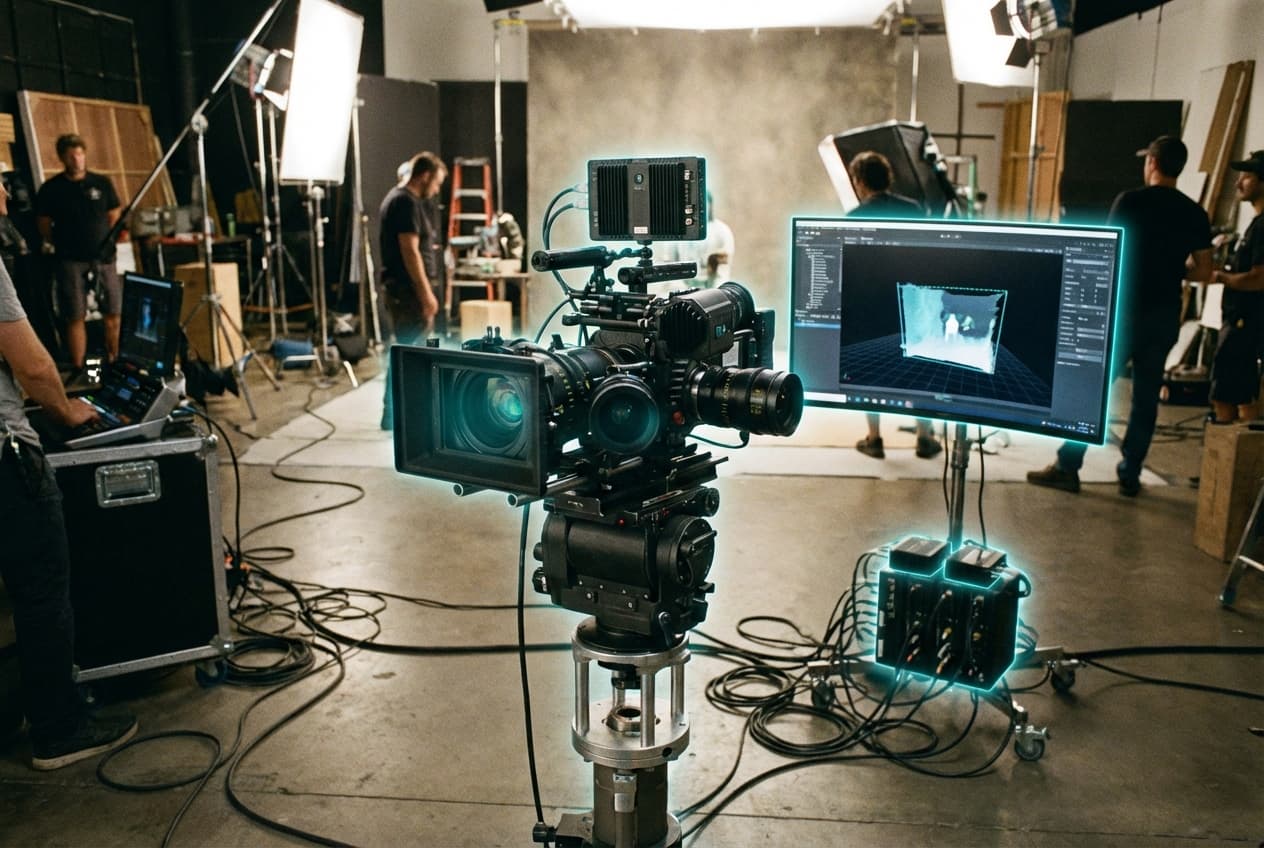
Neural light-field cameras
Neural light-field cameras combine dense plenoptic sensor arrays with neural radiance field reconstruction so every pixel stores both intensity and directional information. Instead of stitching a handful of viewpoints, the capture rig samples thousands of micro-baselines and uses transformer-style encoders to learn a continuous representation of a scene. The result is a manipulable volumetric asset where focus, parallax, and depth of field can be adjusted after the shoot, enabling editors to treat light itself as editable data.
For media producers this collapses the gap between live action and CG pipelines. Immersive studios such as Arcturus, 8i, and Canon’s Kokomo group are exploring light-field stages for volumetric actors, while sports broadcasters see it as a path to holographic replays without the cost of motion-capture suits. Because neural reconstruction understands surface normals and materials, downstream teams can relight or restage performances for AR lenses, mobile volumetric stories, or mixed-reality concerts without pulling talent back on set.
Adoption remains early (TRL 4) because rigs are expensive and neural reconstruction still requires GPU farms, yet the trajectory mirrors the early days of digital cinema. Research labs are optimizing sparse-camera solutions, and standardization efforts within SMPTE and the Metaverse Standards Forum aim to define interoperable light-field codecs. As those pieces mature, neural light-field capture is poised to become the master format for next-gen storytelling, feeding everything from cinematic VR to adaptive advertising.
Related Organizations

Pioneers in Neural Radiance Fields (NeRF) and light-field reconstruction algorithms.
Adobe Research
United States · Research Lab
Conducts extensive research on computational photography and light-field processing.

Develops light-field production tools and Realception software for processing volumetric video.
Raytrix
Germany · Company
Manufactures industrial light-field cameras using microlens arrays for 3D depth estimation.

Manufactures the HOLOSYS volumetric capture system used by studios worldwide for high-fidelity 3D video.
Germany · Startup
Develops light-field lenses that can be attached to standard cameras to capture depth information.

A premier volumetric capture stage in Los Angeles, utilizing Microsoft Mixed Reality Capture technology.

Multinational corporation specializing in optical, imaging, and industrial products.
United Kingdom · Company
Specializes in data compression standards (MPEG-5 LCEVC) applicable to point clouds and light fields.
Supporting Evidence
Research this in Signals
Signals turns a topic into a sourced research record you can inspect and rerun. Your first scan is free, and this one starts with Neural light-field cameras already loaded, so edit it or scan as is.