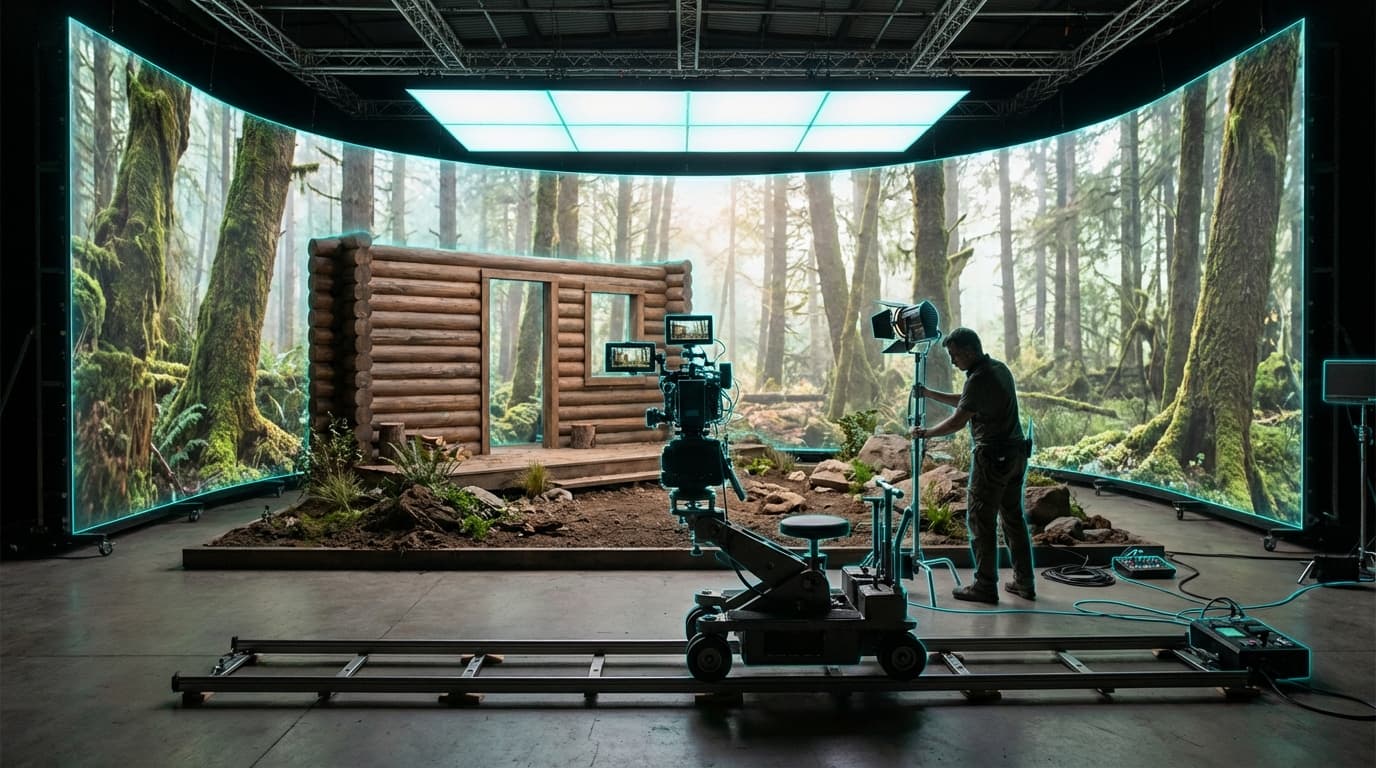
Virtual Production Volumes
Virtual production volumes combine high-brightness LED walls and ceilings, camera/talent tracking, and real-time rendering (Unreal Engine, Disguise, Brompton) to display parallax-corrected environments around performers. The panels themselves light the scene, while nDisplay clusters synchronize imagery to the camera frustum, yielding final-pixel shots with accurate reflections and depth cues. Lens encoding, color pipelines, and stage automation are now tied directly into the engine so art departments can treat the wall as a programmable set piece.
Studios from Disney to Netflix rely on volumes to capture exotic locations without travel, maintain continuity over multi-year shoots, and align art, VFX, and cinematography teams around a shared canvas. Automotive brands shoot commercials in compact volumes to swap vehicle trims instantly; broadcasters deploy semi-permanent XR stages for elections, esports, and weather storytelling. Because actors can see the virtual world, performances are more grounded and directors iterate on blocking and lighting in real time instead of waiting for post.
Scaling volumes introduces challenges: moiré mitigation, panel calibration drift, and a shortage of supervisors who understand both cinematography and real-time graphics. SMPTE’s Rapid Industry Solutions group is drafting best practices for color management and metadata, while LED makers race toward higher-resolution, HDR panels with camera-friendly scan rates. With TRL 8 adoption and falling component costs, virtual production volumes are on track to become standard infrastructure across episodic TV, live events, and even high-end creator studios.
Related Organizations

Developers of Unreal Engine 5, which features Lumen, a fully dynamic global illumination and reflection system designed for next-gen consoles and PC.
United States · Company
VFX studio owned by Disney/Lucasfilm.

Manufacturer of LED video processing products.

Provides the platform and media servers that power xR (Extended Reality) stages and real-time concert visuals.

Lux Machina
United States · Company
Virtual production and display technology specialists.




Supporting Evidence
Research this in Signals
Signals turns a topic into a sourced research record you can inspect and rerun. Your first scan is free, and this one starts with Virtual Production Volumes already loaded, so edit it or scan as is.