






3D holography displays
Holographic Light-Field Displays
Glasses-free 3D displays that reconstruct light fields for natural depth perception
Holographic light-field displays use switchable waveguides, micro-LED backplanes, and diffractive optical elements to emit bundles of rays that reach the eye with the correct angle and focal depth. Rather than faking depth with stereo disparity, the panel reconstructs the light field itself, delivering vergence–accommodation cues that keep viewers’ eyes relaxed. Some systems scan a holographic optical element with MEMS mirrors, while others stack multi-plane LCDs driven by custom ASICs to achieve dozens of depth layers.
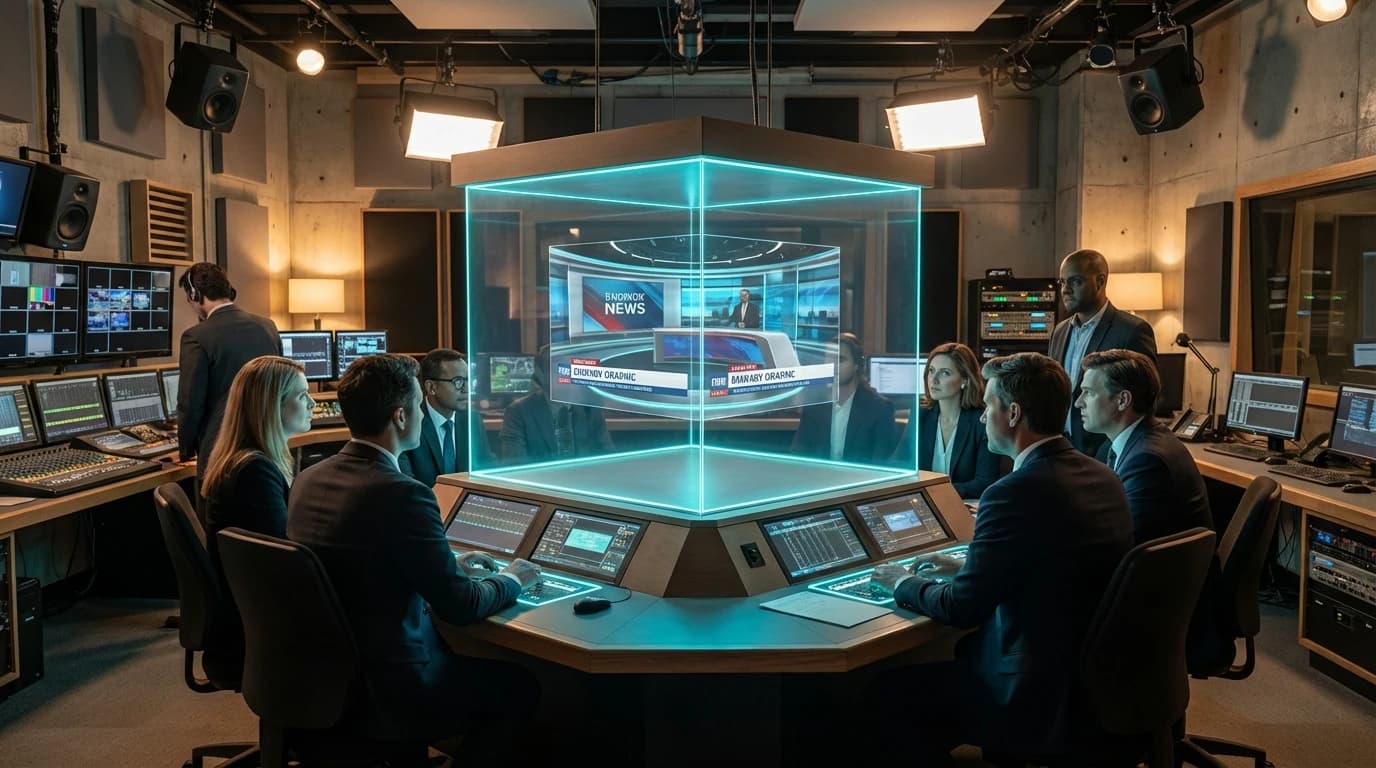
For media production this unlocks glasses-free review of volumetric captures, collaborative data exploration, and immersive retail signage. Looking Glass Factory, Sony Spatial Reality Display, and Leia Inc. sell units to animation houses and automotive studios who need to inspect characters or vehicles at life-like scale. Broadcasters are piloting light-field cubes on news sets, and live-events companies envision stage props that morph between solid-looking artifacts and transmissive effects without LED-wall moiré.
Key hurdles include pixel budgets (billions of rays per frame), content pipeline conversions, and the cost of large apertures. Standardization committees under Khronos and MPEG are defining light-field scene descriptors so studios can author once and deploy to multiple hardware stacks. With TRL 4–5 hardware already in shipping dev kits and mass-production efforts underway in Korea and Taiwan, holographic light-field displays are on track to leave labs and enter control rooms, museums, and flagship retail experiences later this decade.
TRL
4/9Formative
Impact
4/5
Investment
4/5
Category
Hardware
Related Organizations
Develops desktop and large-format holographic displays that generate 45-100 views simultaneously for glasses-free 3D.
Developer
Developing professional holographic displays for medical, defense, and industrial visualization using massive light-field arrays.
Developer
Provides lightfield display hardware and software solutions for mobile devices, tablets, and automotive cockpits.
Developer
Developing light-field display technology primarily for AR glasses but applicable to direct-view panels.
Developer
Software and IP licensing company specializing in computer-generated holography (CGH) for displays and AR.
Developer
Creators of CausalImpact, a package for causal inference using Bayesian structural time-series.
Developer
R&D company focusing on tracked holographic 3D displays, with significant investment from Volkswagen.
Developer
Brelyon
75%United States · Startup
Develops headset-free virtual displays using computational optics to create depth and immersion.
Developer
What was expected
Published forecasts about this technology, graded against what happened in Hindsight.
Holograms
Spatial Displays
Volumetric and Holographic Displays
This page is a narrower case of it.
Supporting Evidence
Evidence data is not available for this technology yet.
Research this in Signals
Scan Holographic Light-Field Displays for yourself.
Signals turns a topic into a sourced research record you can inspect and rerun. Your first scan is free, and this one starts with Holographic Light-Field Displays already loaded, so edit it or scan as is.