Reconfigurable Intelligent Surfaces (RIS)
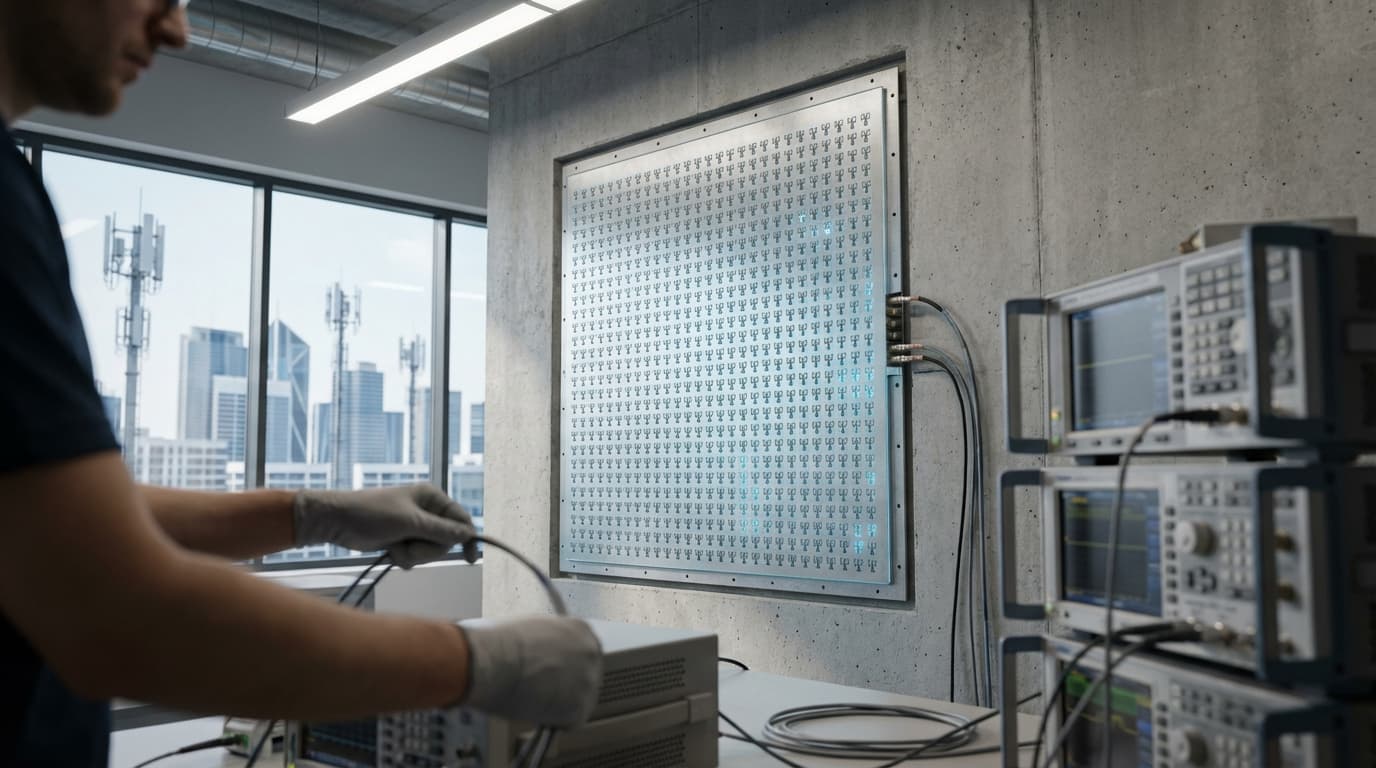
Reconfigurable Intelligent Surfaces represent a paradigm shift in wireless communication infrastructure, transforming passive building facades, walls, and other surfaces into active components of the network itself. These surfaces consist of arrays of small, electronically controllable elements—typically made from metamaterials or metasurfaces—that can dynamically adjust their electromagnetic properties. Each element acts as a tiny antenna capable of reflecting, refracting, or absorbing radio waves in precise ways. By coordinating thousands of these elements through a central controller, RIS can effectively reshape the wireless propagation environment, directing signals around obstacles, focusing energy toward specific users, or eliminating interference. Unlike traditional relay stations or base stations, these surfaces operate in a nearly passive manner, requiring minimal power consumption as they primarily reflect rather than amplify signals. The underlying technology draws from advances in electromagnetic theory, allowing engineers to manipulate phase shifts, amplitude, and polarisation of incoming radio waves with unprecedented precision.
The telecommunications industry faces mounting challenges as wireless networks evolve toward higher frequencies and denser deployments. Millimetre-wave bands used in 5G and anticipated 6G networks offer tremendous bandwidth but suffer from poor penetration through buildings and sensitivity to blockage. Traditional solutions—adding more base stations or increasing transmission power—prove costly and energy-intensive. RIS addresses these fundamental limitations by essentially programming the wireless environment itself. By strategically placing these intelligent surfaces on building exteriors, tunnel walls, or indoor spaces, network operators can extend coverage into dead zones, enhance signal strength in congested areas, and improve overall spectral efficiency without deploying additional power-hungry infrastructure. This approach also enables new network architectures where the environment actively participates in communication, reducing the burden on base stations and potentially lowering operational costs. The technology promises particular value in urban canyons, underground facilities, and indoor environments where conventional signal propagation faces the greatest obstacles.
Research institutions and telecommunications companies have begun field trials of RIS technology, with early deployments demonstrating measurable improvements in signal quality and coverage extension. Pilot programs have explored applications ranging from smart factory environments, where RIS panels guide signals around metal machinery, to urban settings where building-mounted surfaces redirect signals into shadowed areas. Industry analysts note that as 6G research accelerates, RIS is increasingly viewed as a foundational technology rather than an optional enhancement. The surfaces could enable novel use cases such as ultra-precise indoor positioning, where controlled signal reflections create unique electromagnetic fingerprints for different locations, or support massive Internet of Things deployments by efficiently serving numerous low-power devices. Looking forward, the integration of RIS with artificial intelligence for autonomous optimisation, combined with decreasing manufacturing costs for metamaterial arrays, suggests a trajectory toward widespread commercial deployment. This evolution positions RIS as a critical enabler of future wireless networks, fundamentally changing how we conceive of and design communication infrastructure by blurring the boundary between the network and its physical environment.
Related Organizations

European standards organization that launched the Industry Specification Group on Reconfigurable Intelligent Surfaces (ISG RIS).

Greenerwave
France · Startup
Deeptech startup developing Reconfigurable Intelligent Surfaces (RIS) using metasurfaces to control electromagnetic waves.

Pioneered Holographic Beam Forming (HBF) technology for 5G mmWave, allowing antennas to shape and steer beams with low power and cost.

Metawave
United States · Startup
Builds advanced beamforming and steering platforms for 5G and automotive radar using metamaterials.

Industrial research lab with a history of fundamental research in condensed matter physics relevant to topological phases.


Global provider of telecommunications equipment and network solutions.

One of the world's largest glass manufacturers, offering BIPV solutions like SunEwat.

Developer of optical semiconductor solutions enabling solid-state LiDAR using Light Control Metasurfaces (LCM).
Supporting Evidence
Research this in Signals
Signals turns a topic into a sourced research record you can inspect and rerun. Your first scan is free, and this one starts with Reconfigurable Intelligent Surfaces (RIS) already loaded, so edit it or scan as is.